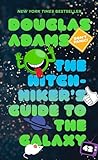
Editors Reads Verdict
The funniest book ever written — and the only one that manages to be genuinely funny on every page while also being philosophically serious about the absurdity of existence. The answer to Life, the Universe, and Everything is 42. Adams's comic timing is perfect; his philosophical insight is hidden in plain sight.
What We Loved
- Genuinely the funniest prose in English — laugh-out-loud on every page
- 224 pages that read in three hours and stay with you for decades
- Philosophical depth disguised as comedy — Adams was doing absurdist existentialism while appearing to do slapstick
- Infinitely quotable — 'Don't Panic', '42', 'mostly harmless' have entered the language
- A perfect antidote to any book that takes itself too seriously
Minor Drawbacks
- Plot is deliberately incoherent — if you need narrative structure, you'll be frustrated
- The sequels decline in quality; stop after *The Restaurant at the End of the Universe* if you want
- Adams's digressions go on longer than the plot — this is a feature, not a bug, but not for everyone
Key Takeaways
- → The Answer to Life, the Universe, and Everything is 42 — the problem was we never knew the Question
- → Space is big — really, incomprehensibly, mind-bogglingly big — and this should inform your sense of proportion
- → Don't Panic — the most practically useful advice ever printed on a book cover
- → The purpose of the universe may be comic rather than tragic — and this is actually comforting
- → Most catastrophes, viewed from sufficient distance, are also absurd
| Author | Douglas Adams |
|---|---|
| Publisher | Del Rey |
| Pages | 224 |
| Published | October 12, 1979 |
| Language | English |
| Genre | Science Fiction, Comedy, Classic Literature |
| Difficulty | Beginner |
| Best For | Anyone who needs to laugh. Fans of Monty Python, Terry Pratchett, and British absurdist comedy. Science fiction readers who want the funniest possible entry point to the genre. Anyone who takes themselves slightly too seriously. |
How The Hitchhiker's Guide to the Galaxy Compares
The Hitchhiker's Guide to the Galaxy at a glance against 3 similar books readers weigh alongside it.
| Book | Author | Rating | Best for |
|---|---|---|---|
| The Hitchhiker's Guide to the Galaxy (this book) | Douglas Adams | ★ 4.7 | Anyone who needs to laugh |
| 1984 | George Orwell | ★ 4.7 | Every adult in a democracy |
| Brave New World | Aldous Huxley | ★ 4.5 | Readers of 1984 and other dystopian fiction, philosophy and ethics enthusiasts, |
| Project Hail Mary | Andy Weir | ★ 4.8 | Science fiction readers who want accurate science without sacrificing story, |
The Answer is 42
Douglas Adams was a writer for Monty Python when he conceived The Hitchhiker’s Guide to the Galaxy in a field in Innsbruck, lying drunk looking up at the stars with a copy of The Hitchhiker’s Guide to Europe. The idea: a hitchhiker’s guide to the galaxy itself.
The book began as a BBC Radio 4 comedy series in 1978, became a novel in 1979, and has since sold over 15 million copies in over 30 languages. The phrase “Don’t Panic” has been on t-shirts since before the internet existed. “42” is the most famous answer to a question in all of fiction.
The Hitchhiker’s Guide is the funniest book ever written. This is not a contested claim.
The Setup
On a Thursday morning, Arthur Dent’s house is about to be demolished to make way for a bypass. The same day, Earth itself is demolished by a Vogon construction fleet to make way for a hyperspace bypass.
Arthur is rescued by his friend Ford Prefect — who turns out not to be from Guildford but from a small planet somewhere in the vicinity of Betelgeuse, and who has been stranded on Earth for fifteen years while researching an entry for The Hitchhiker’s Guide to the Galaxy (the standard repository for all knowledge and wisdom in the universe, currently 531 times more popular than the Encyclopaedia Galactica and significantly cheaper). They hitch a lift on the Vogon constructor fleet and begin one of the most absurd journeys in literary history.
The Comic Philosophy
Adams was doing something more interesting than writing jokes. The central premise — that Earth was, all along, part of a ten-million-year computation designed to find the Ultimate Question to the Answer (which is 42, calculated by the supercomputer Deep Thought in 7.5 million years, but unfortunately the question was lost when the Vogons demolished Earth) — is absurdist philosophy executed as farce.
The joke about 42 is that it’s completely meaningless on its own: an answer without a question. Adams was writing about the condition of knowing that the universe operates by rules without knowing what the question is — and suggesting, with exquisite comic timing, that this is funny rather than tragic.
“The Answer to the Great Question of Life, the Universe and Everything is… Forty-two,” said Deep Thought, with infinite majesty and calm.
The Prose
Adams’s sentences are among the best in English comedy writing. His descriptive passages stop the narrative dead in the best possible way:
“The ships hung in the sky in much the same way that bricks don’t.”
“He was a dreamer, a thinker, a speculative philosopher… or, as his wife would have it, an idler.”
“The Total Perspective Vortex derives its appalling power from its ability to give anyone a momentary glimpse of the entire unimaginable infinity of creation, and somewhere in it a tiny little mark, a microscopic dot on a microscopic dot, which says, ‘You Are Here.’”
The comedy is sustained for 224 pages without a single flat joke. This is an extraordinary achievement.
Read the First Two
The first novel (The Hitchhiker’s Guide to the Galaxy) and the second (The Restaurant at the End of the Universe) were written as a continuous story and should be read together. Books Three and Four (Life, the Universe and Everything and So Long, and Thanks for All the Fish) are enjoyable but diminished. Book Five (Mostly Harmless, the last Adams wrote before his death in 2001 at 49) is darker and more melancholy — the product of a writer who had lost some of his joy.
Start with the first two. Laugh for six hours. Return to existence slightly less burdened than you left it.
The Guide Within the Guide
One of the novel’s quiet structural pleasures is the book-within-the-book: the entries from The Hitchhiker’s Guide to the Galaxy itself, which interrupt the narrative to deliver deadpan cosmic information. These passages — on the improbable economics of the Babel fish, on the reassuring single word “Don’t Panic” printed in large friendly letters on the Guide’s cover, on the sheer mind-numbing bigness of space — are where Adams’s particular voice is most concentrated. They are mock-encyclopedic, confidently authoritative about nonsense, and they let him indulge the digressive, essayistic comedy that is arguably his greatest gift. The Babel fish entry, which manages to disprove the existence of God in the course of explaining a translation device, is a small masterpiece of comic logic folded into a footnote.
This structure — narrative interrupted by reference material — is itself a joke about how we organize knowledge, and it carries forward the radio origins of the material, where the Guide’s entries functioned as a narrator’s interludes. On the page they become something close to a comic essayist’s set pieces, and they are a large part of why the book rewards rereading: the plot you remember, but the Guide entries keep surprising you.
Why It Endures
Beneath the jokes, the book’s durability rests on a genuine emotional stance toward the universe. Arthur Dent, dressing-gowned and bewildered, his planet destroyed before breakfast, is the reader’s stand-in: a small, confused person confronting a cosmos that is vast, indifferent, and frequently absurd. Adams’s response to that predicament is neither despair nor false comfort but a kind of cheerful, clear-eyed amusement — the suggestion that the only sane reaction to an incomprehensible universe is to keep your towel handy and refuse to panic. That posture, more than any single gag, is what readers carry away. The book has sold many millions of copies in dozens of languages not only because it is funny on every page but because its comedy contains a usable philosophy: that the proper response to cosmic insignificance is humor, curiosity, and the steady refusal to take one’s own catastrophe too seriously.
Our rating: 4.7/5 — The funniest book ever written. Read it for the jokes; the philosophy is hiding in there too.
Reading Guides
- Books Like The Hitchhiker
- Books Like Good Omens: 11 Novels of Divine Comedy, Unlikely Friendship, and Cosmic Chaos
- Books Like Piranesi: Labyrinthine Worlds, Mystery, and the Strangeness of Reality
- Books Like The Martian: Problem-Solving, Survival, and Optimistic Science Fiction
- 20 Best Funny Books: Novels and Non-Fiction That Are Genuinely Comic
- 30 Best Fiction Books of All Time — The Ultimate Reading List
- Elon Musk
Frequently Asked Questions
What is "The Hitchhiker's Guide to the Galaxy" about?
Seconds before Earth is demolished to make way for a hyperspace bypass, Arthur Dent is rescued by Ford Prefect — who turns out to be a researcher for the Hitchhiker's Guide to the Galaxy, the standard repository for all knowledge and wisdom in the universe. Their adventures take them to the Restaurant at the End of the Universe, a planet populated by telephone sanitisers, and a search for the Ultimate Question to Life, the Universe, and Everything.
Who should read "The Hitchhiker's Guide to the Galaxy"?
Anyone who needs to laugh. Fans of Monty Python, Terry Pratchett, and British absurdist comedy. Science fiction readers who want the funniest possible entry point to the genre. Anyone who takes themselves slightly too seriously.
What are the key takeaways from "The Hitchhiker's Guide to the Galaxy"?
The Answer to Life, the Universe, and Everything is 42 — the problem was we never knew the Question Space is big — really, incomprehensibly, mind-bogglingly big — and this should inform your sense of proportion Don't Panic — the most practically useful advice ever printed on a book cover The purpose of the universe may be comic rather than tragic — and this is actually comforting Most catastrophes, viewed from sufficient distance, are also absurd
Is "The Hitchhiker's Guide to the Galaxy" worth reading?
The funniest book ever written — and the only one that manages to be genuinely funny on every page while also being philosophically serious about the absurdity of existence. The answer to Life, the Universe, and Everything is 42. Adams's comic timing is perfect; his philosophical insight is hidden in plain sight.
Ready to Read The Hitchhiker's Guide to the Galaxy?
Check the current price on Amazon.
Check Price on Amazon (paid link)Prices and availability are subject to change. See Amazon for current price.
Review last updated: