What to Read Before Christopher Nolan's The Odyssey (2026)
Christopher Nolan's The Odyssey arrives July 2026 with an all-star cast. Here's why Homer's original epic is worth reading first — and how to approach it.
Christopher Nolan’s adaptation of The Odyssey is one of the most anticipated films of 2026. The project has drawn attention not just for its ambition — adapting the oldest surviving work of Western literature for a mainstream audience — but for the scale on which Nolan is pursuing it. Shot across multiple continents on IMAX cameras, with a cast that spans most of the major names in contemporary film acting, it represents the kind of event cinema that only Nolan seems able to reliably produce in the twenty-first century. Whatever the film turns out to be, it will arrive with genuine weight behind it.
That weight, for readers, creates a specific opportunity. The Odyssey — the poem, the original, the thing that existed three thousand years before any film crew assembled — is one of the most readable long works in the literary canon, and one of the most misrepresented. If you have been meaning to read it and have simply never found the right moment, the summer of 2026 is your moment. This guide will tell you how to approach it, which translation to choose, what the poem is actually about beneath the surface of the story, and how its sister epic The Iliad fits into the picture.
The Film: What We Know
Nolan has described The Odyssey as a project he has carried for decades — a work he returns to as a reader and that he believes translates directly into the language of cinema. This is not as strange a claim as it might initially seem. The Odyssey is, at its structural core, a film waiting to happen: a hero trying to get home, an island of monsters, a temptress who turns men into animals, the dead speaking in the underworld, a wife holding off suitors while her husband is presumed dead. These are images, not just narrative events, and Nolan has always been a director who thinks in images before he thinks in plot.
The release is confirmed for July 2026, positioning it as a major summer film — the same slot that Dunkirk, Inception, and The Dark Knight occupied in their respective years. That is worth noting because it says something about the studio’s expectations and Nolan’s own sense of the material. He is not treating this as a prestige art project to be released quietly in December. He is treating it as an event.
We will not speculate at length about how Nolan has adapted the poem — that is the film’s business, and the film will speak for itself. What we can say with confidence is that reading the poem first will make the film richer, not because you’ll be checking it against a source text, but because you’ll arrive with a relationship to the characters and situations that no expository scene can create in two hours.
The Poem: What It Actually Is, and Why You Shouldn’t Be Intimidated
The Odyssey is approximately 12,000 lines of verse, composed in ancient Greek, attributed to a poet called Homer, and dated — with varying degrees of scholarly confidence — to somewhere in the eighth century BC. It depicts the ten-year journey home of Odysseus, king of Ithaca, following the fall of Troy, and the parallel story of his wife Penelope and son Telemachus, who are waiting for him to return.
That description makes it sound like a school assignment. It isn’t.
The poem was composed for performance — to be sung or recited aloud to audiences who didn’t necessarily read, by bards working within a tradition of oral storytelling that preceded writing. This origin matters because it explains why The Odyssey reads, even in translation, with an energy and directness that most literary epics don’t have. There is no throat-clearing, no slow accumulation of prestige. The poem begins in the middle of the action — Odysseus is trapped on a goddess’s island, his crew is dead, ten years have passed — and it stays close to the physical world throughout. The food, the weather, the texture of a stranger’s cloak, the smell of a fire on a beach: Homer is a writer of sensation, not abstraction.
The intimidation people feel about reading epic poetry usually comes from school encounters with very bad translations, or from the assumption that anything called an “epic” will be slow and grandiloquent. The Odyssey is neither. It moves fast. Individual books — the poem’s equivalent of chapters — read in an hour or less. The monsters are genuinely monstrous. The longing is genuinely felt. The tricks Odysseus plays on his enemies are often funny, sometimes dark, occasionally both at once.
Which Translation to Read
For a modern reader coming to The Odyssey for the first time, two translations stand out clearly above the rest.
Emily Wilson’s translation (2017) is the one to start with if you want to understand the poem on its own terms as closely as possible. Wilson was the first woman to translate The Odyssey into English, and her version makes deliberate choices — in diction, in the framing of female characters, in the treatment of enslaved people — that illuminate aspects of the poem that previous translations had softened or obscured. Her verse is plain and swift, closer to speech than to song, and it catches the poem’s directness better than almost anything that came before it. If you read one translation, read this one.
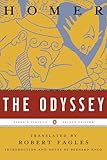
Robert Fagles’s translation (1996) remains excellent and is the version that turned a generation of readers into Homer readers. Fagles’s language has more grandeur and more music than Wilson’s — it reaches slightly further toward the epic register — and for readers who want to feel the poem as a formal, ceremonial thing as well as a story, his version is deeply satisfying. It is also widely available, often inexpensively, and the introduction by Bernard Knox is one of the best short essays on Homer in English.
Both are in The Odyssey in our catalogue. Either will serve you well; the choice depends on whether you want the poem demystified (Wilson) or celebrated (Fagles).
What the Poem Is Actually About
A man tries to get home from a war. That is the premise. It is not the subject.
The deeper subject of The Odyssey is identity — specifically, the question of what remains of a person after long absence, long suffering, and long disguise. Odysseus spends much of the poem in disguise: as a beggar, a stranger, a nobody. He gives himself a false name — Nobody — at the precise moment when concealing his identity saves his life. The poem asks, quietly and persistently, what the relationship is between a name and a self, between reputation and reality, between the hero you were and the man you’ve become.
This is why Odysseus is such an unusual hero by the standards of ancient epic. He is not the strongest or the fastest. His defining quality is cunning — the ability to see a situation clearly, construct a plan, and adapt when the plan breaks. The Iliad’s great hero, Achilles, wins through force and speed and the intensity of his rage. Odysseus wins through thinking. The poem presents this as both a strength and a complicated moral condition: cunning is also deception, and Odysseus uses it on everyone, including people who love him. He lies to his wife’s face, at length, in elaborate detail, when he has no tactical reason to keep lying. The poem knows this about him and does not entirely excuse it.
Penelope, meanwhile, is one of the most underrated figures in ancient literature. She has been waiting for twenty years — ten years of war, ten years of absence — and she has spent that time managing a household, fending off more than a hundred suitors who have installed themselves in her home and are eating through her resources, and keeping her own authority intact in a world that assumes a woman without a husband is a woman without power. She does this through her own form of cunning: she promises to choose a new husband when she has finished weaving a burial shroud for her father-in-law, and for three years she unravels at night what she weaves during the day. When Odysseus finally returns and conceals himself in her household, she stages a contest — stringing Odysseus’s great bow — that she almost certainly knows only her husband can win. She is not waiting passively. She is managing a political crisis with the same intelligence her husband manages his survival at sea.
The poem is also — and this is what the film will need to reckon with, in whatever form — a meditation on the cost of war. Odysseus has been away for twenty years. He arrives home as a stranger to his own son, an absence to his wife, and an old man to his father, who doesn’t recognise him. The journey home is not a triumphant homecoming. It is a reckoning with what war takes. Every monster Odysseus encounters, every delay and trap and temptation, is also a version of the question: why would anyone choose to go back to ordinary life after ten years of being extraordinary? The Lotus-eaters offer the temptation of forgetting. Circe, and later Calypso, offer comfort and immortality. Odysseus refuses all of it and keeps going, toward an ageing wife and a kingdom full of enemies. The poem presents this choice as heroic, but it doesn’t pretend the choice is easy.
The Iliad: Sister Epic, Whether to Read It First
The Iliad is The Odyssey’s companion poem and, in many ways, its opposite. Where The Odyssey is about homecoming, The Iliad is about why heroes can’t come home — because they are addicted to the battlefield, because glory is more real to them than domestic life, because the war is all-consuming. Where The Odyssey’s Odysseus survives by thinking, The Iliad’s Achilles destroys himself by feeling.
The Iliad covers a few weeks near the end of the ten-year Trojan War. It begins with a quarrel between Achilles and the Greek commander Agamemnon over a captive woman, and it ends — famously — not with the fall of Troy, which happens off the page, but with the funeral of the Trojan hero Hector, whose body Achilles has dragged through the dirt and finally, grudgingly, returned to his father. The fall of Troy, the wooden horse, the burning of the city: none of that is in The Iliad. The poem ends on an act of grief and recognition — Achilles and Priam, enemies, sitting together in a tent, weeping for what they have each lost.
Should you read The Iliad before The Odyssey? Chronologically — in terms of the events depicted — The Iliad comes first. The Trojan War is the background to The Odyssey, and Odysseus’s presence at Troy, his famous trick of the wooden horse, is referred to repeatedly. You will understand the references in The Odyssey more fully if you have read The Iliad.
But The Odyssey is the more immediately gripping poem for a modern reader, and it stands entirely on its own. If you have limited time before the film and can only read one, read The Odyssey. If you have a few weeks and want the full picture — the world the characters are coming home from, the weight of what the war cost — read The Iliad first and let The Odyssey be the release it was always meant to be. The experience of finishing The Iliad and moving directly into The Odyssey is one of the most satisfying things you can do with two weeks of reading.
Both are in our catalogue: The Odyssey and The Iliad, as well as our author page for Homer.
Nolan’s Films and the Epic Tradition
It would be easy to overstate the parallels between Christopher Nolan’s filmmaking and Homeric epic, and we will try not to do that. The film hasn’t been released. We can’t know how faithfully or how freely it adapts the source.
What we can say is that certain structural properties of Nolan’s films are genuinely compatible with the way The Odyssey is built. Nolan has, across his career, returned repeatedly to the problem of non-linear time: stories that fold back on themselves, where what something means depends entirely on when you encounter it. The Odyssey is itself a non-linear work — it begins in the middle, loops back through Odysseus’s earlier adventures when he tells his story at the court of the Phaeacians, and operates simultaneously across three storylines (Odysseus at sea, Penelope in Ithaca, Telemachus searching for news of his father). A filmmaker interested in how time and knowledge can be restructured to produce suspense and emotional revelation has been handed, in The Odyssey, one of the oldest and most sophisticated examples of exactly that technique.
Nolan has also been consistently interested in characters who are operating under multiple layers of concealment — from others, from themselves, sometimes from the audience. Odysseus, who spends the last third of the poem hidden in his own house, watching what has been done to it, choosing the exact moment to reveal himself, is a Nolan protagonist waiting to happen.
None of this tells us what the film will be. But it does suggest that Nolan did not choose this material accidentally.
Practical Reading Guide
How long will it take?
The Odyssey in a modern prose translation runs to roughly 400–500 pages depending on the edition. In verse translation, you are reading poetry, which takes longer per page but often covers more ground per reading session because the momentum pulls you forward. Most readers find they can finish it in one to two weeks of regular evening reading — two hours a night will get you through a book or two, and the poem has 24 books.
If the film is your deadline, start three weeks out. That gives you time to read The Odyssey without rushing, absorb it, and — if you want — read the first few books of The Iliad as context.
Which edition?
For Emily Wilson’s translation, the W. W. Norton hardback is the standard edition, but the paperback is identical and easier to hold. It includes a substantial introduction that is worth reading either before you start or immediately after you finish the poem — before if you want context, after if you prefer to meet the poem without framing.
For Robert Fagles’s translation, the Penguin Classics edition is the one to get. Bernard Knox’s introduction (roughly 60 pages) is one of the great pieces of classical scholarship aimed at a general reader, and it repays attention.
How to read epic poetry if you’ve never done it
The most important thing is not to treat it as you would treat a poem by Keats or a contemporary collection — something to be read slowly, word by word, with full attention to every image and sound. Epic poetry is built for cumulative momentum. It rewards sustained reading rather than close reading. Read a whole book in a sitting when you can. Let the repetitions — the repeated epithets, the type-scenes, the formulaic phrases — work on you the way a recurring motif in music works: not as laziness but as structure.
If a passage isn’t landing, keep going. The poem will pick you up again. The Cyclops episode, the descent into the underworld, the return to Ithaca: these sections have pulled in readers for three millennia without needing any warm-up. Trust the poem. It knows what it’s doing.
Don’t feel obliged to footnote everything. Ancient proper nouns can pile up in the early books, and it’s easy to get stuck cross-referencing. If you don’t know who a god or hero is, the poem will tell you what you need to know, or it won’t matter. Classical mythology is less of a prerequisite than most readers assume. The Odyssey was written for audiences who knew some of it and not all of it, and it was written to work regardless.
For the Best Fiction Books
For the definitive guide to fiction — the greatest novels across literary fiction, classics, and contemporary writing — see our Best Fiction Books of All Time list.
More Epic and Classical Literature Guides
- Books Like Don Quixote: Idealism and the Madness of Literature
- Best Public Domain Books You Can Download Free
Affiliate disclosure: Links on this site are affiliate links. We earn a small commission at no extra cost to you. This does not influence our editorial recommendations.
Frequently Asked Questions
Should I read The Odyssey before seeing Christopher Nolan's film adaptation?
Reading The Odyssey beforehand is worthwhile but not required. The poem is long and the film will inevitably compress and adapt it. Reading it first enriches every departure the film makes and gives you the full mythology of Odysseus. Reading it afterward, with the film's images fresh, can make the original feel even more alive.
What is the best translation of The Odyssey for modern readers?
The Emily Wilson translation (2017) is currently considered the best for modern readers — it is the first English translation by a woman, reads naturally and quickly, and makes choices that feel contemporary without losing the poem's dignity. The Robert Fagles translation is the other strong choice and has been the most widely used in universities for decades.
How long does The Odyssey take to read?
The Odyssey is approximately 500 pages in most prose translations and takes most readers 8 to 12 hours to complete. In verse translation it reads faster than expected because the narrative pace is relentless. The Emily Wilson translation is particularly readable and moves quickly for a foundational text of Western literature.
What other Greek epics are worth reading alongside The Odyssey?
The Iliad by Homer is the obvious companion and predecessor — the Odyssey begins at the end of the Trojan War the Iliad depicts. Virgil's Aeneid is the Roman response to both epics and deeply influenced Dante. The Song of Achilles by Madeline Miller retells the Iliad from Patroclus's perspective and is an excellent bridge for modern readers new to classical literature.


