Where to Start with Ernest Hemingway: A Reading Guide
Where to start with Ernest Hemingway — how to approach The Sun Also Rises, For Whom the Bell Tolls, and A Farewell to Arms. A complete reading guide to the master of the iceberg style.
Ernest Hemingway (1899–1961) was an American journalist, novelist, and short story writer who served as an ambulance driver in World War I, lived in Paris in the 1920s among the expatriate literary community, reported on the Spanish Civil War, and won the Nobel Prize in Literature in 1954. He developed what he called the iceberg theory of prose — the idea that the emotional force of writing comes from what is left out, from what the writer knows but chooses not to state, with the reader feeling its weight below the surface — and applied it so consistently that “Hemingwayesque” has become an adjective for a particular kind of declarative minimalism in American fiction.
Where to Start: The Sun Also Rises (1926)
The recommended first Hemingway — and the founding text of the Lost Generation aesthetic. The Sun Also Rises is set in 1925 Paris and Pamplona among a group of American and British expatriates: Jake Barnes, the narrator, a journalist with a war wound that has rendered him sexually impotent; Lady Brett Ashley, the beautiful, charismatic woman he loves and cannot have; and the surrounding circle of drinkers, talkers, and war survivors who make up their world. The novel has almost no conventional plot — the characters drink, travel, drink some more, and attend the Pamplona fiesta — and this is precisely the point.
Hemingway’s iceberg principle is at its most effective here. Jake’s wound is never described directly; it is present in every scene as the thing that cannot be said, shaping every interaction with Brett, every conversation, every moment of watching others in the freedom he does not have. The prose’s surface is flat and declarative — dialogue and observation, with minimal interiority — but the compression creates pressure. A sentence about the weather is not just about the weather.
The Pamplona sequences are Hemingway’s finest extended writing. The fiesta — the bullfighting, the drinking, the dancing, the jostling social dynamics among people who have known each other too long and hurt each other too often — is rendered with the specificity of someone who was there, and the corrida chapters (the art and ethics of bullfighting, the specific qualities of the matador Pedro Romero) function as a meditation on the relationship between craft, courage, and grace under pressure that underpins everything Hemingway admired and tried to write.
The Robert Cohn problem is real and should be acknowledged: Cohn, the Jewish member of the expatriate group, is portrayed with the anti-Semitism of Hemingway’s milieu that exceeds what might be attributed to Jake’s limited narrative perspective. It is a genuine flaw, not merely a product of its era, and should not be read past.
Why The Sun Also Rises Is the Place to Begin
For a reader new to Ernest Hemingway, The Sun Also Rises is the place to begin, for it is his first major novel and the work that announced his revolutionary style to the world. The Sun Also Rises follows a group of disillusioned expatriates from the cafés of Paris to the bullfights of Pamplona, capturing the restless, wounded spirit of the generation that came of age after the First World War. As a first Hemingway, it is the natural starting point: it is the fullest early expression of his famous spare prose and his enduring themes, and it remains among his most celebrated and accessible novels. It welcomes the newcomer with its atmospheric settings, its sharp dialogue, and its emotional undercurrents, while introducing the understated, iceberg method that made him so influential. Because it is the work that established his reputation and his style, it lets the new reader meet Hemingway where his career as a major novelist begins. For the newcomer, then, The Sun Also Rises is the place to begin.
What to Expect When You Open It
As a new reader, you can expect The Sun Also Rises to be a spare, atmospheric, and emotionally understated novel. You can expect Hemingway’s famous style, the spare, plain, understated prose built on his iceberg theory, in which much is left beneath the surface. You can expect a disillusioned mood, for the novel captures the restless, wounded spirit of the postwar generation. You can expect vivid settings, for Hemingway evokes the cafés of Paris and the bullfights of Pamplona with atmospheric power. You can expect sharp, naturalistic dialogue. You can expect strong emotional undercurrents beneath a restrained surface. You can expect themes of disillusionment, longing, and the search for meaning after the war. Expect, in short, a spare, atmospheric, and emotionally understated novel, a characteristic first taste of Hemingway.
Where to Go From Here
Once The Sun Also Rises has introduced you to Hemingway’s style, the reader who wishes to continue can explore his other great novels and his short stories. A Farewell to Arms, his powerful and tragic novel of love and the First World War, and For Whom the Bell Tolls, his great and ambitious novel of the Spanish Civil War, widely regarded as among his finest, deepen his style and his themes, while his late novella of an old fisherman’s struggle distills his vision into a small, perfect form. His short stories are considered among the greatest in the language and are essential to understanding his art. Reading onward deepens your appreciation of Hemingway’s distinctive gifts, the spare prose, the understated emotion, and the engagement with courage, love, and loss. Building a reading journey through Hemingway means following his work from The Sun Also Rises into his other novels and his stories. The reader who begins here and continues will encounter one of the most influential writers of the twentieth century.
The Greatest Novel: For Whom the Bell Tolls (1940)
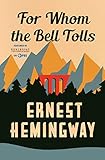
For Whom the Bell Tolls is Hemingway at his most ambitious and most emotionally open. Robert Jordan — an American volunteer with the International Brigades, a professor of Spanish literature who blew bridges in the Republic’s service — is given three days to blow a specific bridge in advance of a Republican offensive. He lives with a guerrilla band in the mountains; he falls in love with Maria, a young woman the band rescued from fascist capture. The three-day frame drives the entire novel.
Pilar — the guerrilla leader Pablo’s wife, the real authority of the group — is Hemingway’s greatest character. She is physically formidable, politically shrewd, capable of genuine cruelty and genuine tenderness, and entirely clear-eyed about the situation in a way that Jordan is only learning to be. Her account of the massacre of the fascists in her village — told to Jordan as a warning about Pablo’s moral deterioration — is the most powerful section in the novel.
The novel is also Hemingway’s most honest political work. He supported the Republic; he understood the Republic’s failures; For Whom the Bell Tolls does not disguise the second by asserting the first. The Communist advisors who control the offensive are incompetent and self-serving. The idealism is real and insufficient. Jordan knows the bridge will probably make no difference and blows it anyway, because the commitment to act on what you believe survives the destruction of the belief’s institutional expression.
For the full Ernest Hemingway bibliography, reviews, and biography, visit the Ernest Hemingway author page on Editors Reads.
Affiliate disclosure: Links to Amazon on this page are affiliate links. We earn a small commission at no extra cost to you.
Frequently Asked Questions
Where should I start with Ernest Hemingway?
The Sun Also Rises (1926) is the recommended starting point — Hemingway's first novel and the definitive statement of his prose method: short declarative sentences, dialogue that carries weight through what it refuses to say, the iceberg principle (seven-eighths below the surface) applied to a story of expatriates in Paris and Pamplona whose war wounds have made genuine feeling both more necessary and less possible. Under 260 pages and immediately readable.
What is For Whom the Bell Tolls about?
For Whom the Bell Tolls (1940) is Hemingway's greatest novel — an American volunteer with Spanish guerrilla fighters during the Spanish Civil War, assigned to blow a bridge in three days, falls in love with the survivor Maria during the time he has left. The compressed time frame (three days) creates a sustained narrative pressure, and the novel's engagement with the Spanish Civil War's moral complexities — the Republic's real failures, the idealism that persists despite them — is unusually honest.
Should I read A Farewell to Arms or The Sun Also Rises first?
The Sun Also Rises first. It is Hemingway's first novel and the clearer statement of his aesthetic — the Lost Generation voice, the Paris and Pamplona setting, the iceberg prose style — in a relatively compact form. A Farewell to Arms (1929) is the more emotionally transparent novel, set during World War I, and benefits from the context that The Sun Also Rises provides about what the war did to the generation that survived it.
What should I read after Hemingway?
After Hemingway, F. Scott Fitzgerald's The Great Gatsby covers the same Lost Generation world from a different angle — more symbolically elaborate, less spare in style, equally concerned with what the American dream does to the people who pursue it. John Steinbeck's The Old Man and the Sea (if you haven't read it) is the shortest and most distilled Hemingway-adjacent novel. Cormac McCarthy's early fiction extends Hemingway's spare masculine prose into a different American landscape with more violent consequences.


