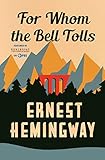
Editors Reads Verdict
Hemingway's greatest novel brings together his Spanish experiences, his iceberg theory of prose, and his deepest preoccupations — courage, death, love, and collective action — into a work of sustained power. The compressed time frame (three days) creates an intensity that the Spanish Civil War setting amplifies.
What We Loved
- The time compression creates tremendous narrative pressure across a relatively long novel
- Pilar is one of Hemingway's greatest characters — powerful, funny, and tragic in equal measure
- The novel's engagement with the Spanish Civil War's moral complexities is unusually honest
- The extended final scene is Hemingway's most emotionally transparent writing
Minor Drawbacks
- The stylised dialogue (translated Spanish) can feel awkward — 'I obscenity thee' is distracting
- Maria is idealised to the point of passivity — the romance is Hemingway's least convincing
- The political analysis of the Republic's failures is sympathetically conducted but occasionally schematic
Key Takeaways
- → No man is an island — the Spanish Civil War is the context for Donne's universal observation
- → Courage is not the absence of fear but the decision to act despite it
- → Political idealism can survive — and must survive — the corruption of the cause that embodies it
- → Love under the shadow of imminent death is not diminished but intensified
- → The bridge is a moral object — its destruction will cost lives on both sides, and Robert Jordan knows this
| Author | Ernest Hemingway |
|---|---|
| Publisher | Scribner |
| Pages | 480 |
| Published | October 21, 1940 |
| Language | English |
| Genre | Fiction, Classic Literature, War Fiction |
| Difficulty | Intermediate |
| Best For | Readers who want Hemingway at his most ambitious and most emotionally open — and those interested in the Spanish Civil War's place in the political and cultural history of the twentieth century. |
How For Whom the Bell Tolls Compares
For Whom the Bell Tolls at a glance against 2 similar books readers weigh alongside it.
| Book | Author | Rating | Best for |
|---|---|---|---|
| For Whom the Bell Tolls (this book) | Ernest Hemingway | ★ 4.6 | Readers who want Hemingway at his most ambitious and most emotionally open — |
| A Farewell to Arms | Ernest Hemingway | ★ 4.5 | Readers who want to understand the World War I generation's literary response |
| The Sun Also Rises | Ernest Hemingway | ★ 4.4 | Readers interested in American modernism and the 1920s Paris scene — and those |
Hemingway’s Greatest Novel
Ernest Hemingway fought in Spain as a correspondent during the Civil War of 1936-1939, watching the Republic that he believed in — and that much of the international left had invested with enormous hope — make catastrophic military decisions, suffer Soviet interference, and descend into the kind of infighting that loses wars. For Whom the Bell Tolls, published in 1940, is the novel born of that experience: not a celebration but an elegy, not propaganda but something far more honest about what political violence costs.
Robert Jordan is an American volunteer — a Spanish teacher from Montana who has committed to the Republican cause with his eyes open. He is assigned to blow a bridge before a Republican offensive, working with a guerrilla band led by the volatile Pablo and the magnificent Pilar. He has three days. He falls in love with Maria. He will do the job.
The Three Days
The novel’s time compression — three days in the pine forests above a Spanish valley — creates an intensity that Hemingway sustains across nearly 500 pages. Everything that Robert Jordan thinks and feels and remembers is packed into those seventy-two hours: his fear, his love for Maria, his doubts about the mission’s strategic necessity, his respect for Pilar, his contempt for Pablo’s cowardice, and his meditation on death.
The meditation on death is Hemingway’s most extended and most honest. Robert Jordan is not ideologically certain — he has seen enough of how idealism operates in practice to hold his political commitments with awareness of their limitations — but he is morally certain: the cause is worth dying for, not because the Republic is perfect but because the alternative is worse.
Pilar: The Novel’s Greatest Character
Pilar, Pablo’s wife and the guerrilla band’s real leader, is one of Hemingway’s greatest creations — a woman of enormous force, intelligence, and tenderness, who has lived a life of violence without being coarsened by it. Her extended description of the massacre of fascist sympathisers in a village — the drunken crowd, the improvised gauntlet, the town priest’s dignity, the guilt that follows — is among the finest pieces of prose in Hemingway’s work, and the most politically honest section of the novel.
The Ending’s Long Shadow
The novel’s final scene — Robert Jordan lying wounded on a hillside as his companions escape, waiting with a submachine gun for the fascist cavalry — is Hemingway’s most moving. The compression is absolute: the pine needles under his hands, the specific quality of the light, Maria’s voice receding. He will hold the position as long as he can.
Our rating: 4.6/5 — Hemingway at his most ambitious and most emotionally open: a war novel that mourns the cause it celebrates.
Reading Guides
- Books Like Moby Dick: Epic Obsession, the Sea, and America
- Books Like The Old Man and the Sea: Man Against Nature and the Dignity of Struggle
- Best Books of All Time: 30 Titles Every Reader Should Know (2026)
Hemingway and the Spanish Civil War
Ernest Hemingway (1899–1961) made four trips to Spain during the Civil War of 1936–1939, working as a correspondent for the North American Newspaper Alliance. He co-wrote and narrated the propaganda documentary The Spanish Earth (1937), raised money for the Republic, and witnessed enough of the war’s progress — and enough of the Soviet-backed factionalism destroying the Republican cause from within — to approach For Whom the Bell Tolls with the kind of clear-eyed ambivalence that propaganda cannot accommodate.
The novel was dedicated to Martha Gellhorn, the journalist who became his third wife in 1940, the year of publication. Gellhorn had covered the Spanish Civil War alongside Hemingway and shared his sympathies and his disillusionment. The book was an immediate bestseller and earned Hemingway more money than any previous work. The Nobel Committee cited it in 1954 among the works supporting the prize.
The Title and John Donne
The novel’s title comes from John Donne’s Devotions upon Emergent Occasions (1624): “No man is an island, entire of itself; every man is a piece of the continent, a part of the main… Any man’s death diminishes me, because I am involved in mankind, and therefore never send to know for whom the bell tolls; it tolls for thee.” Hemingway uses this as his epigraph and as the novel’s moral argument: Robert Jordan’s three days in the Spanish hills are not merely a personal story of love and mission but a statement about human interconnection, about the way each act of political violence — each individual death — belongs to all of humanity.
The irony that Hemingway sustains is that this universal solidarity coexists with the specific, local, and often petty politics that make the Spanish Republic’s cause self-destructive. Jordan knows that the bridge operation may be strategically pointless — the Republican offensive it is meant to support is already compromised by Soviet interference and Spanish Republican infighting — and he does his job anyway. The dedication to a cause you can see failing is the novel’s central moral problem.
Pilar’s Stories
The novel’s formal richness comes substantially from the extended narrative passages that Pilar — the guerrilla band’s real leader, Pablo’s formidable wife — delivers within the frame story. Her account of the massacre of the fascists in the village, her description of what it felt like to be in the ring with the great bullfighters, her ability to smell death on a man — these extended passages give the novel a depth of world that the three-day compression would otherwise prevent. Pilar knows more history, more human truth, and more about death than anyone else in the book, and Hemingway gives her the narrative space her knowledge deserves.
The 1943 film adaptation, with Gary Cooper as Robert Jordan and Ingrid Bergman as Maria, was a major commercial success and earned nine Academy Award nominations. As with most Hemingway adaptations, it simplified the political dimensions while preserving the love story. The novel’s moral complexity — Jordan’s clear-eyed recognition of the Republic’s failures, Pilar’s account of Republican atrocity, the sense that both sides in this war are capable of horror — does not translate easily to the Hollywood films of the early 1940s.
The Hemingway Code in Extremis
For Whom the Bell Tolls is where Hemingway’s code — the code of the man who does his work well regardless of circumstances, who faces death without flinching, who maintains grace under pressure — is tested under its most extreme conditions. Robert Jordan is not a bullfighter or a big-game hunter; he is a political actor in a situation where political idealism is being systematically betrayed. That the code survives this test, in the final scene on the hillside with his enemies approaching and his friends escaping, is Hemingway’s most considered answer to the question of what individual virtue means in the context of collective political failure.
Frequently Asked Questions
What is "For Whom the Bell Tolls" about?
American volunteer Robert Jordan fights with Spanish guerrillas during the Civil War, assigned to blow a bridge — and falls in love with Maria in the three days before the mission.
Who should read "For Whom the Bell Tolls"?
Readers who want Hemingway at his most ambitious and most emotionally open — and those interested in the Spanish Civil War's place in the political and cultural history of the twentieth century.
What are the key takeaways from "For Whom the Bell Tolls"?
No man is an island — the Spanish Civil War is the context for Donne's universal observation Courage is not the absence of fear but the decision to act despite it Political idealism can survive — and must survive — the corruption of the cause that embodies it Love under the shadow of imminent death is not diminished but intensified The bridge is a moral object — its destruction will cost lives on both sides, and Robert Jordan knows this
Is "For Whom the Bell Tolls" worth reading?
Hemingway's greatest novel brings together his Spanish experiences, his iceberg theory of prose, and his deepest preoccupations — courage, death, love, and collective action — into a work of sustained power. The compressed time frame (three days) creates an intensity that the Spanish Civil War setting amplifies.
Ready to Read For Whom the Bell Tolls?
Check the current price on Amazon.
Check Price on Amazon (paid link)Prices and availability are subject to change. See Amazon for current price.
Review last updated: