Where to Start with Greg McKeown: A Reading Guide
Where to start with Greg McKeown — how to approach Essentialism, his essential book on the disciplined pursuit of less. A complete reading guide.
By Lena Fischer
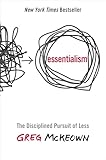
Greg McKeown is a British-born, California-based author, speaker, and consultant whose Essentialism: The Disciplined Pursuit of Less (2014) became one of the most widely read productivity books of the decade — a book about not doing more, but doing less of the right things. McKeown draws on his consulting work with organisations including Apple, Google, and LinkedIn, and his framework is designed for professionals whose default settings maximise activity rather than contribution.
Where to Start: Essentialism (2014)
The essential McKeown — and the most compelling case ever made for the discipline of doing less. Essentialism begins from a diagnosis that will feel familiar to most professional readers: the accumulation of commitments, meetings, projects, and yes-es to every request has produced a life of constant activity that advances no particular priority. The busyness feels productive; the direction is unclear; the highest-value work never gets full attention.
The essentialist thesis is simple and genuinely difficult to live by: almost everything is less important than it appears, and the few things that are truly important deserve far more time and energy than they currently receive. The trade-off implicit in every yes — the hours that yes takes away from something else — is invisible until named. McKeown names it as the central decision of professional life: every commitment accepted is a commitment rejected, and most people accept the wrong ones by default.
The framework has three phases:
Explore: create deliberate space to think and evaluate before committing. Most yes-es are made under social pressure, in the moment, without genuine consideration of the trade-off. The essentialist creates protected time for thinking — sleeping on requests, asking “what am I giving up if I say yes?” — before responding.
Eliminate: once the genuinely essential is identified, the non-essential must be removed. McKeown is specific about the tools for this: the 90 percent rule (if an opportunity doesn’t score above 90 on your criteria, the answer is no), the boundary-setting conversation, and the structural removal of non-essential commitments.
Execute: build systems that make the essential default, removing the need to decide repeatedly. Routine, preparation, and the removal of friction around the most important work.
The book’s signature instruction — “if it’s not a clear yes, it’s a no” — is simple enough to memorise and significant enough to restructure a professional life if applied consistently. The chapters on how to say no without damaging relationships and how to set clear boundaries with demanding colleagues are among the most practically useful sections.
Why Essentialism Is the Ideal First Book
For a reader new to Greg McKeown, Essentialism is the ideal first book because it is his breakthrough work and the fullest expression of his central philosophy, the disciplined pursuit of less but better. Essentialism presents McKeown’s core idea, that we can accomplish what truly matters not by doing more but by ruthlessly focusing on the vital few things that count and eliminating the trivial many, reclaiming control of our choices and our lives. As an entry point, it is ideal because it lays out this clarifying philosophy directly and compellingly, offering a disciplined approach to focusing on what matters most and saying no to everything else. It welcomes the newcomer with its clear central principle, its practical guidance, and its clarifying message, challenging the reader to focus their effort and attention on the essential. It is his best-known book and the one that best represents his philosophy, so that the new reader encounters McKeown’s central idea from the first. For the newcomer, then, Essentialism is the natural and ideal starting point, the influential book that teaches the disciplined pursuit of less but better.
What to Expect as a New Reader
As a new reader, you can expect Essentialism to be a clarifying and practical book on focus and priorities, built around the philosophy of the disciplined pursuit of less but better. You can expect McKeown’s central idea, that we accomplish what truly matters not by doing more but by ruthlessly focusing on the vital few things that count and eliminating the trivial many. You can expect a clarifying message, for the book challenges the culture of busyness, overcommitment, and trying to do everything, arguing instead for the discipline of focusing on the essential and saying no to the rest. You can expect practical guidance, for McKeown offers concrete principles and methods for identifying what is essential, eliminating the nonessential, and protecting your focus and energy for what matters most. You can expect an accessible and motivating style oriented toward reclaiming control of your choices. Expect, in short, a clarifying and practical book on focus and priorities, teaching the disciplined pursuit of less but better, a useful introduction to McKeown’s philosophy.
Going Deeper After Your First Book
Once Essentialism has introduced you to McKeown’s philosophy of focus, the reader who wishes to go deeper can explore his other work, which extends his thinking to the question of how to do essential things with greater ease. His subsequent work addresses how to make the most important things easier, less effortful, and more sustainable, building on the foundation of focus that Essentialism establishes by addressing not only what to do but how to do it without burnout. Reading this after Essentialism deepens your engagement with McKeown’s thinking, extending it from the disciplined focus on the essential to the pursuit of essential things with greater ease. His core concern, the focus on what truly matters and the elimination of the rest, runs through his work, and the reader who has found Essentialism clarifying will find its complement in his other book. Building your reading journey through McKeown’s work is a matter of following his philosophy from the disciplined focus on the essential to the pursuit of the essential with greater ease. The reader who begins with Essentialism and continues through his work will find a clarifying and practical guide to focusing on what matters most.
Reading Greg McKeown
Begin with Essentialism — it is his most essential work. Effortless (2021) is the follow-on covering how to reduce friction around the essentials. Both standalone.
For the full Greg McKeown bibliography, reviews, and biography, visit the Greg McKeown author page on Editors Reads.
Affiliate disclosure: Links to Amazon on this page are affiliate links. We earn a small commission at no extra cost to you.
Frequently Asked Questions
Where should I start with Greg McKeown?
Essentialism (2014) is McKeown's essential and most widely read book — a case for radical prioritisation: identifying the few things that make the highest contribution and systematically eliminating everything else. The most compelling popular book on the discipline of saying no; an important counterpoint to hustle culture and the glorification of busyness.
What is Essentialism about?
Essentialism argues that most people trade their most valuable resource — focused time and energy — for dozens of low-value commitments because they lack a clear principle for refusing. The essentialist approach is to replace the default of 'yes' (to every request, every meeting, every project) with a deliberate filter: if it's not a clear yes, it's a no. McKeown covers how to identify what is genuinely essential, how to create space to think clearly, how to say no without damaging relationships, and how to build systems that prevent non-essentials from returning.
How does Essentialism compare to Cal Newport's Deep Work?
Essentialism and Deep Work address complementary questions. McKeown's Essentialism asks: what should you be spending your time on? Newport's Deep Work asks: how do you do that work with sufficient depth and concentration once you've identified it? Both argue against the shallow busyness that characterises most professional lives, but from different angles. Reading both together provides a complete framework: Essentialism for prioritisation, Deep Work for execution.
What should I read after Essentialism?
After Essentialism, McKeown's Effortless (2021) is his follow-on, arguing that once you identify the essential, the work should become easier rather than harder through reducing friction and building systems. Cal Newport's Deep Work covers how to actually do the focused work that Essentialism prioritises. Oliver Burkeman's Four Thousand Weeks takes a more philosophical approach to the same question of how to spend finite time.