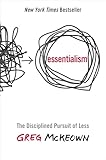
Editors Reads Verdict
The most compelling case ever made for focusing on less. McKeown's philosophy is simple and hard: identify what's truly essential, then systematically eliminate everything else. An important counterpoint to hustle culture and the glorification of busyness.
What We Loved
- Clear, memorable philosophy that's easy to articulate and apply
- Excellent companion to Deep Work — addresses the 'what to focus on' question
- The 'if not a clear yes, then no' rule is immediately applicable
- Well-structured with practical techniques for saying no
Minor Drawbacks
- Repetitive in places — the core idea could be delivered in less space
- Some examples are trivial; the philosophy is better than the cases used to illustrate it
- Doesn't fully address the social and professional cost of saying no
Key Takeaways
- → If you don't prioritise your life, someone else will
- → The essentialist makes one big decision that eliminates a thousand small ones
- → 'If it isn't a clear yes, then it's a clear no' — apply this to every commitment
- → The paradox of success: success creates options which create distraction which undermines success
- → Trade-offs are real — you cannot have everything, so choose deliberately
| Author | Greg McKeown |
|---|---|
| Publisher | Crown Business |
| Pages | 260 |
| Published | April 15, 2014 |
| Language | English |
| Genre | Productivity, Self-Help, Business |
| Difficulty | Beginner |
| Best For | Professionals who feel spread too thin, are constantly busy but rarely fulfilled, or who want a philosophical framework for saying no without guilt. |
How Essentialism Compares
Essentialism at a glance against 3 similar books readers weigh alongside it.
| Book | Author | Rating | Best for |
|---|---|---|---|
| Essentialism (this book) | Greg McKeown | ★ 4.5 | Professionals who feel spread too thin, are constantly busy but rarely |
| Atomic Habits | James Clear | ★ 4.8 | Anyone who wants to build better habits, break bad ones, or improve personal |
| Deep Work | Cal Newport | ★ 4.7 | Knowledge workers, writers, programmers, academics, and anyone whose job |
| The ONE Thing | Gary Keller | ★ 4.6 | Entrepreneurs, knowledge workers, and anyone overwhelmed by competing |
Against Busyness
We live in a culture that equates busyness with importance. The longer your to-do list, the more meetings on your calendar, the more emails in your inbox — the more significant you must be.
Greg McKeown argues this is precisely backwards, and that the pursuit of “more, more, more” is the enemy of your highest contribution.
Essentialism is his manifesto for a different approach.
The Essentialist’s Question
The non-essentialist asks: “How can I do everything?” The essentialist asks: “What is the most important thing I can do right now?”
These questions produce radically different lives. The non-essentialist spreads effort across dozens of priorities and makes a millimetre of progress in every direction. The essentialist puts all of their effort into one direction and makes a metre of progress.
The trade-off is real. You cannot have everything. Choosing to do one thing means choosing not to do a hundred other things. The essentialist makes this choice explicitly, deliberately, and without guilt.
The Paradox of Success
McKeown identifies a devastating cycle that undermines the people most likely to succeed:
- You have clarity of purpose → this leads to success
- Success creates options and opportunities
- You say yes to more options → this creates diffuse effort
- Diffuse effort leads to failure to execute at a high level
The very success that gives you options can become the thing that destroys the focus that created the success in the first place. McKeown’s prescription: the essentialist deliberately protects against this by applying the same selectivity at every stage.
The Decision Rule
The book’s most operationally useful contribution: if it isn’t a clear yes, it’s a clear no.
McKeown applies a simple scoring system. If an opportunity scores less than 90 out of 100 on your key criteria, it’s a no. This eliminates the seductive “it’s pretty good and I might have time for it” class of commitments that gradually consume your capacity without advancing your priorities.
This rule is counterintuitive because it means turning down things that are genuinely good — but the essentialist only has time for the exceptional.
How to Say No
One of the book’s most practical sections: techniques for saying no without destroying relationships:
- The non-committal “I’ll check my schedule and get back to you” (rather than yes in the moment)
- “What should I deprioritise to make room for this?” (puts the trade-off back to the requester)
- “I’m over-committed right now — ask me in three months”
- The awkward pause (silence after a request is made can be more powerful than any word)
For professionals who struggle to say no — particularly those whose career success was built on being capable and helpful — this section is genuinely useful.
Essentialism vs Minimalism
McKeown carefully distinguishes his philosophy from minimalism. The goal is not to have fewer things or do less work — it is to do the right things with all of your capacity. An essentialist may work extremely hard; they simply direct that work toward a carefully selected target.
Our rating: 4.5/5 — A book that will make you uncomfortable with how much you’re doing, and give you permission to do less of it better.
The Discipline of Less
McKeown’s argument is sharper than the usual productivity fare, and it is essentially a single idea pursued relentlessly: that the way to do work that matters is not to do more but to do less, deliberately. The essentialist treats almost everything as noise and reserves time and energy for the vital few things that actually count, learning to say no gracefully and often, to distinguish the trivial many from the essential few, and to treat the question “is this the very most important thing I could be doing?” as a constant filter. The book’s value is less in novelty — the wisdom of focus is old — than in the discipline with which it dismantles the modern assumption that more options, more commitments, and more busyness are signs of a life well used.
Where It Helps and Where to Be Wary
Read as a corrective to over-commitment, Essentialism is genuinely useful, and its central practices — building in time to think, saying no without guilt, designing your life around a few priorities rather than reacting to every demand — can change how a reader spends their days. It is worth reading critically, too. The philosophy assumes a degree of control over one’s time that not everyone enjoys, and the relentless message to cut can tip into its own kind of pressure. The most useful way to take it is selectively, applying its central question rather than its full austere program. Approached that way, it is a clear, motivating, and quotable case for the underrated power of focus, and a helpful antidote to the cult of doing everything.
The Idea Behind the Movement
Essentialism arrived as part of a broader cultural turn against busyness, and it became a touchstone for that conversation by giving a familiar instinct a clear name and a usable discipline. McKeown’s gift is packaging: he turns the vague wish to “focus more” into a repeatable practice of editing one’s commitments down to the vital few. The reader looking for original philosophy will find the underlying wisdom old, but the reader looking for a practical, motivating push to stop saying yes to everything will find it genuinely useful. Read alongside the wider literature on focus and attention it helped popularise, it remains one of the most accessible and quotable cases for the underrated power of doing less, better.
Reading Guides
Frequently Asked Questions
What is "Essentialism" about?
Greg McKeown makes the case for a radical new discipline: the pursuit of less, but better. Essentialism is the art of discerning what is essential and eliminating everything else — so you can make your highest possible contribution.
Who should read "Essentialism"?
Professionals who feel spread too thin, are constantly busy but rarely fulfilled, or who want a philosophical framework for saying no without guilt.
What are the key takeaways from "Essentialism"?
If you don't prioritise your life, someone else will The essentialist makes one big decision that eliminates a thousand small ones 'If it isn't a clear yes, then it's a clear no' — apply this to every commitment The paradox of success: success creates options which create distraction which undermines success Trade-offs are real — you cannot have everything, so choose deliberately
Is "Essentialism" worth reading?
The most compelling case ever made for focusing on less. McKeown's philosophy is simple and hard: identify what's truly essential, then systematically eliminate everything else. An important counterpoint to hustle culture and the glorification of busyness.
Ready to Read Essentialism?
Check the current price on Amazon.
Check Price on Amazon (paid link)Prices and availability are subject to change. See Amazon for current price.
Review last updated: