Where to Start with J. Kenji López-Alt: A Reading Guide
Where to start with J. Kenji López-Alt — how to approach The Food Lab, his landmark culinary science book that explains the science behind everyday cooking through hundreds of rigorously tested recipes. A complete reading guide.
By Priya Anand
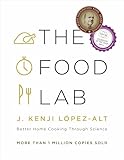
J. Kenji López-Alt is an American chef and culinary writer who served as managing culinary director of Serious Eats, where he developed the Lab column — a systematic examination of cooking through controlled experimentation. The Food Lab: Better Home Cooking Through Science (2015) was published by W. W. Norton and won the James Beard Award for General Cooking. At 960 pages, it is the most comprehensive single-volume home cooking reference published in the twenty-first century.
Where to Start: The Food Lab (2015)
The essential J. Kenji López-Alt — and the most rigorous approach to home cooking instruction ever assembled in a single volume. The Food Lab begins from a simple but radical premise: the conventional way of writing recipes — list ingredients, list steps, assume the cook knows why each step is done — produces cooks who can execute those recipes but cannot adapt, improvise, or troubleshoot when things go wrong. If you know why high heat is required for searing, you can apply that knowledge to any protein in any pan. If you only know that the recipe says high heat, you’re lost when your pan is too small or your cut is too thick.
The scientific method applied to cooking is the book’s distinctive contribution. For every technique, López-Alt describes the question he set out to answer, the experiments he conducted, the variables he isolated, and the results he obtained. This is not merely decoration — it is the mechanism by which the knowledge transfers.
The Maillard reaction versus caramelisation is the foundational example. Most cooks use these terms interchangeably, but they describe different chemical processes with different requirements. The Maillard reaction — the browning of proteins and sugars together, which produces the complex crust on a seared steak, a roasted chicken, a bread crust — occurs above 140°C and is suppressed by surface moisture, because moisture cools the surface and creates steam that keeps temperature below the threshold. Caramelisation involves only sugars and occurs at different temperatures. Knowing which process you want, and what conditions it requires, changes how you approach every high-heat cooking task.
Dry brining — salting meat hours or days before cooking and leaving it uncovered in the refrigerator — is among the book’s most transformative practical recommendations. The mechanism: salt draws moisture to the surface through osmosis, where it dissolves to form a concentrated brine. That brine is then reabsorbed into the meat, seasoning it throughout while also partially denaturing surface proteins in a way that reduces moisture loss during cooking. The meat sears better because the surface is drier; it retains more moisture because of the structural changes; it tastes better throughout because the seasoning has penetrated rather than sitting on the surface. One technique, rigorously explained, permanently changes how you handle meat.
The egg chapter is frequently cited as the book’s finest section. López-Alt covers every method of cooking eggs — soft-boiled, hard-boiled, scrambled, fried, poached, steamed — through systematic experimentation. The finding that low and slow scrambled eggs (constant stirring over the lowest possible heat, sometimes with a double boiler) produce silkier, more custardy results than high-heat scrambled eggs is not intuitive — but the explanation of why (proteins set gradually and retain more moisture at lower temperatures) makes it immediately comprehensible and reproducible.
The burger chapter has become the definitive guide to the home hamburger. The conclusion — that the quality of a burger depends almost entirely on grinding your own beef to the right fat percentage, handling the patty minimally to preserve protein structure, and using the correct heat sequence — is supported by a series of controlled experiments that produce photographs showing exactly what each variable change does to the final result.
At 960 pages, The Food Lab is not a quick reference. It is a study in the fullest sense: a book to read through section by section, cooking as you go, building understanding that outlasts any individual recipe.
Why The Food Lab Is the Essential First Book
For a reader new to J. Kenji López-Alt, The Food Lab is the essential first book because it is his landmark, acclaimed work and the fullest expression of his distinctive contribution, the application of science and rigorous testing to home cooking. The Food Lab explores the science of cooking, using experiments and detailed explanations to reveal why recipes work and how to make familiar dishes better, empowering cooks to understand the how and why of what they do. As an entry point it is both natural and essential, for it is his defining book and a comprehensive, science-based guide to cooking. It welcomes the newcomer with its rigorous testing, its clear explanations, and its empowering approach, drawing the reader into the science of cooking. It is his most famous work and the one that best represents his contribution, so the new reader encounters López-Alt’s approach directly. For the newcomer who wants to understand cooking, then, The Food Lab is the natural and essential starting point.
What to Expect as a New Reader
As a new reader, you can expect The Food Lab to be a rigorous, science-based, and empowering guide to cooking. You can expect a focus on the science of cooking, for López-Alt explores why recipes work and how cooking processes function. You can expect rigorous testing, for the book is built on experiments and careful comparison to find the best methods. You can expect clear explanations, for López-Alt makes the science accessible and practical. You can expect a focus on familiar dishes, made better through understanding. You can expect an empowering approach, for the goal is to help cooks understand the how and why so they can cook better. You can expect a large, comprehensive, and detailed book. You can expect both recipes and the reasoning behind them. Expect, in short, a rigorous, science-based, and empowering guide to cooking, the essential introduction to López-Alt’s approach.
Going Deeper After Your First Book
Once The Food Lab has introduced you to López-Alt’s approach, the reader who wishes to go deeper can explore his other books and the wider world of science-based cooking to which his work is a celebrated contribution. His later book applies his rigorous, science-based approach to cooking with a wok and to a wider range of cuisine, while his broader work, including his recipes, columns, and videos, extends his testing-driven, explanatory approach. The broad world of cooking, including the science of food and the work of other testing-driven cooks and writers, offers many further resources the reader is well prepared to explore. Reading and cooking more widely builds on the understanding his book provides. López-Alt’s science-based approach equips the cook to understand and improve their cooking across the board. Building your reading journey from The Food Lab is a matter of following its approach into his other work and the wider world of cooking. The reader who begins here will have a rigorous, empowering foundation for understanding cooking.
Reading J. Kenji López-Alt
The Food Lab is López-Alt’s essential and most comprehensive work. It stands alone and requires no prior scientific background.
For the full J. Kenji López-Alt bibliography, reviews, and biography, visit the J. Kenji López-Alt author page on Editors Reads.
Affiliate disclosure: Links to Amazon on this page are affiliate links. We earn a small commission at no extra cost to you.
Frequently Asked Questions
Where should I start with J. Kenji López-Alt?
The Food Lab: Better Home Cooking Through Science (2015) is López-Alt's essential book — a 960-page culinary science reference that explains the science behind everyday home cooking through hundreds of rigorously tested recipes. The most systematically rigorous approach to cooking instruction available in any format, and the most important cookbook of the twenty-first century for cooks who want understanding rather than instructions.
What is The Food Lab about?
The Food Lab applies the scientific method to home cooking — asking why techniques work, conducting controlled experiments to find the best approach, and presenting the results with both the recipe and the reasoning. Each section begins with deep dives into the science before presenting tested recipes that demonstrate it. The focus is American comfort food: burgers, steaks, fries, pasta, eggs, pizza, salads, and soups — cooked to the highest possible standard using techniques available in any home kitchen.
Is The Food Lab only for experienced cooks?
The Food Lab is most valuable to intermediate and experienced home cooks who already know how to follow recipes and want to understand why they work. Beginners will find it enormously useful, but the density — 960 pages, extensive scientific explanation — can be overwhelming without some prior experience. The best entry strategy is to focus on one section at a time: read the egg chapter, cook through it, and allow the understanding to build before moving on.
What should I read after The Food Lab?
After The Food Lab, Samin Nosrat's Salt, Fat, Acid, Heat covers the same principles through a more accessible, principle-based framework that applies across all cuisines rather than López-Alt's American comfort food focus. The Flavor Bible by Karen Page and Andrew Dornenburg addresses the creative dimension — which flavors belong together — that The Food Lab's scientific framework largely omits.