Editors Reads Verdict
The most important cookbook of the twenty-first century. Kenji doesn't just give you recipes — he gives you the understanding to cook without recipes. A transformative book for anyone who cooks.
What We Loved
- Every recipe is backed by scientific testing and explains why it works, not just what to do
- The techniques transfer to non-recipe cooking — this book teaches you to cook, not just follow instructions
- 960 pages of dense content — the most comprehensive cooking reference available
- Kenji's writing is both technically precise and warmly accessible
Minor Drawbacks
- At $35 and 960 pages, it is a serious commitment
- The focus on American comfort food means some cuisines are underrepresented
- The depth of scientific explanation may exceed what some readers want
Key Takeaways
- → Understanding why a technique works lets you adapt it to any ingredient or situation
- → Maillard reaction (browning) is not the same as caramelisation — and knowing the difference changes everything
- → Salting meat early (dry brining) dramatically improves both moisture retention and flavour
- → The single most important thing in cooking eggs is controlling temperature
- → The difference between a great burger and a mediocre one is almost entirely about technique, not ingredient quality
| Author | J. Kenji López-Alt |
|---|---|
| Publisher | W. W. Norton & Company |
| Pages | 960 |
| Published | September 21, 2015 |
| Language | English |
| Genre | Cooking, Science, Reference |
| Difficulty | Intermediate |
| Best For | Home cooks at any level who want to understand the science behind cooking and build genuine, transferable technique. |
How The Food Lab Compares
The Food Lab at a glance against 3 similar books readers weigh alongside it.
| Book | Author | Rating | Best for |
|---|---|---|---|
| The Food Lab (this book) | J. Kenji López-Alt | ★ 4.8 | Home cooks at any level who want to understand the science behind cooking and |
| Ottolenghi Simple | Yotam Ottolenghi | ★ 4.7 | Home cooks who want Ottolenghi's bold flavours without spending hours in the |
| Salt, Fat, Acid, Heat | Samin Nosrat | ★ 4.8 | Home cooks from beginners to intermediate who want to move beyond following |
| The Joy of Cooking | Irma S. Rombauer | ★ 4.7 | Every home cook — from complete beginners who need comprehensive guidance to |
The Cookbook That Teaches You to Cook
J. Kenji López-Alt was the managing culinary director of Serious Eats and spent years conducting the kind of rigorous, controlled cooking experiments that food science required but most food media had never bothered with. The Food Lab is the synthesis of those years: 960 pages of tested recipes, scientific explanations, and techniques that genuinely transfer beyond the recipes themselves.
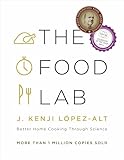
The book’s ambition is stated clearly in its title: not “great recipes” but “better home cooking through science.” Kenji’s goal is not to give you a thousand recipes to follow but to give you the understanding that allows you to cook without recipes — to know why high heat browns meat, why salt changes protein structure, why acid brightens flavours, and to use that understanding to cook anything.
Science as a Cooking Tool
The book’s most distinctive feature is its systematic application of the scientific method to cooking questions. Kenji doesn’t just say “pat your burger dry before searing” — he tells you that moisture on the surface creates steam that lowers the pan temperature below the Maillard reaction threshold, shows you the photographic evidence from his experiments, and explains the chemistry of why dryness creates better browning.
This approach is simultaneously more informative and more memorable than conventional recipe writing. The technique is explained; you understand why it works; you can apply it in any context.
The Content
The book covers American comfort food with depth unusual in cooking literature: burgers, steaks, fries, pasta, soups, salads, eggs, vegetables, pizza, and much more. Each section begins with a deep dive into the science and technique before presenting recipes that demonstrate it.
The egg chapter alone — covering every method of cooking eggs and the science behind each one — is worth substantial fractions of the cover price. The burger chapter has been cited as the definitive guide to making the best American burger at home.
Dry Brining
One example of Kenji’s transformative technique advice: dry brining (salting meat hours or days before cooking and leaving it uncovered in the refrigerator). This allows the salt to draw moisture to the surface, where it dissolves and creates a brine that is reabsorbed. The result is meat that is seasoned throughout, retains more moisture during cooking, and develops better browning — all from one technique applied in advance.
Myth-Busting as a Method
What distinguishes Kenji from a thousand other recipe writers is his MIT-trained skepticism toward received wisdom. He came to food from a science background — he studied at MIT and worked in biology labs before cooking professionally — and he treats kitchen folklore the way a researcher treats an untested hypothesis. The book systematically dismantles cherished myths: that searing meat “seals in the juices” (it doesn’t); that you must bring meat to room temperature before cooking (largely pointless); that adding oil to pasta water stops sticking (it doesn’t); that you should rinse mushrooms sparingly for fear of waterlogging (they barely absorb any). In place of tradition, Kenji offers controlled experiments, side-by-side photographs, and temperature data, and the cumulative effect is liberating: once you see the evidence, you stop cooking out of superstition and start cooking out of understanding.
The Range of the Reference
Across roughly 300 recipes and 960 pages, the book functions less like a cookbook than a hybrid reference text — closer to a textbook of everyday American cooking than to a collection of dishes. It opens with foundational chapters on heat, food safety, knife skills, and essential equipment before moving through eggs, soups, steaks, roasts, fried foods, pasta, and vegetables, each section anchored by the science before the recipes arrive. Crucially, Kenji insists on standard supermarket ingredients and ordinary home equipment; this is not aspirational restaurant cooking but the definitive version of the food people actually make. The egg chapter is a small masterpiece on its own, and the burger chapter is widely cited as the last word on the subject. The book’s reception matched its ambition: more than a million copies sold, a New York Times bestseller, and both the James Beard Award for General Cooking and the IACP Cookbook of the Year.
Honest Caveats
It is not a book for everyone or every meal. At 960 pages and nearly five pounds, it is a genuine physical and financial commitment, and its depth of explanation can exceed what a cook who simply wants dinner on the table is looking for. Its focus on American comfort food means whole world cuisines are underrepresented — a gap Kenji partly addressed in his later, equally rigorous The Wok. And a minority of readers find the relentless optimisation slightly joyless, preferring intuition to instrumentation. But these are quibbles about scope and temperament, not quality.
Final Verdict
The Food Lab is the most important cookbook published in the twenty-first century. More than a collection of recipes, it is an education in how cooking actually works — and once internalised, it makes you better at every dish, including the thousands not in the book. If you cook at home seriously, it will permanently expand what you are capable of.
More than a reference to consult, it is a teacher to learn from — the rare cookbook that, once read, leaves you needing it less, because it has handed you the principles to figure things out for yourself.
Our rating: 4.8/5 — The definitive home cooking reference. Essential for anyone who wants to cook with understanding rather than just follow instructions.
Frequently Asked Questions
What is "The Food Lab" about?
J. Kenji López-Alt's landmark culinary science book explains the science behind everyday cooking and provides hundreds of recipes built on tested, proven techniques.
Who should read "The Food Lab"?
Home cooks at any level who want to understand the science behind cooking and build genuine, transferable technique.
What are the key takeaways from "The Food Lab"?
Understanding why a technique works lets you adapt it to any ingredient or situation Maillard reaction (browning) is not the same as caramelisation — and knowing the difference changes everything Salting meat early (dry brining) dramatically improves both moisture retention and flavour The single most important thing in cooking eggs is controlling temperature The difference between a great burger and a mediocre one is almost entirely about technique, not ingredient quality
Is "The Food Lab" worth reading?
The most important cookbook of the twenty-first century. Kenji doesn't just give you recipes — he gives you the understanding to cook without recipes. A transformative book for anyone who cooks.
Ready to Read The Food Lab?
Check the current price on Amazon.
Check Price on Amazon (paid link)Prices and availability are subject to change. See Amazon for current price.
Review last updated: