Where to Start with Jordan B. Peterson: A Reading Guide
Where to start with Jordan B. Peterson — whether to begin with 12 Rules for Life or Beyond Order. A complete reading guide to the psychologist and cultural commentator.
By Lena Fischer

Jordan B. Peterson (born 1962) is the Canadian clinical psychologist, professor of psychology at the University of Toronto, and author whose YouTube lectures, podcast, and two bestselling books made him one of the most widely read non-fiction writers of the 2010s. 12 Rules for Life: An Antidote to Chaos (2018) sold over five million copies worldwide and established Peterson as a major cultural figure — celebrated by some as a vital voice against nihilism and postmodern relativism, criticised by others for his views on gender and identity. His work integrates clinical psychology, evolutionary biology, Jungian psychoanalysis, and comparative mythology into a framework for individual meaning and responsibility.
Where to Start: 12 Rules for Life (2018)
The essential Peterson — and the book that brought his ideas to a mainstream audience. Twelve rules, each developed at length through personal narrative, clinical case studies, and wide-ranging reference to mythology, literature, and neuroscience. The rules range from the concrete (‘Stand up straight with your shoulders back’) to the metaphysical (‘Pursue what is meaningful, not what is expedient’). Peterson’s central argument across all twelve: meaning and responsibility, not happiness or comfort, are the appropriate goals of a human life; suffering is inescapable and the question is what you do with it.
The book’s range is unusual. A discussion of why you should stand up straight begins with the neuroscience of dominance hierarchies in lobsters and ends with the Book of Genesis. A chapter about cleaning your room becomes an argument about why you should help yourself before trying to help the world. Peterson writes from clinical experience as well as theory — many of the examples come from patients he treated during decades of practice.
Peterson’s style is dense and allusive; readers who prefer direct argument over mythological elaboration may find the digressions excessive. Those who engage with the method will find a distinctive and occasionally brilliant way of reading ancient texts as psychological case studies.
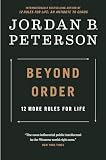
Beyond Order (2021)
The companion volume — twelve more rules, addressing the risks on the other side of the ledger. Where 12 Rules for Life emphasised the need for structure, responsibility, and resistance to chaos, Beyond Order addresses the dangers of excessive certainty, rigidity, and conformity. The argument: too much order is as dangerous as too little; creative disruption, voluntary sacrifice of current status, and engagement with what you don’t yet understand are necessary for genuine development. A worthwhile continuation, though slightly less focused than the first book.
Maps of Meaning (1999)
Peterson’s academic foundation — the densely argued book he spent thirteen years writing, drawing on Jungian psychology, evolutionary biology, cognitive neuroscience, and comparative mythology to argue that religious narratives are evolved psychological technologies for navigating the tension between the known and the unknown. Essential for readers who want the theoretical underpinning of the popular books; demanding and not designed for a general audience. Best read after both popular books.
Why 12 Rules for Life Is the Ideal First Book
For a reader new to Jordan B. Peterson, 12 Rules for Life is the ideal first book because it is his bestselling and most accessible work and the fullest popular expression of his ideas, blending psychology, mythology, and practical advice for living. 12 Rules for Life presents twelve principles for a meaningful and orderly life, each elaborated through a mixture of psychological insight, references to myth and religion, scientific argument, and personal reflection. As an entry point it is the natural place to begin, for it gathers Peterson’s central themes, the search for meaning, the confrontation with chaos and order, and the call to personal responsibility, into an accessible and widely read book. It welcomes the newcomer with its concrete rules, its wide-ranging argument, and its earnest seriousness, drawing the reader into his distinctive way of thinking. Readers will encounter ideas that have provoked both strong admiration and strong criticism, and are wise to engage with them thoughtfully and critically. For the newcomer, then, 12 Rules for Life is the natural starting point.
What to Expect as a New Reader
As a new reader, you can expect 12 Rules for Life to be a wide-ranging, earnest, and at times demanding book of psychological and philosophical self-help. You can expect twelve concrete rules, each used as a starting point for a far broader meditation. You can expect a blend of disciplines, for Peterson draws on clinical psychology, mythology, religion, literature, and science to build his arguments. You can expect central themes of meaning, responsibility, and the balance between order and chaos, which recur throughout. You can expect a serious, sometimes dense style that ranges well beyond conventional self-help. You can expect material that has been both widely praised and sharply criticized, and you are wise to read it thoughtfully and to weigh its claims critically rather than accepting them wholesale. Expect, in short, a wide-ranging, earnest, and demanding work of psychological self-help, an accessible but substantial introduction to Peterson’s ideas, best approached critically.
Going Deeper After Your First Book
Once 12 Rules for Life has introduced you to Peterson’s ideas, the reader who wishes to go deeper can explore his other work, while continuing to engage critically with claims that remain contested. His follow-up volume offers a further set of rules as a companion to the first, extending the same blend of psychology, myth, and practical advice, while his earlier and far more academic Maps of Meaning lays out the dense theoretical foundations of his thinking about myth, belief, and meaning. Reading these after 12 Rules for Life deepens your engagement with Peterson’s distinctive themes, the search for meaning, the psychology of order and chaos, and the emphasis on responsibility. As with the first book, thoughtful readers weigh his arguments critically rather than accepting them uncritically. Building your reading journey through Peterson is a matter of moving from 12 Rules for Life to its sequel and, for the ambitious, to Maps of Meaning. The reader who begins here and continues will encounter a widely discussed and controversial contemporary thinker.
Reading Jordan B. Peterson
Begin with 12 Rules for Life — it is the most accessible and most fully realised version of Peterson’s argument, and the book through which most readers encounter his work. Read Beyond Order as a direct continuation. Approach Maps of Meaning only if you want the full theoretical architecture from which the popular books derive.
Frequently Asked Questions
Where should I start with Jordan B. Peterson?
12 Rules for Life: An Antidote to Chaos (2018) is the essential starting point — Peterson's distillation of decades of clinical psychology, Jungian analysis, evolutionary biology, and religious mythology into twelve practical principles for living. The book became a global phenomenon, selling over five million copies, and established Peterson as one of the most widely read non-fiction authors of his generation. It is accessible without any background in psychology or philosophy; each rule is developed through a blend of personal anecdote, clinical case study, and wide-ranging reference.
What is the difference between 12 Rules for Life and Beyond Order?
12 Rules for Life is primarily about order — about establishing structure, taking responsibility, and resisting the nihilism that Peterson sees as the defining psychological pathology of the modern West. Its central metaphor is the lobster: creatures governed by status hierarchies as ancient as vertebrate life itself, whose biology illustrates why social hierarchy is not a cultural construct. Beyond Order (2021) is its complement — twelve more rules, this time about the dangers of excessive order, the necessity of creative disruption, and why we need to periodically venture beyond our established structures. The two books form a single argument about the balance between chaos and order.
What is Maps of Meaning about?
Maps of Meaning: The Architecture of Belief (1999) is Peterson's academic magnum opus — a dense, heavily researched argument that religious myths and narratives across cultures represent evolved psychological frameworks for navigating the tension between chaos and order. It draws on Jungian psychology, evolutionary psychology, neuroscience, and comparative mythology. Maps of Meaning is far more demanding than 12 Rules for Life and is written for an academic rather than general audience. It is the intellectual foundation for everything Peterson has written since; most readers are better served by starting with 12 Rules.
Is Peterson's writing controversial?
Peterson is one of the most controversial public intellectuals of the past decade. His views on gender, identity politics, and Jungian psychology have attracted both intense following and intense criticism. His books should be approached as works of applied psychology and personal philosophy — arguments about how individuals should orient themselves toward meaning, responsibility, and suffering — rather than as political manifestos (though his cultural commentary extends into political territory that many readers find contentious). The psychological and mythological content of his work is largely independent of his political positions.