Where to Start with Nir Eyal: A Reading Guide
Where to start with Nir Eyal — whether to begin with Hooked or Indistractable. A complete reading guide to the behavioural design author and former tech insider.
By Lena Fischer
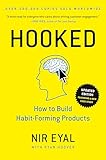
Nir Eyal is the Israeli-American author, behavioural designer, and former tech entrepreneur whose Hooked: How to Build Habit-Forming Products (2014) became the standard reference in Silicon Valley for product managers designing for habitual use — applying behavioural psychology to the mechanics of how apps, games, and platforms create compulsive engagement. His subsequent book, Indistractable (2019), addresses the same psychology from the user’s perspective, arguing for individual strategies to manage attention in a distraction-saturated environment.
Where to Start: Hooked (2014)
The essential Eyal for product designers and entrepreneurs — and one of the most widely cited frameworks in tech product development. The Hook Model describes the mechanism by which successful habit-forming products create cycles of use that become automatic:
Trigger — the prompt that initiates the behaviour (a notification, an email, or, ultimately, an internal state like boredom or loneliness).
Action — the simplest possible behaviour the user takes in anticipation of a reward (opening the app, scrolling, clicking).
Variable reward — the unpredictable payoff that keeps the behaviour interesting and the user returning (likes, new content, messages). Variable reward schedules — borrowed from operant conditioning — are more compelling than fixed rewards.
Investment — the user contribution that makes the product more valuable with use and raises the cost of leaving (stored data, social graph, content created, reputation built).
Each stage is built on research in psychology and behavioural economics; the framework is practical and specific. Eyal includes ethical guidelines and an honest acknowledgment of the manipulative potential of the model — the ‘Manipulation Matrix’ that distinguishes habit formation that serves users from exploitation.
For product managers, startup founders, or anyone trying to understand why certain products capture and retain attention, Hooked is the clearest available framework.
Indistractable (2019)
The self-help companion — managing your own attention against the systems Hooked describes. Timeboxing, internal trigger management, precommitment devices, and making external triggers work for rather than against you. Can be read independently; more useful with the context from Hooked.
Why Hooked Is the Ideal First Book
For a reader new to Nir Eyal, Hooked is the ideal first book because it is his breakthrough work and the fullest expression of his central subject, the psychology of habit-forming products and how they capture and hold our attention. Hooked presents Eyal’s influential model of how products create habits, the cycle of trigger, action, reward, and investment through which apps and services become woven into our daily routines, and it is the foundational work that established his reputation. As an entry point, it is ideal because it lays out this influential framework clearly and compellingly, drawing on psychology and real-world examples to explain how habit-forming products work, knowledge valuable both to those who build products and to those who wish to understand the technologies that shape their behavior. It welcomes the newcomer with its clear model, its engaging examples, and its immediately applicable insights. It is his best-known and most foundational book, the one that best represents his central subject, so that the new reader encounters Eyal’s core framework from the first. For the newcomer, then, Hooked is the natural and ideal starting point, the breakthrough book that explains the psychology of habit-forming products.
What to Expect as a New Reader
As a new reader, you can expect Hooked to be a clear, engaging, and practical book on the psychology of habit-forming products, explaining how apps and services capture and hold our attention through a repeatable model. You can expect Eyal’s influential framework, the cycle of trigger, action, variable reward, and investment through which products create habits, and you can expect this model to be explained clearly and illustrated with vivid real-world examples. You can expect insights valuable from two perspectives, both for those who build products and wish to create engaging experiences, and for those who wish to understand and perhaps resist the technologies designed to capture their attention. You can expect an accessible and practical style, grounded in psychology but oriented toward application. You can expect, in short, to come away understanding how habit-forming products work and why they are so effective at capturing attention. Expect a clear, engaging, and practical exploration of the psychology of habit-forming products, an immediately useful introduction to Eyal’s influential framework.
Going Deeper After Your First Book
Once Hooked has introduced you to the psychology of habit-forming products, the reader who wishes to go deeper can turn to Eyal’s other work, which addresses the other side of the attention question, how to take back control of one’s own focus in a world designed to distract. His subsequent work shifts from how products capture attention to how individuals can resist distraction and become more focused, masters of their own attention rather than its captives, offering practical strategies for reclaiming focus. Reading this after Hooked completes the picture, moving from understanding how products are designed to capture attention to learning how to take back control of one’s own. Together the two sides of Eyal’s work offer a complete understanding of the attention question, from the design of habit-forming products to the defense of one’s own focus. The reader who has understood how products capture attention in Hooked will find the complementary skill of reclaiming attention in his other work. Building your reading journey through Eyal’s work is a matter of moving from the psychology of habit-forming products to the practice of reclaiming one’s own focus. The reader who begins with Hooked and continues through his work will gain both an understanding of and a defense against the attention economy.
Reading Nir Eyal
Begin with Hooked if you build products or want to understand how engagement is designed; begin with Indistractable if you primarily want tools for protecting your own attention. Both are standalone and reward reading in either order.
For the full Nir Eyal bibliography, reviews, and biography, visit the Nir Eyal author page on Editors Reads.
Affiliate disclosure: Links to Amazon on this page are affiliate links. We earn a small commission at no extra cost to you.
Frequently Asked Questions
Where should I start with Nir Eyal?
The answer depends on your purpose. Hooked (2014) is the starting point for product designers, entrepreneurs, and anyone interested in how technology products create habitual use — Eyal's framework for building habit-forming products, widely used in Silicon Valley. Indistractable (2019) is the starting point for readers primarily interested in managing distraction and protecting their own attention — Eyal's self-help book about what he calls traction versus distraction. Both are standalone.
What is Hooked about?
Hooked presents the Hook Model — a four-stage framework for building habit-forming products: trigger (external or internal), action (the simplest behaviour in anticipation of a reward), variable reward (unpredictable rewards that keep users returning), and investment (user contributions that make the product better with use). The book draws on the psychology of habit formation, behavioural economics, and Eyal's experience in the gaming and advertising industries. Widely used in product management and startup culture; raises ethical questions Eyal addresses in the book and expanded on in subsequent work.
What is Indistractable about?
Indistractable (2019) is Eyal's self-help book on managing distraction in an era of attention-capturing technology. The central reframe is that distraction comes not from external technology but from internal discomfort — we use distraction to escape uncomfortable feelings. The solution is to manage internal triggers first, then use 'timeboxing' (scheduling all activities in advance), make external triggers work for you rather than against you, and build 'precommitment devices' that make distraction harder. Often read alongside Deep Work and Digital Minimalism.
Is there a tension between Hooked and Indistractable?
Eyal acknowledges the apparent contradiction between writing a manual for habit-forming product design (Hooked) and then writing a guide to resisting habit-forming products (Indistractable). His response is that ethical product design requires understanding how habits form; that Hooked includes a chapter on the ethics of manipulation; and that individual responsibility for managing technology use coexists with systemic responsibility for how products are designed. Some critics find this resolution unsatisfying; others find it honest.