Editors Reads Verdict
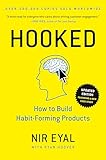
Hooked is one of the most honest and most ethically ambiguous books in technology product design — it explains, with clinical precision, exactly how consumer technology companies manufacture psychological dependency, a framework that has been used both by designers trying to build valuable products and by critics analyzing how those same products exploit users. Reading it creates the uncomfortable feeling of being simultaneously the designer and the designed.
What We Loved
- The Hook Model is elegantly simple and genuinely explanatory of how addictive technology works
- Eyal is unusually honest about the ethical implications of the techniques he describes
- The examples are specific and current rather than generic
- Useful both for building products and for understanding why you cannot stop using certain apps
Minor Drawbacks
- The ethical discussion is brief given the weight of what the techniques can do
- Eyal later wrote Indistractable partly as a corrective, which suggests the ethical issues are unresolved
- Some examples have dated quickly in a rapidly changing technology landscape
Key Takeaways
- → The Hook cycle: Trigger, Action, Variable Reward, Investment — drives user habit formation
- → Variable rewards are more compelling than fixed rewards because unpredictability drives engagement
- → Investment in a product (data, reputation, skills) increases the cost of leaving and returning users
- → Internal triggers (boredom, loneliness, anxiety) are more powerful drivers than external ones (notifications)
- → The most habit-forming products address genuine human needs, even if they do so in exploitative ways
| Author | Nir Eyal |
|---|---|
| Publisher | Portfolio |
| Pages | 256 |
| Published | November 4, 2014 |
| Language | English |
| Genre | Business, Technology, Psychology |
| Difficulty | Beginner |
| Best For | Product managers and designers building consumer technology, entrepreneurs seeking to understand habit formation, and anyone curious about the mechanisms behind social media's hold on attention. |
How Hooked Compares
Hooked at a glance against 3 similar books readers weigh alongside it.
| Book | Author | Rating | Best for |
|---|---|---|---|
| Hooked (this book) | Nir Eyal | ★ 4.2 | Product managers and designers building consumer technology, entrepreneurs |
| Deep Work | Cal Newport | ★ 4.7 | Knowledge workers, writers, programmers, academics, and anyone whose job |
| Indistractable | Nir Eyal | ★ 4.2 | Knowledge workers struggling with digital distraction, readers of Hooked who |
| Influence | Robert Cialdini | ★ 4.7 | Anyone who negotiates, sells, manages people, or simply wants to understand why |
The Architecture of Addiction
Hooked explains something most technology users already sense but cannot articulate: that the apps and services they return to compulsively are not accidents of design but the products of deliberate engineering. Nir Eyal’s Hook Model — Trigger, Action, Variable Reward, Investment — is the skeleton underneath Facebook, Instagram, TikTok, slot machines, and any other system designed to be used repeatedly without prompting.
The trigger initiates behavior: external triggers (a notification, an email) or internal triggers (the emotional state that makes you reach for your phone — boredom, anxiety, loneliness, FOMO). The action follows: the simplest behavior that satisfies the trigger, designed to require minimum friction. The variable reward is the cycle’s most psychologically important component — intermittent reinforcement, the same mechanism behind slot machines, where the unpredictability of the reward makes it more compelling than any fixed outcome would be. The investment phase — contributing data, following people, building a profile — increases the user’s stake and makes the next trigger more likely.
The Ethics Problem
Eyal addresses the ethical implications of his model in a brief final section, and the brevity is one of the book’s most revealing qualities. He distinguishes between “facilitators” (designers who use the Hook Model to solve genuine user problems), “peddlers” (who sell products they believe users want but don’t themselves use), and “dealers” (who build products they acknowledge are harmful). His answer to the ethics question is essentially: only build what you would use yourself.
This is insufficient, as Eyal himself appears to have recognized — his follow-up book Indistractable is partly a corrective, helping users resist the exact systems Hooked describes building.
What the Book Explains
Regardless of its ethics, Hooked is one of the most clarifying books about technology’s relationship to human psychology. Reading it, you will understand your own app behavior differently — the specific mechanisms that make scrolling feel compelling, the role of social validation in driving return visits, the way investment (your photos, your connections, your history) makes services feel indispensable.
That understanding is valuable whether you are building technology or trying to use it more intentionally.
Why Variable Rewards Are the Engine
If the Hook Model has a beating heart, it is the third phase — the variable reward — and Eyal is at his sharpest explaining why unpredictability is so much more compelling than reliability. A reward delivered on a fixed schedule quickly loses its grip; the brain habituates, anticipation fades, and the behavior weakens. A reward delivered unpredictably does the opposite, because the uncertainty itself becomes the draw, sustaining a state of anticipatory craving that a guaranteed payoff never produces. Eyal subdivides these rewards into three useful categories: rewards of the tribe (social validation — likes, comments, messages from other people), rewards of the hunt (the pursuit of material resources or information, the bottomless scroll that might surface something good), and rewards of the self (mastery, completion, the satisfaction of clearing a notification badge or finishing a level). Naming these categories is genuinely clarifying, because it lets a reader diagnose exactly which itch a given product is engineered to scratch — and recognize, in their own compulsive checking, the slot-machine logic operating beneath an ordinary-looking feed.
The Power of the Internal Trigger
The most strategically important idea in the book, and the one that separates durable products from forgettable ones, is Eyal’s distinction between external and internal triggers. A product that depends on external triggers — push notifications, emails, reminders — is renting attention and can be ignored or switched off. A product becomes genuinely habit-forming only when it attaches itself to an internal trigger, an emotion the user already feels many times a day. Boredom, loneliness, anxiety, uncertainty, and the fear of missing out are the raw fuel; the goal of the designer, in Eyal’s candid framing, is to become the automatic solution the user reaches for the instant one of those feelings arises. When checking the app becomes the reflexive response to a flicker of boredom, no notification is required at all — the user supplies their own trigger. This is the mechanism that turns a useful tool into a compulsion, and Eyal’s willingness to state it so plainly is exactly what makes the book both useful and unsettling.
The Compounding Value of Investment
The fourth phase, investment, is what gives the Hook Model its ratchet — the reason a habit deepens rather than simply repeating. Each time a user contributes something to a product — a photo uploaded, a connection followed, a playlist curated, a reputation earned, a preference taught to an algorithm — they increase the stored value that makes leaving costly and returning rewarding. Unlike a one-time purchase, this investment loads the next trigger: the more you put in, the better the service gets at serving you, and the more you stand to lose by going elsewhere. Eyal frames this as the antidote to fickleness; a product full of a user’s accumulated data, content, and social ties is one they will defend rather than abandon. It is also, he notes, why switching costs in modern software are psychological as much as technical. The investment phase explains the otherwise puzzling loyalty users feel toward platforms they actively dislike, and it completes the loop that the next internal trigger will start again.
Legacy and the Double-Edged Lesson
More than a decade after publication, Hooked occupies a strange and revealing place in the technology canon: it is read as eagerly by people trying to defend themselves against persuasive design as by those trying to deploy it. Eyal’s own trajectory captures the tension — having written the manual for building compulsive products, he spent his next book teaching readers to resist exactly those mechanisms, an arc that some critics read as an admission and others as opportunism. The book has also been criticized for treating the line between healthy habit and harmful addiction as more manageable than the subsequent decade of social-media research suggests. Yet none of this diminishes its explanatory power. Hooked remains the clearest available map of why modern software feels the way it does, and its real value may be inverted from its original purpose: in teaching anyone to see the trigger-action-reward-investment loop running beneath their daily scrolling, it hands users the literacy to interrupt it.
Our rating: 4.2/5 — An unusually honest and genuinely clarifying examination of how habit-forming products work, as valuable for users trying to understand their own behavior as for designers building for engagement.
Frequently Asked Questions
What is "Hooked" about?
Nir Eyal presents the Hook Model — a four-step framework for building habit-forming products used by technology companies to create user engagement.
Who should read "Hooked"?
Product managers and designers building consumer technology, entrepreneurs seeking to understand habit formation, and anyone curious about the mechanisms behind social media's hold on attention.
What are the key takeaways from "Hooked"?
The Hook cycle: Trigger, Action, Variable Reward, Investment — drives user habit formation Variable rewards are more compelling than fixed rewards because unpredictability drives engagement Investment in a product (data, reputation, skills) increases the cost of leaving and returning users Internal triggers (boredom, loneliness, anxiety) are more powerful drivers than external ones (notifications) The most habit-forming products address genuine human needs, even if they do so in exploitative ways
Is "Hooked" worth reading?
Hooked is one of the most honest and most ethically ambiguous books in technology product design — it explains, with clinical precision, exactly how consumer technology companies manufacture psychological dependency, a framework that has been used both by designers trying to build valuable products and by critics analyzing how those same products exploit users. Reading it creates the uncomfortable feeling of being simultaneously the designer and the designed.
Ready to Read Hooked?
Check the current price on Amazon.
Check Price on Amazon (paid link)Prices and availability are subject to change. See Amazon for current price.
Review last updated: