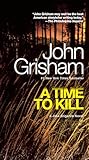
Editors Reads Verdict
Grisham's first novel remains, for many readers, his finest. A Time to Kill is a courtroom drama that refuses easy answers, embedding the murder trial of Carl Lee Hailey inside a richly realized small-town Southern community where racial wounds are still raw and justice is not reliably color-blind.
What We Loved
- A morally complex premise that the novel handles with genuine seriousness
- Ford County is one of the best-realized settings in American popular fiction
- The courtroom sequences are among the finest Grisham ever wrote
- Carl Lee Hailey is rendered with humanity and psychological depth
Minor Drawbacks
- At over 500 pages the novel is densely plotted and takes time to accelerate
- Some of the peripheral characters occasionally edge toward Southern-Gothic caricature
- The violence in the opening chapters is graphic and genuinely disturbing
Key Takeaways
- → Justice is not identical to law — the gap between them is where the most important cases live
- → Community and history shape verdicts as powerfully as evidence
- → The act of telling a story — how facts are arranged and framed — is itself a moral choice
- → Personal courage is the precondition of justice; without someone willing to stand in the gap, systems fail the vulnerable
| Author | John Grisham |
|---|---|
| Publisher | Doubleday |
| Pages | 515 |
| Published | June 1, 1989 |
| Language | English |
| Genre | Thriller, Legal Thriller, Fiction |
| Difficulty | Intermediate |
| Best For | Readers of literary legal fiction; anyone interested in race and justice in America; Grisham fans who want his most ambitious and morally serious work. |
How A Time to Kill Compares
A Time to Kill at a glance against 3 similar books readers weigh alongside it.
| Book | Author | Rating | Best for |
|---|---|---|---|
| A Time to Kill (this book) | John Grisham | ★ 4.5 | Readers of literary legal fiction |
| Big Little Lies | Liane Moriarty | ★ 4.3 | Readers who enjoy domestic fiction with comic elements and genuine depth, |
| Gone Girl | Gillian Flynn | ★ 4.2 | Readers who want their thrillers to also function as literary fiction and |
| The Da Vinci Code | Dan Brown | ★ 3.8 | Readers who want propulsive, puzzle-driven thrillers with art-historical and |
The Novel Grisham Had to Write
John Grisham wrote A Time to Kill before The Firm, before his commercial breakthrough, before the movies and the bestseller lists. He sold it himself, drove to book fairs, stacked copies in the trunks of cars. It was a modest failure by any commercial measure, and for years he could not persuade his publisher to reissue it. When The Firm made him famous, readers went searching for what came before — and they found a novel that many of them considered better than the thing that made him a star.
The setup is one of the most morally charged in American popular fiction. Tonya Hailey, age ten, is abducted, raped, and nearly killed by two white men in rural Ford County, Mississippi. Her father, Carl Lee Hailey, shoots them dead in the courthouse before they can be arraigned. He is charged with murder. The question of whether he deserves to walk free — and what “deserving” means in a society whose institutions have historically failed Black families with systematic thoroughness — is the engine the novel runs on.
Jake Brigance and the Weight of Courage
The novel’s lawyer-protagonist, Jake Brigance, is one of Grisham’s finest creations. He is young, imperfectly brave, and possessed of more ambition than wisdom — but he understands, from the moment he agrees to take Carl Lee’s case, that he is putting his career, his safety, and ultimately his family’s safety on the line. The Ku Klux Klan burns his house down. His secretary is maimed by a bomb. The threat is not abstract.
Grisham is careful not to turn Jake into a saint. He makes mistakes, pursues the case partly for the publicity it generates, and sometimes navigates the racial politics of Mississippi more for personal survival than moral clarity. This ambivalence makes him believable in ways that perfectly virtuous heroes never are.
Ford County as a Character
What elevates A Time to Kill above the standard courtroom thriller is Grisham’s deep immersion in the community surrounding the trial. Ford County, Mississippi — a fictional county that Grisham would return to again and again — feels fully inhabited. The black church networks, the old-money white establishment, the local bar, the law enforcement culture: all of it is rendered with the specificity of someone who understood this world from the inside.
The racial geography is rendered without sentimentality. The novel does not pretend that goodwill alone can dissolve structures of prejudice that have calcified over generations. It asks, instead, what it takes for justice to penetrate those structures — and the answer is costly.
The Closing Argument
Without spoiling the novel’s most celebrated sequence, Grisham’s climactic courtroom scene — a closing argument that remains among the most discussed in popular legal fiction — achieves something that purely procedural thrillers rarely manage: it becomes a meditation on empathy as a legal and moral instrument, on what it means to ask twelve people to imagine themselves into a reality they have spent their lives avoiding.
Our rating: 4.5/5 — Grisham’s most morally serious novel, A Time to Kill is a masterwork of legal fiction that asks hard questions about race, justice, and courage in America — and refuses comfortable answers.
Reading Guides
- John Grisham Books in Order: The Complete Reading Guide (2026)
- John Grisham Books Ranked: Best Legal Thrillers to Read First (2026)
The Publishing History
A Time to Kill was John Grisham’s first novel, written between 1984 and 1987 while he was practicing law and serving in the Mississippi state legislature. It was rejected by dozens of agents and publishers before being accepted by a small press, Wynwood Press, which printed 5,000 copies. Grisham bought 1,000 of them himself and spent months selling them at events around Mississippi. It was, by any commercial measure, a failure.
When The Firm became a phenomenon in 1991, readers went looking for what Grisham had written before. A Time to Kill was reissued and quickly became a bestseller in its own right. It has since sold millions of copies and is consistently rated by Grisham’s readers as his finest novel — a judgement that Grisham himself has sometimes endorsed.
The novel was adapted into a film in 1996, directed by Joel Schumacher and starring Matthew McConaughey as Jake Brigance, Samuel L. Jackson as Carl Lee Hailey, and Sandra Bullock, Kevin Spacey, and Oliver Platt in supporting roles. The film was a significant commercial success.
The Racial Politics of Ford County
A Time to Kill is set in 1984, not 1964 — and Grisham is careful about the distinction. The racial dynamics of Ford County are not those of the Jim Crow era but of the generation that followed desegregation: legally transformed, culturally unresolved, still operating on the informal hierarchies that explicit law could never fully reach. The KKK that mobilises around Carl Lee Hailey’s trial is not anachronism but continuity.
Grisham, born in Arkansas in 1955 and raised in Mississippi, grew up inside the world he depicts. The novel does not use racial injustice as exotic local colour. It treats it as the central fact of life in a particular American place, around which all other social and legal institutions have been organised. Carl Lee Hailey’s decision to kill the men who raped his daughter is inseparable from his assessment of what the Mississippi justice system would do if he left the matter to them.
Jake Brigance’s Return
A Time to Kill launched a universe that Grisham would return to across three subsequent decades. Jake Brigance reappeared in Sycamore Row (2013) and A Time for Mercy (2020). Ford County itself has accumulated a body of short fiction, collected in Ford County (2009). The accumulated depth of this fictional geography — the product of thirty years of intermittent return — gives the original novel a retrospective significance it did not have when it was first published.
Frequently Asked Questions
What is "A Time to Kill" about?
In Ford County, Mississippi, a Black father kills the two men who brutally raped his ten-year-old daughter — and the young lawyer Jake Brigance must defend him before a white jury in the Deep South.
Who should read "A Time to Kill"?
Readers of literary legal fiction; anyone interested in race and justice in America; Grisham fans who want his most ambitious and morally serious work.
What are the key takeaways from "A Time to Kill"?
Justice is not identical to law — the gap between them is where the most important cases live Community and history shape verdicts as powerfully as evidence The act of telling a story — how facts are arranged and framed — is itself a moral choice Personal courage is the precondition of justice; without someone willing to stand in the gap, systems fail the vulnerable
Is "A Time to Kill" worth reading?
Grisham's first novel remains, for many readers, his finest. A Time to Kill is a courtroom drama that refuses easy answers, embedding the murder trial of Carl Lee Hailey inside a richly realized small-town Southern community where racial wounds are still raw and justice is not reliably color-blind.
Ready to Read A Time to Kill?
Check the current price on Amazon.
Check Price on Amazon (paid link)Prices and availability are subject to change. See Amazon for current price.
Review last updated: