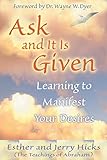
Editors Reads Verdict
Ask and It Is Given is the foundational text of the modern law of attraction movement — a spiritual framework for aligning thought, feeling, and action that has influenced millions, and whose practical tools have genuine psychological merit regardless of the metaphysical claims.
What We Loved
- The Emotional Guidance Scale is a genuinely useful practical tool
- The emphasis on emotional alignment before action has sound psychological grounding
- The 22 processes in the second half provide concrete, varied practices
- The writing is unusually warm and non-judgmental
Minor Drawbacks
- The channelling framework — Abraham as entities — requires significant belief to accept literally
- The law of attraction as a literal mechanism lacks scientific support
- Can be used to blame people for circumstances genuinely outside their control
Key Takeaways
- → The Emotional Guidance Scale — from depression to joy — provides a framework for understanding and improving emotional state
- → Feeling better incrementally is more sustainable than trying to jump immediately from negative to positive
- → Resistance — the habitual patterns of thought that contradict what you want — is the primary obstacle to change
- → Appreciation and gratitude are not platitudes but genuine state-changers with measurable effects
- → The focus of this work is emotional alignment, which has merit regardless of the metaphysical framework
| Author | Esther Hicks and Jerry Hicks |
|---|---|
| Publisher | Hay House |
| Pages | 336 |
| Published | October 1, 2004 |
| Language | English |
| Genre | Self-Help, Spirituality |
| Difficulty | Beginner |
| Best For | Readers drawn to spiritual self-help, the law of attraction, and emotional wellbeing practices — particularly those open to a non-mainstream spiritual framework. |
How Ask and It Is Given Compares
Ask and It Is Given at a glance against 3 similar books readers weigh alongside it.
| Book | Author | Rating | Best for |
|---|---|---|---|
| Ask and It Is Given (this book) | Esther Hicks and Jerry Hicks | ★ 4.2 | Readers drawn to spiritual self-help, the law of attraction, and emotional |
| Letting Go | David R. Hawkins | ★ 4.5 | Readers seeking practical tools for emotional regulation and healing — |
| The Seat of the Soul | Gary Zukav | ★ 4.3 | Spiritually oriented readers interested in a serious, intellectually structured |
| You Can Heal Your Life | Louise Hay | ★ 4.3 | Readers open to a mind-body-spirit framework who are seeking tools for |
The Abraham Teachings
Ask and It Is Given presents teachings that Esther Hicks describes as channelled from a group of non-physical entities called Abraham. The framework — which Esther and Jerry Hicks have developed across dozens of books and hundreds of workshops — is one of the most influential in contemporary spirituality, providing the philosophical foundation for The Secret (2006) and the modern law of attraction movement.
The core claim is that the universe operates on the principle of attraction: thoughts and emotions that you consistently hold attract corresponding experiences. What you focus on expands. And the key to directing this principle is emotional alignment — choosing thoughts and perspectives that shift your emotional state toward wellbeing, which then creates the conditions for desired experiences to manifest.
The Phenomenon Behind the Book
It is worth understanding where these teachings come from, because the framing is unusual even by the standards of spiritual self-help. Esther Hicks presents the material not as her own but as dictated by “Abraham,” which she describes as a collective of non-physical entities she channels in a meditative state — a practice she developed with her late husband and co-author, Jerry Hicks. Together they built one of the most commercially successful operations in modern spirituality, spanning dozens of books, audio programs, and sold-out workshops staged around the world. The reach extends far beyond their own audience: the Hickses’ ideas, and Esther herself, were central to Rhonda Byrne’s blockbuster The Secret (2006), which carried law-of-attraction thinking into the global mainstream. Whatever one concludes about the channelling conceit, Ask and It Is Given is the closest thing the movement has to a foundational text, which is reason enough to read it critically rather than dismiss it unread.
The Emotional Guidance Scale
The book’s most practically useful contribution, regardless of how you feel about the metaphysical framework, is the Emotional Guidance Scale. Hicks identifies a spectrum of emotional states from depression and powerlessness at the bottom, through various intermediate states, to joy, appreciation, and freedom at the top.
The insight — which has genuine psychological grounding independent of the law of attraction — is that you cannot jump from profound negativity to joy in a single step. But you can move incrementally: from depression toward anger (which is actually an improvement), from anger toward frustration, from frustration toward hope. The goal is not immediate positivity but consistent incremental movement up the scale.
The Twenty-Two Processes
The second half of the book provides twenty-two concrete exercises for improving emotional state and clarifying desired outcomes. These range from visualisation practices to appreciation journals to mental scripting, with names like the “Rampage of Appreciation,” “Pivoting,” and “Scripting.” The premise running through all of them is that emotions are a kind of guidance system — an indicator of how aligned your thinking is with what the Hickses call Source Energy — and that by deliberately reaching for slightly better-feeling thoughts you raise your “vibration” and, the book claims, draw matching experiences toward you. Whatever one makes of the cosmology, the exercises themselves function as accessible tools for mood regulation, reframing, and gratitude.
The Law of Attraction and Its Critics
It would be dishonest to review this book without taking its problems seriously, because they are substantial. The central claim — that thoughts and feelings literally attract corresponding events — has no empirical support; despite decades of popularity, no rigorous evidence has ever demonstrated that “vibration” summons money, health, or love. More troubling is the moral logic the framework implies. If you attract everything you experience, then victims of illness, poverty, abuse, and disaster have, on some level, attracted their own suffering — a conclusion the Abraham-Hicks material has at times stated with startling callousness, and one that critics rightly identify as both cruel and false. Psychologists also warn that the relentless emphasis on feeling good can become “spiritual bypassing”: a way of denying, suppressing, or escaping genuine grief, anger, and injustice rather than processing them. And the channelling conceit — that “Abraham” is a collective of non-physical entities speaking through Esther Hicks — asks for a leap of faith that many readers simply cannot make.
What Survives the Skepticism
Strip away the metaphysics, though, and a useful psychological core remains. The Emotional Guidance Scale is essentially a model of incremental mood improvement, and its key insight — that you cannot leap from despair to joy, but you can climb one rung at a time — aligns well with what therapists know about emotional regulation and cognitive reframing. The practices of appreciation, deliberate attention, and noticing the stories that fuel distress have real, evidence-backed benefits, whatever you believe about their cosmic effects. Read critically — as a toolkit for managing your inner state rather than a literal user’s manual for the universe — Ask and It Is Given can genuinely help some readers feel and function better. Read literally, it risks self-blame and magical thinking.
Verdict
Ask and It Is Given is the foundational text of the modern law of attraction movement and the philosophical wellspring behind The Secret. Its warmth, its non-judgmental tone, and its concrete emotional tools explain its enormous influence, and the emotional-alignment material has genuine merit. But its core mechanism is unproven, its implications can shade into victim-blaming, and its channelled framing demands a credulity many will not extend. Take the practical psychology, leave the cosmic guarantees, and keep your critical faculties switched on.
Our rating: 4.2/5 — Influential and warmly written, with genuinely useful emotional tools wrapped around an unproven and sometimes troubling metaphysics — best read for the psychology, not the physics.
Frequently Asked Questions
What is "Ask and It Is Given" about?
Esther and Jerry Hicks present the teachings of Abraham — a group of spiritual entities — on the law of attraction and how to align with what you desire.
Who should read "Ask and It Is Given"?
Readers drawn to spiritual self-help, the law of attraction, and emotional wellbeing practices — particularly those open to a non-mainstream spiritual framework.
What are the key takeaways from "Ask and It Is Given"?
The Emotional Guidance Scale — from depression to joy — provides a framework for understanding and improving emotional state Feeling better incrementally is more sustainable than trying to jump immediately from negative to positive Resistance — the habitual patterns of thought that contradict what you want — is the primary obstacle to change Appreciation and gratitude are not platitudes but genuine state-changers with measurable effects The focus of this work is emotional alignment, which has merit regardless of the metaphysical framework
Is "Ask and It Is Given" worth reading?
Ask and It Is Given is the foundational text of the modern law of attraction movement — a spiritual framework for aligning thought, feeling, and action that has influenced millions, and whose practical tools have genuine psychological merit regardless of the metaphysical claims.
Ready to Read Ask and It Is Given?
Check the current price on Amazon.
Check Price on Amazon (paid link)Prices and availability are subject to change. See Amazon for current price.
Review last updated: