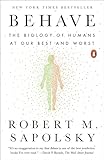
Editors Reads Verdict
Sapolsky's magnum opus is the most comprehensive scientific account of human behaviour ever written for a general audience. Challenging but extraordinarily rewarding — a book that permanently expands how you think about the causes of action.
What We Loved
- The most comprehensive synthesis of behaviour science available for general readers
- Sapolsky's wit and self-deprecating humour make 800 pages genuinely readable
- The time-scale framework (seconds to evolutionary history) is a masterly organising device
- Deeply humane despite being entirely biological in its explanations
Minor Drawbacks
- 800 pages is a serious commitment
- The neuroscience sections require patient reading for non-specialists
- Some chapters are significantly denser than others
Key Takeaways
- → Human behaviour has causes operating across multiple time scales simultaneously
- → Us/them distinctions are biologically wired but culturally malleable
- → The adolescent brain is genuinely different in ways that explain (not excuse) adolescent behaviour
- → Free will is more complicated than our intuitions suggest — biology shapes every decision
- → Understanding the biological causes of behaviour is a path to compassion, not fatalism
| Author | Robert M. Sapolsky |
|---|---|
| Publisher | Penguin Books |
| Pages | 800 |
| Published | May 2, 2017 |
| Language | English |
| Genre | Science, Psychology, Biology |
| Difficulty | Advanced |
| Best For | Intellectually ambitious readers interested in the biological foundations of human behaviour, violence, morality, and social life. |
How Behave Compares
Behave at a glance against 3 similar books readers weigh alongside it.
| Book | Author | Rating | Best for |
|---|---|---|---|
| Behave (this book) | Robert M. Sapolsky | ★ 4.6 | Intellectually ambitious readers interested in the biological foundations of |
| Emotional Intelligence | Daniel Goleman | ★ 4.4 | Parents, educators, managers, and anyone interested in understanding the |
| The Gene | Siddhartha Mukherjee | ★ 4.6 | Anyone interested in biology, the history of genetics, and the ethical |
| The Selfish Gene | Richard Dawkins | ★ 4.5 | Anyone with intellectual curiosity about evolution, genetics, and the nature of |
The Most Ambitious Book on Human Behaviour Ever Written
Robert Sapolsky is a neuroendocrinologist at Stanford who spent decades studying baboons in Kenya and teaching the biology of human behaviour. Behave is the culmination of that career: an 800-page synthesis of neuroscience, endocrinology, evolutionary biology, developmental psychology, anthropology, and primatology, all organised around a single organising question: what causes human behaviour?
The book’s structural genius is its temporal framework. Sapolsky begins by examining the biology operating one second before a behaviour — the neural firing in the prefrontal cortex. Then one minute before — the hormonal context. Then days before — hormonal fluctuations. Then years before — adolescent development. Then decades before — childhood environment. Then centuries before — cultural evolution. Then millennia before — genetic evolution. This concentric structure demonstrates that every behaviour has causes at every time scale simultaneously, and that the reductive argument — “it was the testosterone” or “it was the childhood trauma” — is always incomplete.
The Us/Them Brain
Among the book’s most important themes is the biology of in-group/out-group thinking. Sapolsky documents the speed and automaticity with which the brain categorises people as “us” or “them” — within milliseconds of visual processing, the amygdala responds differently to faces perceived as outgroup members. This is not a choice or a character flaw; it is a deeply wired survival mechanism.
But Sapolsky’s crucial observation is that the categories used to define us and them are culturally constructed and malleable. The same biological hardware that drove tribal violence can be reprogrammed by culture, shared identity, and contact. This is simultaneously sobering (the hardware is real) and hopeful (the software is changeable).
The Adolescent Brain
The chapter on adolescent neuroscience is one of the book’s most practically valuable. Sapolsky demonstrates that the adolescent brain is genuinely different from both childhood and adult brains — not yet fully myelinated in the prefrontal cortex, hypersensitive to peer evaluation, and primed for risk-taking. Understanding this biology doesn’t excuse adolescent behaviour but it profoundly changes how it should be responded to.
Biology and Moral Responsibility
The book’s deepest philosophical thread concerns the implications of biological determinism for moral responsibility. If behaviour is ultimately the product of genes, hormones, childhood environment, and evolutionary history — all factors over which individuals have no choice — what does “responsibility” mean? Sapolsky argues this question is genuinely complicated and that our intuitions about free will deserve scrutiny.
Sapolsky’s Career and Companion Works
Behave is best understood as the summation of an unusually wide-ranging scientific life. Robert Sapolsky spent more than thirty years studying wild baboons in Kenya, work he chronicled in the acclaimed memoir A Primate’s Memoir, and that fieldwork informs the book’s primatology and its insights into social hierarchy and stress. He is also the author of Why Zebras Don’t Get Ulcers, a landmark popular account of how chronic stress damages the body, and the long-time teacher of a celebrated Stanford course on human behavioural biology whose recorded lectures circulate widely online. Behave effectively distils decades of that teaching into a single volume, which is part of why it manages to be both encyclopaedic and genuinely pedagogical — Sapolsky has spent his career figuring out how to make this material land for non-specialists.
Readers drawn to Behave should know that Sapolsky later took the book’s central provocation to its logical conclusion in Determined, a sustained argument against the existence of free will. Behave raises that question and treats it as genuinely open; Determined answers it. Reading them in sequence shows a thinker following his own evidence toward an uncomfortable destination, and the earlier book is the more balanced and capacious of the two.
Why the Time-Scale Structure Matters
The organising device of Behave — moving outward from the second before an action to the millions of years of evolution behind it — is more than a clever framing; it is the book’s central argument made structural. By the time the reader has travelled through neurons, hormones, development, culture, and genes, the lesson is inescapable: no single cause ever explains a behaviour, and any account that stops at one level is a distortion. This is Sapolsky’s quiet polemic against reductionism in all its popular forms, whether the gene-for-everything determinism of pop genetics or the it’s-all-childhood determinism of pop psychology. Every behaviour, he insists, is overdetermined, the product of causes layered across every time scale at once.
Who Should Read It and How to Approach It
This is a book for intellectually ambitious readers willing to treat 800 pages as a course rather than a casual read. Sapolsky helpfully signposts which chapters can be skimmed by those who already know their neuroscience and which contain the conceptual payoffs, and the book is genuinely navigable in sections. The wit and digressive footnotes keep the density humane, but the neuroscience chapters in particular reward slow, patient reading. Anyone interested in violence, morality, empathy, or the perennial nature-versus-nurture debate will find their thinking permanently altered, and the book pairs naturally with broad-canvas works like The Selfish Gene and The Gene for readers building a fuller picture of human biology. Approached with patience, it is among the most rewarding science books a general reader can undertake, and one of the few that genuinely lives up to the ambition implied by its subtitle — to account for humans at both our best and our worst within a single, coherent biological frame.
Final Verdict
Behave is demanding and extraordinary. For readers willing to invest the time, it permanently expands the explanatory framework you bring to understanding why people do what they do.
Our rating: 4.6/5 — One of the most important science books of the decade. Dense, essential, and humane.
Frequently Asked Questions
What is "Behave" about?
A comprehensive exploration of the biological underpinnings of human behaviour — from the neural firing a second before an act to the evolutionary pressures that shaped our species over millions of years.
Who should read "Behave"?
Intellectually ambitious readers interested in the biological foundations of human behaviour, violence, morality, and social life.
What are the key takeaways from "Behave"?
Human behaviour has causes operating across multiple time scales simultaneously Us/them distinctions are biologically wired but culturally malleable The adolescent brain is genuinely different in ways that explain (not excuse) adolescent behaviour Free will is more complicated than our intuitions suggest — biology shapes every decision Understanding the biological causes of behaviour is a path to compassion, not fatalism
Is "Behave" worth reading?
Sapolsky's magnum opus is the most comprehensive scientific account of human behaviour ever written for a general audience. Challenging but extraordinarily rewarding — a book that permanently expands how you think about the causes of action.
Ready to Read Behave?
Check the current price on Amazon.
Check Price on Amazon (paid link)Prices and availability are subject to change. See Amazon for current price.
Review last updated: