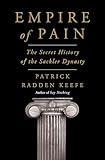
Editors Reads Verdict
Keefe's most ambitious book is a sweeping, devastating account of how one family's relentless ambition and carefully maintained respectability enabled a public health catastrophe. Essential reading for understanding modern American institutions.
What We Loved
- Extraordinary reporting across three generations of the Sackler family
- Makes the mechanisms of pharmaceutical corruption clear and specific
- The philanthropy chapters are particularly chilling — generosity as reputation laundering
- National Book Critics Circle Award winner
Minor Drawbacks
- The sheer volume of family members and business entities can overwhelm
- Keefe's inability to interview Sackler family members limits some perspectives
- The moral verdict is so clear that the book's tension is structural rather than analytical
Key Takeaways
- → OxyContin was marketed with deliberate misrepresentation of its addiction risk
- → Purdue Pharma's aggressive sales tactics pioneered techniques later used across the pharmaceutical industry
- → The Sacklers' philanthropy was inseparable from their efforts to manage their reputation
- → Regulatory capture allowed Purdue to operate with minimal effective oversight for decades
- → Over 500,000 Americans died from opioid overdoses in the two decades after OxyContin's launch
| Author | Patrick Radden Keefe |
|---|---|
| Publisher | Doubleday |
| Pages | 560 |
| Published | April 13, 2021 |
| Language | English |
| Genre | History, True Crime, Journalism |
| Difficulty | Intermediate |
| Best For | Anyone seeking to understand the opioid crisis, corporate accountability failures, or the mechanisms by which wealth and philanthropy insulate wrongdoers from consequences. |
How Empire of Pain Compares
Empire of Pain at a glance against 3 similar books readers weigh alongside it.
| Book | Author | Rating | Best for |
|---|---|---|---|
| Empire of Pain (this book) | Patrick Radden Keefe | ★ 4.8 | Anyone seeking to understand the opioid crisis, corporate accountability |
| Caste | Isabel Wilkerson | ★ 4.7 | Anyone seeking to understand the structural foundations of racial inequality in |
| Say Nothing | Patrick Radden Keefe | ★ 4.8 | Anyone interested in the Troubles, political violence, narrative nonfiction |
| The Warmth of Other Suns | Isabel Wilkerson | ★ 4.8 | Anyone seeking to understand the full scope of African American history and the |
Three Generations of Ambition
Patrick Radden Keefe opens Empire of Pain in the early twentieth century, with Arthur Sackler — the brilliant, driven physician and advertising genius who, more than anyone, invented the modern pharmaceutical marketing industry. It was Arthur who turned the sober selling of medicine into a science of persuasion, most famously in the blockbuster campaign for the tranquiliser Valium, pioneering the practice of marketing directly to physicians through journals, gifts, and an army of sales representatives. His relentless ambition, his genius for promotion, and his slippery moral universe set the template for everything that follows across three generations and the families of his two younger brothers, Mortimer and Raymond.
The book then traces how the Sacklers, through their company Purdue, launched OxyContin in 1996 and over the next two decades deployed the very marketing infrastructure Arthur had perfected — aggressive sales incentives, misleading claims about addiction risk, and the systematic cultivation of doctors — to create and perpetuate an opioid crisis that would kill hundreds of thousands of Americans. One of Keefe’s quiet, damning ironies is that Arthur died before OxyContin existed, yet the catastrophe was, in every meaningful sense, built with his tools.
The OxyContin Launch
Keefe’s account of OxyContin’s launch is the most important section of the book. Purdue marketed OxyContin as a revolutionary painkiller whose sustained-release formulation made it substantially less addictive than other opioids. This claim was not well-supported by evidence — and Purdue’s own researchers had data suggesting it was false. The FDA approved it based on a single small study. Sales representatives were given financial incentives to encourage prescription of the highest doses.
The result — which Purdue’s leadership was aware of much earlier than they acknowledged — was a wave of addiction and overdose deaths that spread outward from Appalachian and Rust Belt communities where OxyContin had been most aggressively promoted, eventually becoming a national catastrophe. A central deception was the drug’s promised twelve-hour duration: when the relief wore off early, patients were told to take higher doses rather than dose more often, a recommendation that intensified both the high and the dependency. More than 500,000 Americans would die of opioid overdoses in the two decades after the drug’s launch, and Keefe never lets the reader lose sight of the human wreckage behind the corporate maneuvering — the patients, families, and towns hollowed out while the fortune compounded.
Philanthropy as Reputation Management
One of the book’s most revealing threads concerns the Sacklers’ philanthropic activity: the museums, universities, and cultural institutions that bear the Sackler name. Keefe demonstrates, with documentary evidence, that the family was acutely aware of the reputational risks their business created, and that their philanthropic strategy was explicitly designed to insulate them from accountability.
The spectacle of art institutions debating whether to remove the Sackler name from their walls — while the opioid crisis continued to escalate — illuminates the complex relationship between elite philanthropy and corporate accountability in American society. Keefe traces how the artist Nan Goldin, herself a recovered OxyContin addict, mobilised protests inside the Met, the Guggenheim, and other temples of culture, and how, one by one, the Met, the Louvre, the Tate, and other institutions finally stripped the once-coveted name from their galleries.
The Reckoning — and the Escape
The book’s final movement is, in many ways, its most infuriating. As lawsuits multiplied and the evidence of Purdue’s conduct became undeniable, the Sacklers executed a legal strategy of extraordinary cynicism: they drained billions from the company in the years before steering Purdue into bankruptcy, then used that bankruptcy to shield their personal fortunes and seek sweeping immunity from civil claims — all without admitting wrongdoing or, for years, facing any personal financial consequence. Keefe lays out the mechanics of this manoeuvre with cold precision, and it stands as the book’s central indictment not just of a family but of a legal and regulatory system that allowed enormous wealth to purchase a kind of impunity.
Keefe as Storyteller
Much of the book’s power comes from Keefe’s craft. The author of Say Nothing, he is a master of narrative nonfiction, and he marshals a vast cast of family members, executives, lawyers, and regulators into a propulsive, novelistic story without ever sacrificing rigour. Notably, no member of the Sackler family agreed to be interviewed, and the family disputed the book — yet Keefe builds his account from depositions, internal documents, and court records so thoroughly that the absence of their voices becomes its own kind of evidence. The result won the National Book Critics Circle Award and confirmed Keefe as one of the finest investigative writers working today.
Final Verdict
Empire of Pain is a landmark work of investigative journalism. Keefe spent years reporting it, and the result is the definitive account of one of the most consequential corporate-crime stories in American history — a chronicle of how ambition, marketing genius, and carefully purchased respectability combined to fuel a public-health disaster, and of how rarely such wealth is ever truly held to account.
For readers it grips — and it grips hard — the natural companions are Keefe’s own Say Nothing and Beth Macy’s Dopesick, but Empire of Pain remains the essential account of the family at the centre of it all. It is a hard, necessary book about wealth, power, and consequence, and it lingers long after the final page.
Our rating: 4.8/5 — Essential reading. Devastating, meticulously reported, and important for understanding American institutions.
Reading Guides
Frequently Asked Questions
What is "Empire of Pain" about?
The definitive account of the Sackler family, the pharmaceutical dynasty behind OxyContin, and their role in creating and perpetuating the opioid crisis.
Who should read "Empire of Pain"?
Anyone seeking to understand the opioid crisis, corporate accountability failures, or the mechanisms by which wealth and philanthropy insulate wrongdoers from consequences.
What are the key takeaways from "Empire of Pain"?
OxyContin was marketed with deliberate misrepresentation of its addiction risk Purdue Pharma's aggressive sales tactics pioneered techniques later used across the pharmaceutical industry The Sacklers' philanthropy was inseparable from their efforts to manage their reputation Regulatory capture allowed Purdue to operate with minimal effective oversight for decades Over 500,000 Americans died from opioid overdoses in the two decades after OxyContin's launch
Is "Empire of Pain" worth reading?
Keefe's most ambitious book is a sweeping, devastating account of how one family's relentless ambition and carefully maintained respectability enabled a public health catastrophe. Essential reading for understanding modern American institutions.
Ready to Read Empire of Pain?
Check the current price on Amazon.
Check Price on Amazon (paid link)Prices and availability are subject to change. See Amazon for current price.
Review last updated: