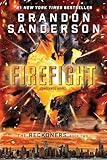
Editors Reads Verdict
Firefight improves on Steelheart's formula by deepening the philosophical question at the series' core: if power corrupts every Epic, why? The flooded Manhattan setting is more atmospherically interesting than Newcago, and the introduction of Megan's storyline adds genuine emotional complexity to what could have been a straightforward sequel.
What We Loved
- Babylon Restored is a richer, more visually distinctive setting than Newcago
- The question of Epic psychology — why corruption is universal — is developed with real depth
- Megan's storyline adds emotional stakes that the series needed
- The action sequences in a flooded city are some of Sanderson's most inventive choreography
Minor Drawbacks
- Some middle-book pacing issues slow the momentum established in Steelheart
- Secondary Reckoners remain underdeveloped relative to the main cast
- The villain's master plan becomes clear too early
Key Takeaways
- → The most interesting questions in a series are introduced when the central premise is challenged rather than confirmed
- → Settings that reflect thematic content — flooding as loss of control — do narrative work without being heavy-handed
- → Romantic relationships in YA work best when the love interest challenges the protagonist's core assumptions
- → Why corruption happens matters as much as the fact that it happens
- → Hope for individual exceptions doesn't require abandoning the systemic analysis
| Author | Brandon Sanderson |
|---|---|
| Publisher | Delacorte Press |
| Pages | 416 |
| Published | January 6, 2015 |
| Language | English |
| Genre | Science Fiction, Fantasy, Young Adult |
| Difficulty | Beginner |
| Best For | Readers of Steelheart continuing the series; YA readers who want action with genuine philosophical content; fans of the superhero genre interested in its darker possibilities. |
How Firefight Compares
Firefight at a glance against 3 similar books readers weigh alongside it.
| Book | Author | Rating | Best for |
|---|---|---|---|
| Firefight (this book) | Brandon Sanderson | ★ 4.3 | Readers of Steelheart continuing the series |
| Calamity | Brandon Sanderson | ★ 4.2 | Reckoners series readers completing the trilogy |
| Ender's Game | Orson Scott Card | ★ 4.7 | Science fiction readers from teenage years upward, fans of military fiction who |
| Steelheart | Brandon Sanderson | ★ 4.3 | YA readers who enjoy action-driven plots with clever world-building |
Babylon Restored
The city-as-character principle that made Newcago work in Steelheart is applied to a new setting in Firefight, and the result is arguably more interesting. Babylon Restored is the flooded remains of Manhattan, its skyscrapers rising from artificial seas created by an Epic’s power, its population living on upper floors and bridges and the rooftops of submerged buildings. The verticality of the original city is preserved while being completely transformed — and in a story about power that distorts everything it touches, this is a setting that does genuine thematic work.
Regalia, the Epic who controls Babylon Restored, is a more sophisticated antagonist than Steelheart. Where Steelheart was power in its most naked form — domination, fear, control — Regalia has a plan that involves the Reckoners specifically and David in particular, which makes her more interesting as a villain and raises the stakes of the eventual confrontation.
The Question the Series Needed
Steelheart proposed that all Epics are corrupt because of their power. Firefight asks: why? If the corruption is universal, it must have a cause, and understanding the cause might suggest something about whether the corruption is truly inevitable. David’s growing attachment to Megan — an Epic who seems to be fighting the corruption with partial success — is not just a romantic subplot but a philosophical challenge to the series’ central premise.
This is exactly the kind of middle-book work that series fiction needs: not merely advancing the plot but complicating the argument.
David’s Growth
David in Firefight is recognizably the same obsessive data-collector from Steelheart, but he has been changed by having his obsession rewarded and by leading actual operations rather than simply studying them. The David who exists at the end of this book — who has been to a second city, who has confronted his assumptions about Epics, who has experienced real loss — is ready for the series-ending confrontation in a way the David from book one wasn’t.
Sanderson manages the character development without losing the voice that made David appealing, which is the most technically difficult thing to do in a YA series protagonist.
Our rating: 4.3/5 — A strong middle entry that uses its new setting and deepened philosophy to complicate the series’ central premise rather than simply extending it.
Babylon Restored as Urban Fantasy
The flooded Manhattan of Firefight is the most atmospherically distinct setting in the Reckoners trilogy. Where Newcago was a horror of turned earth — a human city made inhuman by transforming its substance — Babylon Restored is a horror of displacement: the familiar vertical structure of Manhattan preserved but relocated into an artificial sea, the skyscrapers now islands, the streets replaced by water. Navigation requires boats rather than vehicles, the wealthy inhabit higher floors (of course), and the entire urban logic of the city has been inverted.
Sanderson uses the setting for thematic purposes that go beyond mere visual interest. Regalia — the Epic who created and controls the flooded city — chose to drown Manhattan specifically, and the choice reflects something about her psychology that the novel explores. Water as a metaphor for the unconscious, for buried things, for what resurfaces when suppressed — these are not subtle implications, but they are real ones, and the setting does narrative work that a neutral backdrop could not.
The Psychology of Epic Corruption
The series’ central philosophical question — why do all Epics become corrupt? — receives its deepest preliminary analysis in Firefight. David’s investigation, complicated by his attachment to Megan, forces him to take seriously the hypothesis that the corruption is not inevitable but has a cause, and that understanding the cause might suggest either a cure or a different understanding of what the corruption actually is.
Megan’s partial resistance is the novel’s evidence that the rule has exceptions, or at least that the rule has a mechanism rather than being metaphysically fixed. Her specific power — the ability to access alternate versions of reality, to bring things from other probable worlds — and her specific struggle with corruption are connected in ways the novel begins to articulate and Calamity resolves.
Prof’s Arc Foreshadowed
One of Firefight’s most important functions is laying the groundwork for what happens to Prof in Calamity. The leader of the Reckoners is revealed here to have a more complicated relationship with the source of his abilities than David understands, and the specific nature of that complication is seeded carefully. Readers on first pass often miss how much Firefight is preparing for Calamity’s central conflict; rereaders find a novel where Prof’s trajectory is visible from the first third.
This kind of long-form foreshadowing — the setup planted books before the payoff — reflects Sanderson’s architectural approach to series construction. He is building toward specific events rather than discovering them organically, which creates the experience of inevitability rather than surprise in retrospective reading.
David’s Voice in Transition
The first-person narration that defines the Reckoners trilogy is David’s voice, and that voice changes between Steelheart and Firefight in ways that the narrative earns. David in the first book is reactive, obsessive, building toward a single goal he has held since childhood. David in the second book has achieved that goal and must figure out who he is without it — a genuine psychological challenge that manifests in his narration as both more confident and more uncertain.
Frequently Asked Questions
What is "Firefight" about?
The Reckoners take their fight to Babylon Restored — the flooded ruins of Manhattan — pursuing the Epic known as Regalia while David confronts the possibility that not all Epics are irredeemably corrupt.
Who should read "Firefight"?
Readers of Steelheart continuing the series; YA readers who want action with genuine philosophical content; fans of the superhero genre interested in its darker possibilities.
What are the key takeaways from "Firefight"?
The most interesting questions in a series are introduced when the central premise is challenged rather than confirmed Settings that reflect thematic content — flooding as loss of control — do narrative work without being heavy-handed Romantic relationships in YA work best when the love interest challenges the protagonist's core assumptions Why corruption happens matters as much as the fact that it happens Hope for individual exceptions doesn't require abandoning the systemic analysis
Is "Firefight" worth reading?
Firefight improves on Steelheart's formula by deepening the philosophical question at the series' core: if power corrupts every Epic, why? The flooded Manhattan setting is more atmospherically interesting than Newcago, and the introduction of Megan's storyline adds genuine emotional complexity to what could have been a straightforward sequel.
Ready to Read Firefight?
Check the current price on Amazon.
Check Price on Amazon (paid link)Prices and availability are subject to change. See Amazon for current price.
Review last updated: