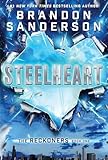
Editors Reads Verdict
Steelheart is Sanderson's most successful genre-shift, applying his magic system rigor to superhero mythology and arriving at something genuinely original: a world where superpowers have made their bearers irredeemably corrupt, and the heroism belongs to the powerless humans who fight back. Fast, clever, and surprisingly emotional for YA action fiction.
What We Loved
- The inversion — all Epics are villains, heroes are ordinary humans — is executed with real conviction
- The weakness-finding concept for each Epic creates genuine mystery and puzzle-solving momentum
- David's obsessive data collection makes him a distinctive and believable YA protagonist
- The Newcago setting — Chicago turned to steel by Steelheart's power — is genuinely evocative
Minor Drawbacks
- Some of the Reckoners ensemble is underdeveloped compared to the lead duo
- David's metaphor habit is a comedic tic that works better at the start than the end
- The romantic subplot is handled with less finesse than the action elements
Key Takeaways
- → Power without accountability produces corruption — the superhero premise interrogated rather than celebrated
- → Ordinary people choosing to fight extraordinary power is genuinely heroic precisely because it's a choice
- → Obsessive study of an enemy is a form of intimacy — David's knowledge of Steelheart borders on worship
- → The weakness concept implies that every power has a cost, even if the bearer doesn't recognize it
- → Community and shared purpose are the only weapons the powerless have against the powerful
| Author | Brandon Sanderson |
|---|---|
| Publisher | Delacorte Press |
| Pages | 386 |
| Published | September 24, 2013 |
| Language | English |
| Genre | Science Fiction, Fantasy, Young Adult |
| Difficulty | Beginner |
| Best For | YA readers who enjoy action-driven plots with clever world-building; superhero fans who want a subversive take on the genre; Sanderson fans looking for a lighter, faster entry point to his work. |
How Steelheart Compares
Steelheart at a glance against 3 similar books readers weigh alongside it.
| Book | Author | Rating | Best for |
|---|---|---|---|
| Steelheart (this book) | Brandon Sanderson | ★ 4.3 | YA readers who enjoy action-driven plots with clever world-building |
| Calamity | Brandon Sanderson | ★ 4.2 | Reckoners series readers completing the trilogy |
| Ender's Game | Orson Scott Card | ★ 4.7 | Science fiction readers from teenage years upward, fans of military fiction who |
| Firefight | Brandon Sanderson | ★ 4.3 | Readers of Steelheart continuing the series |
What If the Heroes Were All Villains?
The superhero genre has spent decades exploring the question of whether power corrupts. Steelheart answers the question definitively and then builds a world on the answer. When Calamity appeared in the sky a decade before the novel opens, it granted ordinary people extraordinary powers — the ability to transform matter, to fly, to become invulnerable, to see the future. Every single one of them became a tyrant. The Epics are not heroes who struggle with their responsibilities; they are monsters who have divided the world into territory to be controlled.
This is not a nuanced position — Sanderson is writing YA, and the genre demands legible moral stakes — but the conviction with which he commits to it generates real dramatic energy. The question is not whether the Epics are bad; they clearly are. The question is how ordinary humans fight back.
David and His Obsession
David Charleston was eight years old when he watched Steelheart — the most powerful Epic in the former United States — kill his father in a bank robbery. He has spent ten years cataloguing every Epic he can find, studying their powers and, crucially, their weaknesses. Every Epic has one. Steelheart’s weakness is unknown because no one has ever managed to hurt him and survived.
David is a genuinely distinctive YA protagonist. His obsession is not presented as admirable — it has consumed his adolescence and made him socially isolated — but it is presented as useful, which creates an interesting moral ambiguity for a genre that usually treats its protagonists’ obsessive tendencies as straightforwardly heroic.
Newcago and the World-Building
One of Sanderson’s consistent strengths is making his settings feel physically specific, and Steelheart is no exception. Steelheart transformed Chicago into steel — the buildings, the streets, the bodies of those who didn’t escape. Newcago is a genuinely strange and vivid setting, lit by electric lights from Epic power sources, inhabited by a population that has adapted to living in a city where the architecture is all the same material.
The Reckoners — the underground organization of ordinary humans who hunt Epics — operate in the tunnels beneath this steel city, which is exactly the right kind of guerrilla warfare setting for a David-versus-Goliath story.
Our rating: 4.3/5 — A fast, clever genre inversion that asks what superhero stories would look like if power reliably corrupted, and answers with action, mystery, and a genuinely compelling protagonist.
Reading Guides
The Genre Shift to YA
Steelheart marked Sanderson’s most deliberate foray into Young Adult fiction, a genre he had approached earlier with The Rithmatist but that had not been his primary territory. The decision to write the Reckoners series for a YA audience shaped the prose, the pacing, and the moral architecture: clearer stakes, faster setup, a protagonist whose age and emotional situation are designed to resonate with teenage readers specifically.
But Sanderson did not simply write a simplified version of his epic fantasy instincts. Steelheart applies his magic-system rigor to a genre — superhero fiction — that had rarely received it. The Marvel and DC traditions that most superhero stories draw from are fundamentally unconcerned with internal consistency; powers expand and contract as the story requires. Sanderson treats the Epics’ abilities as he would treat allomancy or Stormlight — with specific rules, documented through David’s obsessive research, which creates actual puzzles rather than narrative conveniences.
The Weakness Concept
The requirement that every Epic has a specific, personal weakness is the concept that makes Steelheart a mystery rather than simply an action story. David’s cataloguing project — accumulating data on every Epic he can find, trying to identify patterns in the weaknesses’ origins — is the novel’s intellectual engine, and Sanderson constructs it fairly. The solution to Steelheart’s weakness is arrived at through evidence the reader can retroactively trace once it is revealed.
The deeper implication of the weakness concept — that power and vulnerability are connected in ways that say something specific about the person holding the power — is developed further in Firefight and Calamity, but its seeds are planted here. Every weakness is personal, connected to the Epic’s fears or history. Power has not divorced the Epics from their human psychology; it has amplified it.
The Reckoners as Guerrilla Organization
The Reckoners — Abraham, Cody, Prof, Megan, and later David — are not a superhero team in the conventional sense. They are a small, resource-limited, perpetually outgunned organization that has developed specific tactics for killing beings who would be unkillable by conventional means. Their approach to each operation is methodical in ways that echo Sanderson’s heist-fantasy work in Mistborn: careful intelligence gathering, contingency planning, specific assignments based on individual skills.
The team dynamics are lighter and more comedic than the Mistborn crew — this is YA, and the banter reflects that — but the structural logic is the same: a small group using intelligence and preparation to defeat much larger power.
Chicago as Character
Newcago is one of Sanderson’s most effective uses of a real city as fantasy setting. The choice of Chicago — already iconic for its architecture and its specific urban mythology — and the transformation of it into a city of steel creates a setting that carries the resonance of the real place while being wholly reconceived. Readers familiar with Chicago’s geography will find details that play with that familiarity; readers who are not will simply find an inventive dystopian environment.
The underground tunnels where the Reckoners operate are a counterpoint to the steel city above: human scale, improvised, hidden, the guerrilla space beneath the tyrant’s grand architecture.
Frequently Asked Questions
What is "Steelheart" about?
Ten years after a cosmic event granted ordinary people superhuman abilities, the Epics have taken over as tyrants rather than heroes. David Charleston joins the Reckoners — ordinary humans who hunt Epics — to kill Steelheart, the most powerful Epic alive.
Who should read "Steelheart"?
YA readers who enjoy action-driven plots with clever world-building; superhero fans who want a subversive take on the genre; Sanderson fans looking for a lighter, faster entry point to his work.
What are the key takeaways from "Steelheart"?
Power without accountability produces corruption — the superhero premise interrogated rather than celebrated Ordinary people choosing to fight extraordinary power is genuinely heroic precisely because it's a choice Obsessive study of an enemy is a form of intimacy — David's knowledge of Steelheart borders on worship The weakness concept implies that every power has a cost, even if the bearer doesn't recognize it Community and shared purpose are the only weapons the powerless have against the powerful
Is "Steelheart" worth reading?
Steelheart is Sanderson's most successful genre-shift, applying his magic system rigor to superhero mythology and arriving at something genuinely original: a world where superpowers have made their bearers irredeemably corrupt, and the heroism belongs to the powerless humans who fight back. Fast, clever, and surprisingly emotional for YA action fiction.
Ready to Read Steelheart?
Check the current price on Amazon.
Check Price on Amazon (paid link)Prices and availability are subject to change. See Amazon for current price.
Review last updated: