Editors Reads Verdict
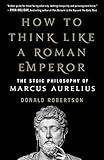
How to Think Like a Roman Emperor is the best practical introduction to Stoicism available — Robertson combines deep philosophical knowledge with clinical expertise in CBT to show not just what the Stoics believed but precisely how they trained themselves to live those beliefs. The biographical framing through Marcus Aurelius makes the ideas concrete and the human stakes vivid.
What We Loved
- Robertson's dual expertise in Stoic philosophy and CBT allows him to connect ancient practice to modern psychology in ways that illuminate both
- The biographical framing through Marcus Aurelius keeps the philosophy grounded in lived human experience
- The practical exercises are specific and derived from actual ancient Stoic training manuals, not invented for the self-help market
- The writing is clear and engaging without being simplistic — this respects the complexity of the philosophy
Minor Drawbacks
- Readers who already know the Stoics well will find the biographical sections cover familiar ground
- The CBT parallels, while illuminating, occasionally make the ancient philosophy seem less independently interesting
- Some of the exercises require significant sustained practice to be meaningful — the book can only introduce them
Key Takeaways
- → The Stoics distinguished sharply between what is 'up to us' (our judgments, desires, actions) and what is not (outcomes, others' behavior, external events)
- → Negative visualization — contemplating loss before it occurs — builds genuine appreciation and psychological resilience
- → Stoic meditation is not passive contemplation but active practice of specific mental techniques
- → The Stoic sage is not a human being without emotion but one who experiences 'good emotions' (joy, caution, wish) rather than 'passions' (pleasure, fear, desire)
- → Marcus Aurelius governed the largest empire in the world while practicing daily Stoic philosophy — and the Meditations show it was hard for him too
| Author | Donald Robertson |
|---|---|
| Publisher | St. Martin's Press |
| Pages | 304 |
| Published | April 2, 2019 |
| Language | English |
| Genre | Philosophy, Self-Help, Biography |
| Difficulty | Intermediate |
| Best For | Anyone interested in Stoic philosophy, practical methods for building emotional resilience, or the intersection of ancient wisdom and modern psychology. |
How How to Think Like a Roman Emperor Compares
How to Think Like a Roman Emperor at a glance against 3 similar books readers weigh alongside it.
| Book | Author | Rating | Best for |
|---|---|---|---|
| How to Think Like a Roman Emperor (this book) | Donald Robertson | ★ 4.5 | Anyone interested in Stoic philosophy, practical methods for building emotional |
| Discipline Equals Freedom | Jocko Willink | ★ 4.5 | Anyone seeking a no-excuses framework for building discipline, readers |
| Emotional Agility | Susan David | ★ 4.3 | Anyone who struggles with difficult emotions, tends to suppress or ruminate, or |
| The Willpower Instinct | Kelly McGonigal | ★ 4.3 | Anyone who has struggled with self-control, wants to understand why behavior |
The Most Powerful Person in the World Practicing Philosophy
Between 161 and 180 CE, Marcus Aurelius was the Roman Emperor — the most powerful single human being on Earth, responsible for governing an empire that stretched from Scotland to Mesopotamia. He spent a portion of every day writing private philosophical notes to himself, wrestling with the same questions about anger, desire, mortality, and right action that he had been wrestling with since he was a teenager studying under Stoic teachers.
Those notes survive as the Meditations, one of the most remarkable documents in Western philosophy. Donald Robertson, a cognitive behavioral therapist who has spent decades studying Stoicism, uses Marcus’s biography — his childhood, his years under Hadrian’s court, his reign, and his recurring failures to live up to his own philosophy — as the frame for the most practically grounded introduction to Stoic thought available.
Stoicism and CBT
Robertson’s most distinctive contribution is the explicit connection between Stoic practice and cognitive behavioral therapy. CBT, which is the most empirically supported form of psychotherapy currently available, was heavily influenced by Stoic philosophy — Albert Ellis, who developed rational emotive behavior therapy in the 1950s, explicitly cited Marcus Aurelius, Epictetus, and Seneca as intellectual predecessors.
This is not a superficial connection. Both traditions share the central insight that it is not events themselves that disturb us but our judgments about events — and therefore that changing our judgments changes our experience. Robertson shows how specific Stoic exercises map onto specific CBT techniques: the evening review, the Socratic questioning of initial reactions, the deliberate practice of examining the worst case and discovering it is bearable.
The Practical Exercises
Where Robertson excels is in the specificity of the practices he describes. The Stoics were not just philosophers — they were practitioners of a rigorous mental training program, and Robertson is careful to distinguish between the philosophical principles and the training techniques derived from them.
Negative visualization — briefly contemplating the loss of what you value — is one such technique. The Stoics practiced it not to become pessimistic but to cultivate genuine appreciation and to prepare emotionally for the inevitable losses that life delivers. Morning meditation, evening review, the view from above (imagining your situation from cosmic perspective) — each is explained in its philosophical context and translated into a practical exercise a contemporary reader can use.
Marcus as Case Study
The biographical framing serves the philosophy well. Marcus Aurelius was not a Stoic saint — he struggled with anger, with the temptations of luxury, with bitterness about his situation, and with the despair of presiding over a plague that killed millions of his subjects. The Meditations show a man practicing imperfectly toward an ideal he takes seriously. Robertson is careful not to sanitize this: Marcus’s failures make the philosophy more credible, not less.
The Author and the Modern Stoic Revival
Donald Robertson is unusually well positioned to write this book. He is a cognitive-behavioral psychotherapist and a long-standing scholar of Stoicism, and he had already written more technical works — including Stoicism and the Art of Happiness and a study of the philosophical roots of CBT — before How to Think Like a Roman Emperor translated that expertise into a popular biography-cum-manual. That dual credential is the book’s defining feature. Most popular Stoicism is written either by classicists who know the texts but not the clinical evidence, or by self-help authors who borrow the slogans without the philosophical or therapeutic depth. Robertson belongs to neither camp; he can trace a specific exercise from Epictetus through Albert Ellis to a modern therapy session and show that the lineage is real rather than rhetorical.
The book arrived in 2019, near the crest of a broad popular revival of Stoicism that had been building through the 2010s, alongside the work of writers like Ryan Holiday and Massimo Pigliucci and a growing online community of practitioners. Robertson has been a notable figure in that revival, helping organize the annual Stoicon gatherings and the Modern Stoicism movement, and he later returned to Marcus Aurelius in a graphic-novel treatment, Verissimus. Within the crowded field of contemporary Stoic books, How to Think Like a Roman Emperor stands out precisely because it refuses to reduce the philosophy to a set of productivity hacks; it insists that Stoicism is a demanding therapeutic discipline with real intellectual content.
The Biographical Frame as Method
The decision to structure the book around the life of Marcus Aurelius is more than a presentational choice — it is central to the argument. Abstract philosophical principles are easy to nod along with and hard to apply; embodied in the life of a specific person facing war, plague, betrayal, chronic illness, and the crushing responsibilities of empire, they become concrete and testable. Robertson moves through Marcus’s life roughly chronologically, from his boyhood and his apprenticeship under Stoic teachers to his reign and his death, and at each stage he draws out the particular practice that Marcus was using to meet a particular difficulty. This lets the reader see Stoicism not as a finished doctrine but as a working toolkit deployed under genuine pressure, which is exactly how the Stoics themselves understood it. The Meditations were, after all, private notes — Marcus coaching himself — and Robertson’s framing restores that original, intimate, self-directed character.
Who Should Read It and How to Approach It
This is the book to recommend to a reader new to Stoicism who wants something more substantial than a list of quotations but less forbidding than the primary texts. It works equally well as a first introduction and as a practical companion for someone who has read the Meditations and wants to know how to actually use them. The exercises Robertson describes — the morning preparation, the evening review, negative visualization, the view from above — are presented clearly enough to begin practicing immediately, but readers should understand that the book can only introduce them; their value emerges from sustained, repeated practice rather than a single read. Approach it, in other words, the way the Stoics approached their philosophy: not as information to be consumed but as a discipline to be trained. Readers already steeped in the ancient sources will find some of the biographical material familiar, but even they will likely value the CBT parallels, which are the book’s most original and useful contribution.
Our rating: 4.5/5 — The best practical introduction to Stoicism available, made distinctive by Robertson’s dual expertise in ancient philosophy and modern psychology, and grounded throughout in the human reality of Marcus Aurelius’s life.
Frequently Asked Questions
What is "How to Think Like a Roman Emperor" about?
Cognitive behavioral therapist Donald Robertson weaves together Marcus Aurelius's biography with the Stoic philosophy he practiced, showing how ancient techniques map onto modern psychological methods.
Who should read "How to Think Like a Roman Emperor"?
Anyone interested in Stoic philosophy, practical methods for building emotional resilience, or the intersection of ancient wisdom and modern psychology.
What are the key takeaways from "How to Think Like a Roman Emperor"?
The Stoics distinguished sharply between what is 'up to us' (our judgments, desires, actions) and what is not (outcomes, others' behavior, external events) Negative visualization — contemplating loss before it occurs — builds genuine appreciation and psychological resilience Stoic meditation is not passive contemplation but active practice of specific mental techniques The Stoic sage is not a human being without emotion but one who experiences 'good emotions' (joy, caution, wish) rather than 'passions' (pleasure, fear, desire) Marcus Aurelius governed the largest empire in the world while practicing daily Stoic philosophy — and the Meditations show it was hard for him too
Is "How to Think Like a Roman Emperor" worth reading?
How to Think Like a Roman Emperor is the best practical introduction to Stoicism available — Robertson combines deep philosophical knowledge with clinical expertise in CBT to show not just what the Stoics believed but precisely how they trained themselves to live those beliefs. The biographical framing through Marcus Aurelius makes the ideas concrete and the human stakes vivid.
Ready to Read How to Think Like a Roman Emperor?
Check the current price on Amazon.
Check Price on Amazon (paid link)Prices and availability are subject to change. See Amazon for current price.
Review last updated: