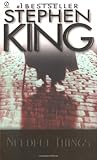
Editors Reads Verdict
Needful Things is King's farewell to Castle Rock — a sprawling, darkly comic novel about desire, community, and the devil's bargain. It's longer than it needs to be but builds to a genuinely spectacular and cathartic finale.
What We Loved
- The central conceit — desire weaponised against community — is brilliantly conceived
- King's love for Castle Rock gives the town genuine texture and history
- The escalating chaos in the second half is enormously entertaining
- Leland Gaunt is one of King's most memorable villains
Minor Drawbacks
- At 736 pages the setup is extended well beyond what the story needs
- Some subplot characters are thinly drawn
- The ending wraps up too neatly given the scale of destruction
Key Takeaways
- → Human desire and resentment require very little outside help to become destructive
- → Community bonds are more fragile than they appear from the outside
- → The devil's greatest trick is making you think your need is unique
- → Small grievances, amplified, can produce catastrophic violence
- → Attachment to things can be a form of possession
| Author | Stephen King |
|---|---|
| Publisher | Viking |
| Pages | 736 |
| Published | October 1, 1991 |
| Language | English |
| Genre | Horror |
| Difficulty | Beginner |
| Best For | Stephen King fans who enjoy his small-town horror and Castle Rock mythology, and readers interested in psychological horror about community and desire. |
How Needful Things Compares
Needful Things at a glance against 3 similar books readers weigh alongside it.
| Book | Author | Rating | Best for |
|---|---|---|---|
| Needful Things (this book) | Stephen King | ★ 4.2 | Stephen King fans who enjoy his small-town horror and Castle Rock mythology, |
| Billy Summers | Stephen King | ★ 4.2 | Stephen King fans open to a non-supernatural thriller, and crime fiction |
| Fairy Tale | Stephen King | ★ 4.2 | Stephen King fans and fantasy readers looking for a generous, big-hearted |
| The Outsider | Stephen King | ★ 4.3 | Stephen King fans and readers who enjoy crime thrillers willing to accept a |
The Last Stand of Castle Rock
Needful Things opens with one of the most promising premises in Stephen King’s career: a mysterious shop appears in Castle Rock, Maine, staffed by the charming and unsettling Leland Gaunt. Every customer finds exactly the object of their dreams — a rare baseball card, a vintage record, a painting. The price is nominal. The favour required in return is small, seemingly harmless.
And then the favours compound, the resentments they stoke catch fire, and Castle Rock begins to tear itself apart. King has always been interested in how communities fail — how the bonds of small-town life are more competitive and grudge-laden than their surface of neighbourliness suggests. Needful Things is the fullest expression of that interest.
Gaunt as Devil
Leland Gaunt is one of King’s great villains — a figure of consummate charm who never forces anyone to do anything they weren’t capable of doing independently. His genius is knowing exactly which resentment to press. A conflict between a Catholic woman and the wife of a Baptist preacher over a town feud becomes, in his hands, a fuse leading to catastrophe. He is the devil as social engineer rather than supernatural tyrant.
The Escalating Chaos
The novel’s most entertaining passages come in its final third, when the carefully stacked dominoes begin to fall simultaneously. King orchestrates the escalating violence across multiple storylines with genuine skill — it is chaos rendered with almost musical structure. The book earns its length primarily in this section.
Castle Rock’s Epitaph
King explicitly intended this as a farewell to Castle Rock, the fictional Maine town that had featured in The Dead Zone, Cujo, The Dark Half, and dozens of shorter works. The ending is therefore thematically appropriate even if it is narratively tidy: a town that survived so much finally meets its destroyer, and the destroyer turns out to be itself.
Our rating: 4.2/5 — Overlong but ultimately satisfying: King’s definitive statement about desire, community, and the darkness in small-town America.
Reading Guides
- Stephen King Books in Order: The Complete Reading Guide (2026)
- 18 Best Horror Books of All Time: Novels That Will Keep You Up at Night
Publication History
Needful Things was published by Viking in October 1991 and was billed on its jacket as “The Last Castle Rock Story” — King’s explicit farewell to the fictional Maine town he had used as a setting since The Dead Zone (1979). The novel debuted at number one on the New York Times bestseller list and remained there for several weeks. By 1991 King had been publishing continuously for seventeen years, and his ability to attract instant commercial success while attempting something as architecturally ambitious as Needful Things — a novel that requires the reader to track dozens of intersecting plotlines across a large ensemble cast — was a demonstration of the degree to which his readership trusted him with complex material.
The “last Castle Rock story” billing was eventually retired: King has returned to Castle Rock in subsequent work, and the Hulu streaming service produced a Castle Rock anthology series (2018-2019) drawing on the location and King’s various characters associated with it. But the novel’s intention as a valediction to the setting remains structurally legible throughout.
Leland Gaunt as Devil Figure
Leland Gaunt is one of the most carefully constructed villain figures in King’s catalog. He functions within a long tradition of devil-as-salesman in American folklore and literature — a figure whose power derives not from force but from his intimate understanding of what each person most desires and what resentments they most carefully maintain. The genius of the conceit is that Gaunt never forces anyone to do anything: he merely provides the object of desire and asks, in return, a small favor that seems unrelated to anything important. The favors are designed to exploit and amplify existing resentments between specific community members, creating chains of escalating violence that Gaunt orchestrates from a position of apparent innocence.
King’s Gaunt is distinguished from other devil figures by his specificity: he knows each Castle Rock resident’s private shame and private want with a precision that implies surveillance rather than supernatural omniscience. He is less a creature of supernatural evil than a portrait of what a sufficiently attentive social engineer could accomplish with a community’s existing fault lines.
Castle Rock’s History
Castle Rock enters Needful Things with a substantial fictional history that gives the novel’s events their weight. The town has been the site of Cujo’s rabid dog siege, the events of The Dead Zone, Alan Pangborn’s investigations in The Dark Half, and dozens of shorter works. King populates the novel with characters who carry this history — Alan Pangborn, now Castle Rock’s sheriff, has personal losses from The Dark Half that make him vulnerable to Gaunt’s manipulations in specific ways. The Merrill family’s grudge against Sheriff Pangborn provides the novel’s central conflict with a backstory that rewards readers familiar with King’s earlier Castle Rock fiction.
For readers encountering Castle Rock for the first time, none of this prior knowledge is required — King provides enough context — but the accumulated fictional history gives the town’s destruction a genuine sense of loss that a first-contact reading cannot fully produce.
The 1993 Television Film
A television film adaptation was produced by Castle Rock Entertainment and broadcast on TNT in 1993, starring Max von Sydow as Leland Gaunt and Ed Harris as Sheriff Alan Pangborn. The film condensed the novel’s large ensemble to a manageable cast of principal players, a process that necessarily simplified the novel’s intricate web of escalating resentments. Von Sydow’s Gaunt received generally positive notices, his patrician menace well-suited to the character’s surface of civilized charm. The adaptation performed well enough in its initial broadcast but has not maintained the cultural profile of King’s better-known film adaptations.
King on Desire and Community
Needful Things is King’s most extended meditation on the relationship between desire, acquisition, and community. The novel’s argument — that desire, once commodified and weaponized, is sufficient to destroy the social fabric without any external supernatural pressure — is stated through structure rather than authorial commentary. Gaunt never tells anyone what to feel; he provides the conditions for what they already feel to express itself fully.
This makes Needful Things one of King’s most politically conservative novels in the classical sense: a story that treats community as a fragile achievement requiring active maintenance, rather than a natural condition that can be taken for granted. What Gaunt reveals about Castle Rock is not anything he introduces; it is everything that was already present, waiting for someone to press the right combinations.
Frequently Asked Questions
What is "Needful Things" about?
A mysterious new shop opens in Castle Rock, Maine — and its proprietor offers every customer exactly what they desire, at a price that will destroy the town.
Who should read "Needful Things"?
Stephen King fans who enjoy his small-town horror and Castle Rock mythology, and readers interested in psychological horror about community and desire.
What are the key takeaways from "Needful Things"?
Human desire and resentment require very little outside help to become destructive Community bonds are more fragile than they appear from the outside The devil's greatest trick is making you think your need is unique Small grievances, amplified, can produce catastrophic violence Attachment to things can be a form of possession
Is "Needful Things" worth reading?
Needful Things is King's farewell to Castle Rock — a sprawling, darkly comic novel about desire, community, and the devil's bargain. It's longer than it needs to be but builds to a genuinely spectacular and cathartic finale.
Ready to Read Needful Things?
Check the current price on Amazon.
Check Price on Amazon (paid link)Prices and availability are subject to change. See Amazon for current price.
Review last updated: