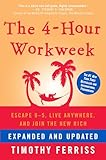
Editors Reads Verdict
The most polarising book on this list — and one of the most influential of the 2000s. Not everything Ferriss advises is practical or ethical. But the core mental models (Pareto's 80/20 applied to work, the distinction between busyness and productivity, the concept of 'mini-retirements') are genuinely liberating for anyone who has never questioned the default work script.
What We Loved
- The 80/20 principle applied to work tasks is one of the most actionable ideas in productivity
- The concept of 'mini-retirements' and deferred-life planning is a genuine paradigm shift
- Practical frameworks: DEAL (Definition, Elimination, Automation, Liberation) is structured and executable
- The outsourcing and automation sections are more relevant now than in 2007
- Inspired a generation of remote workers and digital nomads before either concept was mainstream
Minor Drawbacks
- Some advice is ethically questionable (the chapter on outsourcing homework to virtual assistants)
- The 'muse business' section is more aspirational than realistic for most readers
- Ferriss's specific examples (his supplement business) are hard to replicate without his privilege and risk tolerance
- The tone is relentlessly bro-confident and can grate
Key Takeaways
- → The 80/20 principle: 80% of your results come from 20% of your efforts — identify and focus on the 20%
- → Being busy is not the same as being productive — busyness is often a form of avoidance
- → The 'deferred life plan' (work now, live later) is a design choice, not an inevitability
- → Fear-setting: define your worst realistic case — it's usually survivable and often recoverable
- → The most dangerous poison is the feeling of achievement from busyness rather than results
| Author | Tim Ferriss |
|---|---|
| Publisher | Crown Currency |
| Pages | 418 |
| Published | April 24, 2007 |
| Language | English |
| Genre | Business, Self-Help, Entrepreneurship |
| Difficulty | Beginner |
| Best For | Employees questioning the 9-5 default, aspiring entrepreneurs, digital nomads, and anyone who suspects they are working hard without being effective. Best read with a critical eye — take the frameworks, question the specifics. |
How The 4-Hour Workweek Compares
The 4-Hour Workweek at a glance against 3 similar books readers weigh alongside it.
| Book | Author | Rating | Best for |
|---|---|---|---|
| The 4-Hour Workweek (this book) | Tim Ferriss | ★ 4.4 | Employees questioning the 9-5 default, aspiring entrepreneurs, digital nomads, |
| Deep Work | Cal Newport | ★ 4.7 | Knowledge workers, writers, programmers, academics, and anyone whose job |
| Essentialism | Greg McKeown | ★ 4.5 | Professionals who feel spread too thin, are constantly busy but rarely |
| Zero to One | Peter Thiel | ★ 4.5 | Startup founders, aspiring entrepreneurs, venture investors, and anyone |
The Book That Launched a Million Blog Posts
Tim Ferriss was running a failing supplement company, working 80-hour weeks, and miserable when he accidentally discovered that taking a two-week vacation and delegating almost everything made his business run better, not worse. The 4-Hour Workweek is the extrapolation of that discovery into a full system.
Published in 2007, it spent four years on the New York Times bestseller list, popularised the concept of the digital nomad, and inspired a generation of bloggers, podcasters, and remote workers before any of those were established categories.
What the Book Actually Argues
The title is deliberately provocative — Ferriss is not seriously arguing everyone can work four hours a week. The actual argument is:
Most work is busywork. Pareto’s principle (80% of results come from 20% of efforts) applies to nearly every job. Most knowledge workers spend the majority of their time on low-value tasks — answering emails, attending meetings, producing reports nobody reads — while the genuinely valuable work gets a fraction of their attention.
The default life script is a choice, not a law. The assumption that you work full-time for 40 years and then retire is presented as inevitable, but it’s a design choice — and not necessarily the best one. Ferriss argues for “mini-retirements” distributed throughout life rather than deferred wholesale to a single period that may never arrive.
Fear is the main constraint. The reason most people don’t change their work arrangements isn’t logistical but psychological. Ferriss’s “fear-setting” exercise — explicitly defining the worst realistic outcome of a change, estimating its probability, and planning the recovery — is the most practically valuable section of the book.
The DEAL Framework
Ferriss structures his system in four phases:
Definition — Challenge the assumptions behind your current work/life arrangement. What do you actually want?
Elimination — Apply 80/20 ruthlessly. What 20% of clients produce 80% of revenue? What tasks, if eliminated, would have no real consequence?
Automation — Outsource and systematise everything that doesn’t require your specific judgment. Virtual assistants, automated reporting, delegated decisions.
Liberation — Create the conditions for location independence. Negotiate remote working; design a business that runs without your physical presence.
The Book That Launched “Lifestyle Design”
Whatever one makes of its specifics, The 4-Hour Workweek was a genuinely influential book. Published in 2007, it popularized the phrase “lifestyle design” and helped catalyze the entire digital-nomad and location-independent-work movement that has only grown since — the idea that you might engineer a life of remote work, geographic freedom, and “mini-retirements” rather than deferring all freedom to a distant retirement at sixty-five. Tim Ferriss’s central provocation — that most office work is performative busyness that could be eliminated, automated, or compressed, and that the conventional deferred-life plan is a poor bargain — landed at exactly the moment broadband, outsourcing platforms, and laptop work were making such arrangements newly plausible. The book made Ferriss a brand and launched a career that now includes one of the most popular podcasts in the world and a series of “4-Hour” follow-ups on health and skill acquisition. Its DNA is visible across a decade and a half of writing about remote work, passive income, and intentional living.
How to Use It Today
The honest way to read The 4-Hour Workweek now is selectively. Treat it as a book of mental models rather than a literal blueprint: the 80/20 analysis of where your results actually come from, the “fear-setting” exercise for defusing the anxieties that keep you stuck, the distinction between effectiveness and mere efficiency, and the reframing of time and mobility as things to be designed rather than endured. These ideas remain genuinely useful for knowledge workers, freelancers, and would-be entrepreneurs. The literal tactics — specific outsourcing services, arbitrage schemes, the precise mechanics of building a low-maintenance “muse” business — are dated and, in places, ethically glib, and the breezy confidence that any reader can simply opt out of conventional work overstates how transferable Ferriss’s particular circumstances are. Read for the frameworks, filter the bravado, and it still earns its place as one of the defining productivity and lifestyle books of its era.
Reading It With Appropriate Scepticism
The honest caveat: some of Ferriss’s specific advice is dated (the outsourcing landscape of 2007 is different from today), some is ethically questionable (outsourcing personal tasks to poorly-paid virtual workers in developing countries is presented uncritically), and some of the business-building sections require resources and risk tolerance that most readers don’t have.
The frameworks, however, are durable. The 80/20 principle, fear-setting, the distinction between busyness and productivity, and the concept of lifestyle design as a deliberate practice rather than a lucky accident — these are genuine intellectual contributions that justify the book regardless of its weaknesses.
Read it for the mental models. Apply them with judgement.
Nearly two decades after publication, the world has caught up with much of what once seemed radical here — remote work, the creator economy, and intentional lifestyle design are now mainstream rather than fringe — which paradoxically makes the book both less startling and easier to evaluate clearly. Stripped of its era-specific hustle and its salesmanship, the durable core remains genuinely useful: question the default assumption that a conventional career is the only path, audit where your time and results actually come from, and design your life on purpose. That reframing is what has kept The 4-Hour Workweek in print and in conversation, and it is why it still earns a place on the shelf of anyone rethinking the relationship between work and life.
Our rating: 4.4/5 — Uneven but genuinely liberating in places. The frameworks are worth the price; the attitude requires filtering.
Reading Guides
Frequently Asked Questions
What is "The 4-Hour Workweek" about?
Tim Ferriss dismantles the assumption that the standard life script — work 40+ hours a week for 40 years, then retire — is either necessary or desirable. He outlines a practical system for outsourcing, automating, and liberating your work life to create what he calls 'lifestyle design'.
Who should read "The 4-Hour Workweek"?
Employees questioning the 9-5 default, aspiring entrepreneurs, digital nomads, and anyone who suspects they are working hard without being effective. Best read with a critical eye — take the frameworks, question the specifics.
What are the key takeaways from "The 4-Hour Workweek"?
The 80/20 principle: 80% of your results come from 20% of your efforts — identify and focus on the 20% Being busy is not the same as being productive — busyness is often a form of avoidance The 'deferred life plan' (work now, live later) is a design choice, not an inevitability Fear-setting: define your worst realistic case — it's usually survivable and often recoverable The most dangerous poison is the feeling of achievement from busyness rather than results
Is "The 4-Hour Workweek" worth reading?
The most polarising book on this list — and one of the most influential of the 2000s. Not everything Ferriss advises is practical or ethical. But the core mental models (Pareto's 80/20 applied to work, the distinction between busyness and productivity, the concept of 'mini-retirements') are genuinely liberating for anyone who has never questioned the default work script.
Ready to Read The 4-Hour Workweek?
Check the current price on Amazon.
Check Price on Amazon (paid link)Prices and availability are subject to change. See Amazon for current price.
Review last updated: