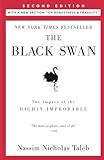
Editors Reads Verdict
The Black Swan introduced an entire vocabulary — black swans, Mediocristan, Extremistan, the narrative fallacy — that has become standard in discussions of risk and uncertainty. Taleb's core insight is powerful and well-supported; his delivery is confrontational and uneven, but the book repays persistence.
What We Loved
- The central concept of black swans is genuinely important and widely applicable
- The distinction between Mediocristan and Extremistan is one of the more useful analytical frames in recent popular non-fiction
- Taleb's epistemological critique of expert forecasting is well-evidenced
- The book's influence on risk management, investing, and policy is substantial and ongoing
Minor Drawbacks
- Taleb's combative, name-dropping style alienates many readers
- The repetition is significant — the core argument could be made in half the space
- Some of the philosophical material in the second half requires patience
- Taleb's dismissal of critics is not always fair-minded
Key Takeaways
- → Rare, high-impact events that nobody predicted in advance drive far more of history than everyday fluctuations
- → Bell-curve statistics are appropriate for Mediocristan (height, weight) but catastrophically wrong for Extremistan (wealth, casualties)
- → After the fact, we construct narratives that make black swans seem predictable — the narrative fallacy
- → Absence of evidence is not evidence of absence, especially for rare catastrophic events
- → Being robust to uncertainty requires accepting that models will fail in the ways that matter most
| Author | Nassim Nicholas Taleb |
|---|---|
| Publisher | Random House |
| Pages | 366 |
| Published | April 17, 2007 |
| Language | English |
| Genre | Philosophy, Economics, Non-Fiction |
| Difficulty | Intermediate |
| Best For | Investors, risk managers, policy professionals, and intellectually curious readers interested in probability, epistemology, and the limits of prediction. |
How The Black Swan Compares
The Black Swan at a glance against 3 similar books readers weigh alongside it.
| Book | Author | Rating | Best for |
|---|---|---|---|
| The Black Swan (this book) | Nassim Nicholas Taleb | ★ 4.2 | Investors, risk managers, policy professionals, and intellectually curious |
| Antifragile | Nassim Nicholas Taleb | ★ 4.2 | Readers who found The Black Swan compelling and want Taleb's prescriptive |
| Fooled by Randomness | Nassim Nicholas Taleb | ★ 4.2 | Investors, anyone in a performance-evaluated profession, and readers interested |
| Skin in the Game | Nassim Nicholas Taleb | ★ 4.1 | Readers who have engaged with Taleb's earlier work and want his ethical |
The Event That Changes Everything
A black swan, as Taleb defines it, is an event with three properties: it is outside the realm of regular expectations, it carries an extreme impact, and after it occurs, we concoct explanations that make it seem predictable. The September 11 attacks, the 2008 financial crisis, the rise of the internet — each was, in advance, inconceivable to the forecasters who should have been thinking about it.
The Black Swan published in 2007 achieved the rare distinction of becoming more famous after its subject arrived — the 2008 crash made it retroactively prophetic. But the book’s argument was never primarily about finance. It is a philosophical treatise on the structure of uncertainty.
Mediocristan and Extremistan
Taleb’s most enduring conceptual contribution may be this distinction. Mediocristan is the world where bell-curve statistics work: if you sample a thousand people’s height, a single outlier cannot meaningfully affect the average. Extremistan is the world of wealth, book sales, or casualties, where a single observation — Bill Gates’s net worth, a single bestselling novel, a single terrorist attack — can dominate all others combined.
The mistake of modern risk management, Taleb argues, is the systematic application of Gaussian statistics to Extremistan phenomena. Value-at-Risk models, the bell curves of academic economics, the standard deviation calculations underlying derivative pricing — all of them assume the wrong distribution and therefore catastrophically underestimate tail risk.
The Narrative Fallacy
One of the book’s most penetrating ideas is the narrative fallacy: the human tendency to fit a causal story onto random events. After a stock market crash, commentators produce detailed explanations for why it was inevitable. Before it, they missed it entirely. The same brain that cannot tolerate randomness invents patterns in noise and then believes the pattern was always there.
This connects to Taleb’s critique of experts and forecasters. He cites Philip Tetlock’s research showing that expert predictions are barely better than random and often worse, yet experts speak with undiminished confidence. The problem is not that we have too little information but that we have calibration that dramatically overstates the precision of our models.
Style and Substance
Taleb is a difficult author. He writes with evident contempt for the people he disagrees with and returns to his grievances repeatedly. The book contains more footnotes about his own brilliance than is comfortable. But the core ideas are important enough that serious readers have always been willing to pay this price.
The Incerto and Taleb’s Larger Project
The Black Swan is the second and most famous installment of what Nassim Nicholas Taleb came to call the Incerto — a multi-volume meditation on uncertainty, probability, and how to live in a world we cannot predict. It was preceded by Fooled by Randomness, which examined the role of luck in markets and life, and followed by Antifragile, which pushed the argument forward by asking not merely how to survive black swans but how to build systems that actually gain from disorder, and Skin in the Game, on the ethics of risk-bearing. Taleb’s biography sharpens the books’ authority: a former options trader and quantitative analyst who grew wealthy by betting against the very models he criticizes, he writes as a practitioner who watched supposedly sophisticated risk systems fail in real markets rather than as an academic theorizing from the outside. The Incerto is best read as a single sprawling argument, and The Black Swan is its keystone — the book where the central vocabulary of the whole project is laid down.
Why the Ideas Outlasted the Hype
The book arrived in 2007, and when the global financial system nearly collapsed the following year, Taleb was vindicated in the most public way imaginable; his warnings about fat-tailed risk and the false precision of Gaussian models suddenly read as prophecy. But the reason The Black Swan still matters, well beyond the crisis that made it famous, is that its argument is not really about finance at all. It is an epistemological claim about the limits of knowledge — about how much of consequence is driven by the rare and unforeseeable, and how systematically human institutions delude themselves into believing otherwise. That claim has proved portable, informing how people think about pandemics, technological disruption, geopolitical shocks, and personal risk. The concepts have entered ordinary language precisely because they describe something real that earlier frameworks obscured.
Who Should Read It — and How
This is essential reading for investors, risk managers, forecasters, and policymakers, but its insights reach anyone who makes decisions under uncertainty, which is everyone. The honest caveat is the prose: Taleb digresses, settles scores, and repeats himself, and readers should be prepared to extract the durable ideas from a combative and self-regarding package. The most productive approach is to read for the architecture — the definition of a black swan, the Mediocristan-Extremistan distinction, the narrative fallacy, the critique of expert forecasting — and to treat the polemical asides as texture rather than substance. Read that way, with patience for the author’s temperament, it remains one of the most genuinely useful works of popular nonfiction of its era.
A final word on how to apply it. The danger of a book this persuasive about the unknowability of the future is that it can curdle into paralysis or, worse, into a cheap excuse for any failed prediction. Taleb’s actual prescription is more constructive than that. He argues for a “barbell” posture toward risk — extreme caution with the bulk of one’s resources combined with small, deliberate exposures to enormous upside — and for designing systems robust enough to survive the shocks we cannot foresee rather than fragile ones optimized for a future we wrongly assume we can model. Read with that practical aim in mind, The Black Swan becomes less a counsel of helplessness than a manual for humility under uncertainty, which is exactly the use its author intended.
Our rating: 4.2/5 — A genuinely influential framework for thinking about risk and uncertainty, delivered in a package that rewards patience with its style.
Frequently Asked Questions
What is "The Black Swan" about?
Nassim Nicholas Taleb's argument that highly improbable, high-impact events drive history and that our models systematically fail to account for them.
Who should read "The Black Swan"?
Investors, risk managers, policy professionals, and intellectually curious readers interested in probability, epistemology, and the limits of prediction.
What are the key takeaways from "The Black Swan"?
Rare, high-impact events that nobody predicted in advance drive far more of history than everyday fluctuations Bell-curve statistics are appropriate for Mediocristan (height, weight) but catastrophically wrong for Extremistan (wealth, casualties) After the fact, we construct narratives that make black swans seem predictable — the narrative fallacy Absence of evidence is not evidence of absence, especially for rare catastrophic events Being robust to uncertainty requires accepting that models will fail in the ways that matter most
Is "The Black Swan" worth reading?
The Black Swan introduced an entire vocabulary — black swans, Mediocristan, Extremistan, the narrative fallacy — that has become standard in discussions of risk and uncertainty. Taleb's core insight is powerful and well-supported; his delivery is confrontational and uneven, but the book repays persistence.
Ready to Read The Black Swan?
Check the current price on Amazon.
Check Price on Amazon (paid link)Prices and availability are subject to change. See Amazon for current price.
Review last updated: