Editors Reads Verdict
A ferociously original war novel that strips away every romantic illusion about combat and replaces it with something truer and more terrifying: the chaos inside one young man's mind.
What We Loved
- The prose style — impressionistic, hallucinatory, relentlessly present-tense in feeling — was decades ahead of its time
- Henry's self-deceptions are rendered with psychological precision that feels modern rather than Victorian
- At 112 pages it achieves more than many war novels ten times its length
Minor Drawbacks
- The ending's note of redemption has struck some readers as insufficiently earned given Henry's persistent dishonesty
- The deliberate anonymity of setting and character can make the novel feel abstract on first reading
Key Takeaways
- → Courage and cowardice are not fixed qualities but situational responses that shift from moment to moment
- → War reduces individual identity to sensation and survival instinct
- → Self-narrative — the stories we tell ourselves about our own actions — is almost always self-serving
- → Crane's impressionism anticipated both literary modernism and the psychological realism of the best twentieth-century war writing
| Author | Stephen Crane |
|---|---|
| Publisher | Dover Publications |
| Pages | 112 |
| Published | October 1, 1895 |
| Language | English |
| Genre | Classic Fiction, War Fiction, American Literature |
How The Red Badge of Courage Compares
The Red Badge of Courage at a glance against 3 similar books readers weigh alongside it.
| Book | Author | Rating | Best for |
|---|---|---|---|
| The Red Badge of Courage (this book) | Stephen Crane | ★ 4.5 | Classic Fiction |
| A Farewell to Arms | Ernest Hemingway | ★ 4.5 | Readers who want to understand the World War I generation's literary response |
| All Quiet on the Western Front | Erich Maria Remarque | ★ 4.8 | Classic Fiction |
| The Sun Also Rises | Ernest Hemingway | ★ 4.4 | Readers interested in American modernism and the 1920s Paris scene — and those |
The Red Badge of Courage Review
Stephen Crane was twenty-two years old and had never seen a battle when he wrote The Red Badge of Courage. He published it in 1895. Veterans of the Civil War, reading it, assumed he must have fought. That assumption is the novel’s first and most startling achievement.
What Crane understood, without having experienced it, was that war is not primarily an external event but an internal one. Henry Fleming’s story is not really about the Battle of Chancellorsville — the battle is never named — but about the contents of one frightened young man’s mind as it tries and fails to process the fact that he has run away. The novel’s great subject is self-deception: the extraordinary speed with which Henry reframes his cowardice as wisdom, his flight as instinct, his shame as grievance. Crane watches his protagonist lie to himself with the detachment of a naturalist observing an insect, and the effect is both darkly comic and genuinely frightening.
The prose was unlike anything in American fiction at the time. Crane writes in jolting, colour-saturated fragments — the red sun pasted in the sky, the corpses with their blue faces — that read less like conventional narrative and more like a series of photographic exposures. The effect is disorienting in exactly the way combat must be, and it would influence Hemingway, Dos Passos, and virtually every serious American war writer who came after.
At barely over a hundred pages, the novel is a model of compression. Nothing is wasted; every sentence is doing work. The ending — Henry deciding he has become a man — is deliberately ambiguous. Crane does not confirm that Henry has earned this conclusion. That ambiguity is the point.
Jim Conklin and the Tattered Man
The novel’s emotional core is two deaths Henry witnesses during his flight. The first is the tattered soldier, a gentle, wounded man who keeps asking Henry where he is hurt — a question Henry cannot answer because his only wound is shame, and whom Henry finally abandons in a field to die alone, an act of cowardice far worse than his flight. The second is Jim Conklin, Henry’s friend, who staggers out of the chaos already dying and performs a strange, ritualistic final dance before collapsing, his body shaking, in one of the most harrowing death scenes in American literature. These encounters are where Crane’s detachment turns to something close to anguish, and where Henry’s self-justifications run up against deaths that cannot be reframed or explained away.
The Irony of the Red Badge
The title is bitterly ironic, and that irony is the key to the whole book. Henry longs for a wound — a “red badge of courage” — that would prove to others he stood and fought rather than fled. When he finally gets his head wound, it is no badge of courage at all: he is struck by the rifle butt of another panicked Union soldier, one of his own side, during a chaotic retreat. The injury he had coveted as a mark of valor is in fact a mark of the army’s disorder and his own continued cowardice — yet he allows his comrades to believe he was grazed by a bullet, and the lie becomes the foundation of his rehabilitated reputation. Crane lets the symbol of heroism rest on an accident and a falsehood, which is as sharp a comment on the machinery of military glory as fiction has produced.
An Indifferent Universe
Crane’s prose is the engine of the novel’s power, and its philosophy is built into the imagery. He renders battle in jolting, color-saturated fragments — the red sun “pasted in the sky like a wafer,” corpses with blue faces, the landscape personified into something monstrous and uncaring. This is literary impressionism, decades before the term would be fashionable, and beneath it runs the cold current of naturalism: nature is utterly indifferent to Henry’s fate. When he flees into the forest seeking comfort, he finds instead a decaying corpse propped in a “natural chapel,” the ants crawling over its face — the universe offering not consolation but a memento mori. Man, in Crane’s vision, is a small instinct-driven creature in a world that does not notice him.
The Question of Henry’s Manhood
The ending has divided readers for over a century. Henry, having finally fought well and seized a flag in battle, concludes that he has put his cowardice behind him and become a man, and the prose seems to swell toward redemption. But Crane has shown us how reliably Henry rewrites his own story to flatter himself, and nothing in the text confirms that this final self-assessment is any more honest than the earlier ones. Is this genuine growth, or merely the latest and most comfortable self-deception? Crane refuses to say, and that withheld judgment is the source of the novel’s lasting disquiet. It is a war story that denies the reader the reassurance of a clear moral.
An American Masterwork
The Red Badge of Courage is one of the founding documents of modern war literature and arguably the finest war novel an American has written. That a twenty-two-year-old who had never seen combat could produce something Civil War veterans mistook for memoir is a feat of pure imaginative penetration, and its influence runs straight through Hemingway and every honest war writer since. Its deliberate abstraction can feel cold on a first reading, and its ambiguity frustrates those who want resolution — but those are the choices of a genuine original. More than a century on, it remains the most psychologically truthful account of fear and courage in the language.
Our rating: 4.5/5 — A ferociously original war novel whose impressionistic prose and unflinching honesty about fear and self-deception make it the finest combat novel in American literature.
Reading Guides
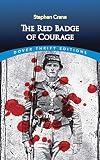
The Dover Thrift Edition is an unabridged, affordable reprint of the complete original text.
Frequently Asked Questions
What is "The Red Badge of Courage" about?
Henry Fleming, a young Union soldier, flees from his first battle and spends a day wrestling with cowardice and shame before returning to fight. Crane had never witnessed combat when he wrote this novel — yet his hallucinatory, impressionistic account of a single soldier's experience in the American Civil War remains the most psychologically honest war novel ever written by an American.
What are the key takeaways from "The Red Badge of Courage"?
Courage and cowardice are not fixed qualities but situational responses that shift from moment to moment War reduces individual identity to sensation and survival instinct Self-narrative — the stories we tell ourselves about our own actions — is almost always self-serving Crane's impressionism anticipated both literary modernism and the psychological realism of the best twentieth-century war writing
Is "The Red Badge of Courage" worth reading?
A ferociously original war novel that strips away every romantic illusion about combat and replaces it with something truer and more terrifying: the chaos inside one young man's mind.
Ready to Read The Red Badge of Courage?
Check the current price on Amazon.
Check Price on Amazon (paid link)Prices and availability are subject to change. See Amazon for current price.
Review last updated: