
Bestseller
Human Acts
by Han Kang
4.4
Based on the 1980 Gwangju Uprising in South Korea, Human Acts traces the aftermath of a massacre through the perspectives of the living, the dead, and those caught between.
Check Price on Amazon (paid link)South Korean · b. 1970
Nobel Prize in Literature (2024), Man Booker International Prize (2016)
Han Kang is a South Korean novelist and Nobel laureate whose works, including The Vegetarian and Human Acts, confront bodily autonomy, political violence, and the limits of endurance with unflinching precision.
Han Kang is among the most important living writers in world literature, and her Nobel Prize in 2024 confirmed a reputation built across a body of fiction of extraordinary formal and emotional intensity. The Vegetarian, the novel that first brought her broad international recognition in Deborah Smith’s English translation, follows a Korean woman whose decision to stop eating meat triggers a spiral of family violence, hospitality, and bodily transformation. The novel is unsettling in ways that are difficult to pin down — it operates on psychological and symbolic registers simultaneously, and its violence is rendered without comment in a way that makes it more rather than less disturbing.
Human Acts returns to the 1980 Gwangju Uprising — a student democracy movement brutally suppressed by the South Korean military — and tells the story of the massacre and its aftermath through multiple perspectives across time. The novel is a meditation on how political violence marks survivors and how societies reckon with atrocity. Han Kang’s prose in this book is perhaps her most direct, and the cumulative weight of the testimonies she constructs is devastating. The White Book, more lyric and formally experimental, meditates on grief, the colour white, and the death of a sister who did not survive infancy.
Han Kang’s work demands real engagement — her novels resist comfort, easy resolution, and the management of difficult feeling. Readers who approach them looking for conventional narrative satisfactions will be frustrated. But for readers willing to sit with genuine literary discomfort, she is extraordinary.
Han Kang is a South Korean writer who became, in 2024, the first Korean and the first Asian woman to win the Nobel Prize in Literature, recognised for her intense, poetic, and unflinching fiction. Celebrated for her spare yet powerful prose and her fearless exploration of violence, trauma, the body, and the human capacity for both cruelty and tenderness, Han has brought Korean literature to a vast international readership. Her work confronts historical and personal pain with extraordinary sensitivity and formal control, and her Nobel Prize confirmed her stature as one of the most significant writers at work in the world today.
Han’s most internationally famous novel, The Vegetarian, brought her to global attention and won the International Booker Prize. The story of a woman whose sudden decision to stop eating meat sets off a cascade of consequences within her family and her own life, the novel is a disturbing and beautiful exploration of autonomy, desire, violence, and the body, told from multiple perspectives. Its strangeness, its intensity, and its refusal of easy interpretation made it a sensation, and it remains the work through which most readers first encounter Han’s singular vision.
A central preoccupation of Han’s fiction is human violence and its lasting trauma, explored at both the personal and the historical level. Her novel Human Acts confronts the brutal suppression of a popular uprising in her native city of Gwangju, bearing witness to historical atrocity and its aftermath with profound moral seriousness. Across her work, she examines how violence marks individuals and societies, and how the wounded body and psyche endure, refusing to look away from suffering while treating it with a tenderness and care that gives her unflinching subject matter its devastating power.
Han is deeply concerned with the human body as a site of pain, resistance, transformation, and meaning. Her fiction returns repeatedly to bodily experience, to questions of what the body can endure and express, and to the relationship between the physical self and identity, autonomy, and the soul. This intense attention to the body, whether in suffering, refusal, or longing for transformation, gives her work a visceral immediacy and a philosophical depth, and it is central to the distinctive, unsettling quality of her vision.
Han’s prose is spare, precise, and intensely poetic, achieving great power through restraint and exactness rather than abundance. She writes with a heightened sensitivity to image, sensation, and silence, and her controlled, luminous style gives even her most harrowing material a strange beauty. This poetic quality, preserved in acclaimed translations that have helped carry her work to international readers, is fundamental to her achievement, allowing her to render extremity and trauma with a delicacy that intensifies rather than softens their impact.
Much of Han’s work functions as an act of memory and witness, recovering and honouring experiences of suffering that history threatens to erase or forget. Whether confronting historical atrocity or intimate personal pain, she insists on remembrance and on the moral importance of bearing witness, and her later work continues to explore historical trauma and its echoes. This commitment to memory, to giving voice to the silenced and the wounded, gives her fiction its ethical weight and its profound seriousness of purpose.
Han Kang’s Nobel Prize marked a historic moment for Korean and Asian literature, and her intense, poetic, morally serious fiction has earned her a global readership and lasting influence. For newcomers, The Vegetarian is the most common starting point, with the powerful Human Acts offering her historical witness at its most affecting. For readers seeking spare, poetic, and unflinching fiction that confronts violence, trauma, and the body with rare sensitivity and beauty, Han Kang is widely regarded as one of the most important and rewarding writers of our time. Her growing body of work, increasingly available in translation, continues to draw new readers into her singular and haunting literary world.
by Han Kang
Based on the 1980 Gwangju Uprising in South Korea, Human Acts traces the aftermath of a massacre through the perspectives of the living, the dead, and those caught between.
Check Price on Amazon (paid link)
by Han Kang
A novelist travels to Jeju Island in the middle of a snowstorm to care for her friend's injured bird — and confronts the buried history of the Jeju April Third Incident, the 1948 massacre in which tens of thousands of Koreans were killed.
Check Price on Amazon (paid link)
by Han Kang
A woman who has lost her language — who has gone mute following personal losses — attends a class in ancient Greek taught by a man who is losing his sight. A novel about language, loss, and the possibility of connection when ordinary communication fails.
Check Price on Amazon (paid link)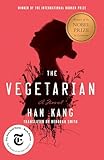
by Han Kang
A South Korean woman's decision to stop eating meat triggers a crisis that ripples through her family, her marriage, and her sense of self.
Check Price on Amazon (paid link)
by Han Kang
A meditation on whiteness, grief, and a sister who died hours after birth — Han Kang's most lyrical and formally experimental work.
Check Price on Amazon (paid link)list
The best Korean literature — from The Vegetarian and Human Acts to Pachinko and The White Book. Essential contemporary and classic Korean fiction.
guide
Where to start with Han Kang — whether to begin with The Vegetarian, Human Acts, or Greek Lessons. A complete reading guide to the Nobel Prize-winning Korean novelist.
list
All Han Kang novels in order — The Vegetarian, Human Acts, The White Book, Greek Lessons, We Do Not Part. Complete guide to the 2024 Nobel Prize winner.
list
Han Kang's triptych about a woman who stops eating meat — and what this decision does to the people around her — is unlike almost anything else in contemporary fiction. These books share its unsettling precision, its focus on the body as battleground, and its willingness to follow transgression to its end.
Disclosure: Amazon links on this page are affiliate links. If you purchase through them we earn a small commission at no extra cost to you.