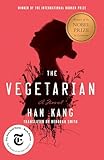
Editors Reads Verdict
The Vegetarian is a deeply unsettling novel about bodily autonomy, violence, and the cost of nonconformity in a society that demands compliance — told in three distinct parts that grow progressively stranger and more beautiful.
What We Loved
- Formally innovative — three narrators, three tones, one unravelling story
- Han Kang's prose (in Deborah Smith's translation) is arrestingly strange and beautiful
- The allegorical dimensions are rich without being reductive
- Short and intense — the novel accomplishes more in 192 pages than most do in 400
Minor Drawbacks
- The subject matter — including violence, eating disorders, and self-harm — is deeply difficult
- The dreamlike logic can feel elusive on first reading
- Deborah Smith's translation has been contested by some Korean scholars
Key Takeaways
- → The body is a site of political resistance as much as biological necessity
- → Refusal to comply with social norms is treated as madness in Han Kang's Korea
- → Violence within family structures is often invisible until it erupts
- → The desire to become plant-like — rooted, harmless — is about escaping human cruelty
- → Each narrator reveals the limits of their own understanding of Yeong-hye
| Author | Han Kang |
|---|---|
| Publisher | Hogarth Press |
| Pages | 192 |
| Published | February 2, 2016 |
| Language | English |
| Genre | Fiction, Literary Fiction |
| Difficulty | Intermediate |
| Best For | Literary fiction readers drawn to challenging, formally unusual work — particularly those interested in Korean literature, feminist fiction, and novels about bodily autonomy. |
How The Vegetarian Compares
The Vegetarian at a glance against 2 similar books readers weigh alongside it.
| Book | Author | Rating | Best for |
|---|---|---|---|
| The Vegetarian (this book) | Han Kang | ★ 4.1 | Literary fiction readers drawn to challenging, formally unusual work — |
| Human Acts | Han Kang | ★ 4.4 | Readers of serious literary fiction prepared for challenging content — |
| The White Book | Han Kang | ★ 4.1 | Readers drawn to lyrical, experimental literary fiction and prose poetry — |
A Decision That Changes Everything
When Yeong-hye decides to stop eating meat, her husband is puzzled and embarrassed. Her family is furious. The decision seems, from the outside, like an ordinary lifestyle choice — eccentric perhaps, but no more. What unfolds over The Vegetarian’s three sections reveals it as something far more radical: a withdrawal from the demands of human existence itself.
Han Kang’s novel, originally published in Korean in 2007 and translated by Deborah Smith in 2015, won the International Booker Prize and introduced Western readers to one of the most distinctive literary voices of the contemporary moment. Its 2024 Nobel Prize — awarded to Han Kang — was a delayed recognition of what careful readers already knew.
Three Perspectives, One Unravelling
The novel is told in three parts, each from a different perspective. Yeong-hye’s husband narrates the first — clinical, resentful, ultimately revealing. Her brother-in-law narrates the second, in which an obsessive and transgressive desire for Yeong-hye develops into something both disturbing and oddly tender. Her sister narrates the third, watching Yeong-hye’s retreat from food, from flesh, from the very category of animal, with helpless grief.
None of these narrators are fully reliable, and none of them fully understands what Yeong-hye is doing. That is the point. Her withdrawal is legible as madness from every external angle, and the novel asks you to consider what it would mean to take her seriously on her own terms.
Body as Battleground
Han Kang is writing about a very specific kind of violence: the violence of a society that claims ownership of women’s bodies, that demands compliance and punishes refusal. Yeong-hye’s vegetarianism is not dietary but existential. Her ultimate desire — to photosynthesize, to stand in light and grow — is a fantasy of escaping the food chain of human cruelty entirely.
The novel is not comfortable reading. But it is essential.
Our rating: 4.1/5 — Formally brilliant and deeply disturbing: Han Kang’s most accessible novel and a perfect entry point to her work.
Publication and Awards
The Vegetarian was published in Korean in 2007 as three linked novellas; it was translated into English by Deborah Smith and published by Portobello Books in 2015. In 2016 it won the Man Booker International Prize, which Han Kang shared with her translator — the first time a Korean author had won the award, and the first time the prize had been shared with a translator under its revised rules for translated fiction. The prize brought Han Kang to international attention and prompted translations into more than forty languages.
The translator Deborah Smith, who was learning Korean while making the translation, was subsequently praised and criticised for her choices: some Korean critics argued that Smith’s English was freer than the original warranted, that the novel’s formal restraint in Korean had become something more lush. The controversy raised questions about translation practice that extended well beyond the novel itself.
Structure
The three novellas — “The Vegetarian,” “The Mongolian Mark,” and “Flaming Trees” — each narrate the same story from a different distance. The first is told by Yeong-hye’s husband, the most distant and obtuse witness to her transformation; the second by her brother-in-law, whose obsessive response to her strange birthmark leads him to his own destruction; the third by her sister In-hye, who must choose between the impulse to save Yeong-hye and Yeong-hye’s own increasingly clear desire not to be saved.
Han Kang’s Themes
The novel belongs to a strand of Han Kang’s work concerned with the body as the site of resistance to a world that demands compliance. In The Vegetarian, meat-eating is first and simply a social obligation — eating what the family eats — and Yeong-hye’s refusal to participate is understood by everyone around her as a form of aggression. What follows is the escalating effort of her family, her husband, her doctors to force her back into compliance: a violence that wears the face of care. Han Kang received the Nobel Prize in Literature in 2024.
Translation and the Booker International
The Man Booker International Prize, established in 2005, is given to a single work of fiction translated into English and published in the UK. The 2016 prize was the first under revised rules that gave equal credit to translator and author. The prize brought sustained attention to contemporary Korean literature in the Anglophone world and to the translation practices that mediate it. The debate about Deborah Smith’s translation choices — whether her freer approach to Kang’s spare Korean enhanced or distorted the original — raised questions about translation ethics that have informed practice in the field since.
The Body as Resistance
In Han Kang’s subsequent novels — Human Acts (2014), The White Book (2016), The Vegetarian (2007) — the body appears repeatedly as the site at which political or social pressure is registered most directly. Yeong-hye’s body, transformed by her refusal to eat meat, is the most literal version of this pattern: a woman who has no language for her resistance expresses it through the only medium left to her. In Human Acts, it is the bodies of the dead that carry the novel’s political weight; in The White Book, it is the physical sensation of whiteness. Kang’s 2024 Nobel Prize recognised this consistent attention to embodied experience as the vehicle for her most serious inquiry.
The Man Booker International Prize’s recognition of both Han Kang and her translator Deborah Smith marked a turning point in Anglophone awareness of contemporary Korean literature and of translation’s role in shaping what reaches international readers.
Frequently Asked Questions
What is "The Vegetarian" about?
A South Korean woman's decision to stop eating meat triggers a crisis that ripples through her family, her marriage, and her sense of self.
Who should read "The Vegetarian"?
Literary fiction readers drawn to challenging, formally unusual work — particularly those interested in Korean literature, feminist fiction, and novels about bodily autonomy.
What are the key takeaways from "The Vegetarian"?
The body is a site of political resistance as much as biological necessity Refusal to comply with social norms is treated as madness in Han Kang's Korea Violence within family structures is often invisible until it erupts The desire to become plant-like — rooted, harmless — is about escaping human cruelty Each narrator reveals the limits of their own understanding of Yeong-hye
Is "The Vegetarian" worth reading?
The Vegetarian is a deeply unsettling novel about bodily autonomy, violence, and the cost of nonconformity in a society that demands compliance — told in three distinct parts that grow progressively stranger and more beautiful.
Ready to Read The Vegetarian?
Check the current price on Amazon.
Check Price on Amazon (paid link)Prices and availability are subject to change. See Amazon for current price.
Review last updated: