Small Things Like These: A Reading Guide to Claire Keegan's Novella
A reading guide to Small Things Like These by Claire Keegan — the historical context of the Magdalene Laundries, Keegan's craft, the Cillian Murphy film, and discussion questions for book clubs.
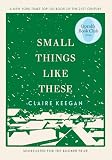
Claire Keegan’s Small Things Like These is 120 pages that do what most 400-page novels don’t manage: they make you sit with a moral question you cannot dismiss. Published in 2021, it won the Orwell Prize for Political Fiction and the Kerry Group Irish Novel of the Year. In 2023, a film adaptation starring Cillian Murphy premiered at Cannes.
This guide covers the historical context, Keegan’s craft, the film adaptation, and discussion questions for reading groups.
The Historical Context: The Magdalene Laundries
To read Small Things Like These with full understanding, you need to know something about the Magdalene Laundries — the institutions the novella circles.
What were they? The Magdalene Laundries (named for Mary Magdalene) were Catholic-run institutions in Ireland, Britain, and elsewhere where women and girls were sent to work. In Ireland, they operated from the 18th century until 1996. Women were committed for reasons that included: being unmarried and pregnant, being orphaned, being considered promiscuous, being intellectually disabled, or simply being inconvenient to their families.
What happened there? Women were confined without pay, often without their consent, sometimes without any route to leave. They worked in industrial laundries. Many had their children taken away. Some died inside the laundries; others were buried on the grounds in unmarked graves.
The scale: Approximately 10,000 women and girls passed through Magdalene Laundries in Ireland alone during the 20th century. The Bon Secours Mother and Baby Home in Tuam, County Galway, had a mass grave of approximately 800 infant remains discovered in 2017.
The reckoning: Ireland’s Government commissioned the McAleese Report (2013), which confirmed the state’s role in committing women to the laundries. Taoiseach Enda Kenny issued a formal state apology on 19 February 2013. The last Irish Magdalene Laundry, the Sean MacDermott Street Laundry in Dublin, closed in 1996.
Small Things Like These is set in 1985 — eleven years before closure, during a period when the laundries were still operating and the community around them still mostly looked away.
Keegan’s Craft: What the Novella Does
The choice of protagonist. Keegan does not give us a survivor’s perspective. She gives us Bill Furlong — the coal merchant, the peripheral figure, the man who just delivers the coal. This is not accidental. By choosing Furlong, Keegan places the moral question with the ordinary person, not the exceptional one. Anyone can identify with someone whose involvement is as incidental as delivering fuel.
The weight of what is not said. The novella’s prose style is famous for what it leaves out. Keegan never names the Magdalene Laundries explicitly. She does not describe what Furlong finds in graphic detail. The horror accumulates through implication, through the reactions of other characters, through what Furlong begins to see that he had chosen not to see before. This is the formal equivalent of the community’s silence: Keegan makes the reader complicit in the same looking-away.
Free indirect discourse. Keegan uses free indirect discourse — the blending of narrator’s voice and character’s interior thought — with unusual precision. We are inside Furlong’s consciousness without being trapped there. This allows Keegan to show the gap between what Furlong perceives and what he is able to articulate, which is where the moral drama lives.
The seasonal frame. The Christmas setting is not sentimental decoration. Christmas is when charity is expected, when community bonds are supposed to tighten, when goodwill is a social obligation. Setting the crisis in Advent — the season of waiting and preparation — gives Furlong’s decision a liturgical weight that resonates even for secular readers.
The Film Adaptation (2023)
Directed by Tim Mielants and produced by Element Pictures, the film premiered at the Cannes Film Festival (Un Certain Regard) in May 2023 and went into wide release later that year.
Cillian Murphy as Bill Furlong. Murphy’s performance is one of restraint and physical presence — he captures Furlong’s watchfulness, his physical labour, his incremental reckoning. It is among the best performances of his career.
What the film adds. The film gives visual texture to 1985 New Ross: the industrial waterfront, the fog and damp of the town, the contrast between the convent’s formal coldness and the warmth of Furlong’s domestic life. The production design is meticulous.
What the film can’t do. Keegan’s prose is doing work that film cannot easily replicate. The free indirect discourse — the way we are in Furlong’s consciousness but slightly outside it — is inherently literary. The film compensates with visual metaphor (water, light, spatial relationships between Furlong and the institutions around him), which works, but differently.
Recommendation: Read the book first. The film is an excellent companion, not a substitute.
Key Passages for Discussion
On looking away:
“What else was there to do, when a thing was just life and not its derangement? […] Was it not the case that all men alive were simply getting through it as best they could, while they could?”
On complicity:
“The town would go on as it had always done, with its church and its school and its convent and its petty rivalries and conveniences and its silence.”
On Furlong’s decision:
“It was not possible to carry on and to turn away. He knew this now. He had known it for some time.”
Discussion Questions for Book Clubs
-
Bill Furlong is not a hero in any conventional sense — he doesn’t expose the convent, he doesn’t call the authorities. What exactly does he do at the end of the novella, and is it enough?
-
Every character who warns Furlong off — his wife, the merchants, the priest — gives reasons that are coherent within their own logic. How does Keegan prevent these characters from becoming simple villains?
-
The novella is set in 1985, not at the height of the Laundries’ power. Why might Keegan have chosen this particular moment?
-
Furlong’s own origins — the unmarried woman who worked in the big house, the uncertain father — give him a specific relationship to the situation he discovers. How does his own history shape his response?
-
Keegan uses extraordinary economy of language. Find a passage where what is left unsaid carries as much weight as what is written. What is the effect?
-
The Christmas setting: is Keegan using religious symbolism here, or undermining it, or both?
-
What is the significance of Furlong’s profession as a coal merchant — a man who literally brings fuel to the institutions in his town?
-
The novella ends without full resolution. Is this a failure, or is the open ending the most truthful response to the historical reality it depicts?
Related Reading
- Claire Keegan: Books in Order → — the full Keegan bibliography, including Foster, So Late in the Day, and her story collections
- Foster by Claire Keegan — her earlier novella, also about a child and the care of strangers; the clearest comparison piece
- So Late in the Day by Claire Keegan — her most recent work, a short story about male entitlement told in Keegan’s characteristic prose
Small Things Like These will stay with you. It is the kind of book that makes you think about what you know and have chosen not to act on — in your community, in your institutions, in your own small things. That discomfort is the point. Keegan is a precise and purposeful writer. She put it there deliberately.
Frequently Asked Questions
What is Small Things Like These about?
Small Things Like These by Claire Keegan is set in a small Irish town in the weeks before Christmas 1985. Bill Furlong, a coal merchant, discovers a young woman imprisoned in the local convent's coal shed — one of the Magdalene Laundries run by the Catholic Church. The novella explores whether he will act on what he has seen or look away, as everyone around him urges him to.
Is Small Things Like These based on a true story?
The novella is fictional but rooted in historical fact. The Magdalene Laundries were real institutions run by Catholic religious orders in Ireland, where unmarried mothers, orphans, and other women deemed morally problematic were forced to work without pay. The last Magdalene Laundry in Ireland closed in 1996. Ireland's Government issued a formal state apology in 2013.
Is Small Things Like These a long book?
No — it is a novella of approximately 120 pages. Most readers complete it in two to three hours. Its brevity is part of its design: Keegan's economy of language means there is not a single superfluous sentence.
How does the film compare to the book?
The 2023 film, directed by Tim Mielants and starring Cillian Murphy as Bill Furlong, is a faithful adaptation. Murphy gives a performance of extraordinary restraint that matches the book's tone. The film adds visual texture that complements Keegan's prose. Most readers prefer the book, because Keegan's interior rendering of Furlong's consciousness is where the novella's real work happens — and that is harder to translate to screen.
What is the significance of the title Small Things Like These?
The title comes from a passage about what ordinary people do — or don't do — when confronted with something they would rather not see. 'Small things' are the individual acts of looking away that collectively maintain institutional abuse. The title asks what small things we are each capable of, and what small things we refuse.
Is Small Things Like These appropriate for book clubs?
Yes — it is one of the most book-club-ready novellas of recent years. At 120 pages, it can be read in a single evening, and it generates substantial discussion about complicity, conscience, Irish Catholicism, and the gap between public morality and private knowledge. The historical context of the Magdalene Laundries adds an educational dimension.