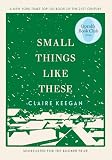
Editors Reads Verdict
A novella of devastating precision. Keegan says more about complicity, decency, and the cost of looking away in 120 pages than most novelists achieve in 400. The Cillian Murphy film adaptation brought it to a global audience, but the book is the richer experience.
What We Loved
- Prose of extraordinary economy — not a word is wasted across 120 pages
- The moral question at the heart of the novel is presented without sentimentality or easy resolution
- The small-town Irish setting is rendered with complete authenticity
- Bill Furlong is one of the most quietly heroic protagonists in recent literary fiction
- The Magdalene Laundries context is handled with rigour and restraint
Minor Drawbacks
- At 120 pages it is a novella — readers wanting a full novel may want to pair it with Keegan's other work
- The ending is deliberately open; readers wanting resolution will find it incomplete
Key Takeaways
- → Small acts of conscience in communities governed by silence can carry enormous moral weight
- → Complicity is not always active — it can be simply the habit of not looking
- → The Magdalene Laundries represent a specific failure of Irish Catholicism and community
- → Ordinary decency, in the right circumstances, is an act of courage
| Author | Claire Keegan |
|---|---|
| Publisher | Grove Press |
| Pages | 120 |
| Published | October 28, 2021 |
| Language | English |
| Genre | Literary Fiction, Historical Fiction, Irish Literature |
| Difficulty | Intermediate |
| Best For | Readers of literary fiction, Irish fiction, and anyone interested in the Magdalene Laundries period of Irish history. Ideal for book clubs given its length and moral complexity. |
How Small Things Like These Compares
Small Things Like These at a glance against 3 similar books readers weigh alongside it.
| Book | Author | Rating | Best for |
|---|---|---|---|
| Small Things Like These (this book) | Claire Keegan | ★ 4.4 | Readers of literary fiction, Irish fiction, and anyone interested in the |
| Foster | Claire Keegan | ★ 4.3 | Readers of literary fiction, Irish fiction, and short-form narrative |
| Normal People | Sally Rooney | ★ 4.1 | Literary fiction readers interested in contemporary Irish society, millennial |
| So Late in the Day | Claire Keegan | ★ 4.0 | Existing Keegan readers and fans of her New Yorker work |
Small Things Like These Review
Small Things Like These is set in New Ross, County Wexford, in the cold weeks before Christmas 1985. Bill Furlong, a coal and timber merchant, is a self-made man who knows exactly what he came from and has worked steadily to build something better for his wife, Eileen, and their five daughters. He was born to an unmarried teenage mother and might easily have been one of the discarded — but his mother kept her job and her dignity because her employer, the Protestant widow Mrs. Wilson, chose decency over the prevailing cruelty and took them both in. That accident of grace shapes everything about the man Furlong becomes. He is, by the standards of his town, a good man. He delivers coal to the convent on the hill. He does not ask what happens behind its walls.
Then one December morning he finds something in the convent’s coal shed that he cannot unknow: a girl, locked in, half-frozen and desperate, one of the young women hidden inside.
A great subject seen from the edge
Claire Keegan’s novella takes one of the darkest chapters of modern Irish history — the Magdalene Laundries, the network of Catholic-run institutions where unmarried mothers, “fallen women,” and girls deemed troublesome were confined and made to labour without pay, their babies frequently taken from them — and approaches it from an unexpected angle. She does not narrate from inside the laundry. She tells the story through a peripheral figure who did not build the institution and does not run it. Bill Furlong is simply the man who delivers the coal. In making him her protagonist, Keegan places the novel’s moral question exactly where it belongs: not with the obvious villains, but with the ordinary, respectable townspeople who knew and said nothing.
This is the book’s central insight, and it is delivered with merciless economy. Small Things Like These is about the condition Keegan dramatises as looking the other way — the community-wide, unspoken agreement not to acknowledge what the convent does, in exchange for the social order, moral authority, and commercial goodwill the Church guarantees. The nuns control the local girls’ school and the laundry that the town relies on; to cross them is to risk your children’s prospects and your own livelihood. Every character who warns Furlong to leave it be, to mind his own business, to not go upsetting things for himself and his family, is quietly enacting that bargain. Even Eileen, whom Keegan refuses to caricature, counsels caution out of love and fear. The question the book holds open to its final page is whether one decent man can refuse the bargain that everyone around him has accepted.
The weight of small things
The novel’s title is also its argument. Keegan is interested in how the apparently insignificant gestures of a life — a kindness shown, a coin pressed into a hand, a door opened — accumulate into something that finally amounts to a person’s character. There is quiet design even in her protagonist’s name: a furlong is the length of a furrow, the distance a team of oxen could plough before resting, a unit built from small, patient increments of effort. Furlong’s act of conscience is not heroic in any cinematic sense. It is small, almost domestic, and enormously costly precisely because he can see, clearly, what it will cost. Keegan never lets us pretend otherwise; the courage of the ending is inseparable from its danger.
What makes the book extraordinary is the prose. In roughly 120 pages Keegan says more about complicity, decency, and the price of looking away than most novelists manage in four hundred. Not a word is wasted. The sentences are lean, rhythmic, and controlled, the small-town setting rendered with complete authenticity — the cold, the routines, the gossip, the Christmas lights against the grey. The restraint is the point: she trusts the reader to feel the horror without being told how to feel it.
Reception, the film, and the verdict
The novella’s stature was quickly recognised. It won the 2022 Orwell Prize for Political Fiction and was shortlisted for the Booker Prize the same year, remarkable for a book of its length, and it has since become a fixture of book-club and classroom reading lists. The acclaimed screen adaptation starring Cillian Murphy — who also produced — opened the 2024 Berlin International Film Festival and reached a global audience later that year. The film is faithful in its essentials and gives the material the gravity it deserves. The book, however, remains the richer experience: Keegan’s prose does things on the page that cinema cannot easily translate, and the interior drift of Furlong’s conscience is best followed in her own words.
A few readers will want more. At 120 pages this is unmistakably a novella, and those hoping for a full-length novel may wish to pair it with Keegan’s equally fine Foster. The ending, too, is deliberately open — it withholds the tidy resolution a more conventional book would supply, leaving Furlong, and the reader, suspended on the threshold of consequence. But these are not flaws so much as the terms of the achievement; the restraint that frustrates is the same restraint that makes the final pages land with such force. It is the kind of book you finish in a single sitting and then carry with you for weeks, returning in your mind to that walk through the cold streets and the choice it represents. Small Things Like These is a small book about the largest of subjects: the difference between knowing and doing, and the rare, ordinary courage it takes to close that gap. It is one of the finest pieces of Irish fiction of its generation, and essential reading.
Reading Guides
Frequently Asked Questions
What is "Small Things Like These" about?
In a small Irish town in the weeks before Christmas 1985, a coal merchant named Bill Furlong begins to see what the respected convent at the edge of town is hiding — and must decide whether to look away or act.
Who should read "Small Things Like These"?
Readers of literary fiction, Irish fiction, and anyone interested in the Magdalene Laundries period of Irish history. Ideal for book clubs given its length and moral complexity.
What are the key takeaways from "Small Things Like These"?
Small acts of conscience in communities governed by silence can carry enormous moral weight Complicity is not always active — it can be simply the habit of not looking The Magdalene Laundries represent a specific failure of Irish Catholicism and community Ordinary decency, in the right circumstances, is an act of courage
Is "Small Things Like These" worth reading?
A novella of devastating precision. Keegan says more about complicity, decency, and the cost of looking away in 120 pages than most novelists achieve in 400. The Cillian Murphy film adaptation brought it to a global audience, but the book is the richer experience.
Ready to Read Small Things Like These?
Check the current price on Amazon.
Check Price on Amazon (paid link)Prices and availability are subject to change. See Amazon for current price.
Review last updated: