Where to Start with Lewis Carroll: A Reading Guide
Where to start with Lewis Carroll — whether to begin with Alice's Adventures in Wonderland or Through the Looking-Glass. A complete reading guide.

Lewis Carroll (the pen name of Charles Lutwidge Dodgson, 1832–1898) was the British mathematician, logician, photographer, and author who created Alice’s Adventures in Wonderland (1865) and Through the Looking-Glass, and What Alice Found There (1871) — two of the most significant children’s books ever written and among the most widely referenced works in Western culture, their imagery (the Cheshire Cat’s smile, the Mad Hatter’s tea party, the Queen of Hearts) having entered the general cultural vocabulary. Dodgson was a mathematics lecturer at Christ Church, Oxford; his mathematical and logical training is inseparable from his construction of Wonderland, which is a world of rigorous illogic rather than mere chaos.
Where to Start: Alice’s Adventures in Wonderland (1865)
The essential Carroll — and one of the great works of English children’s literature. Alice is seven years old and sitting by a riverbank when a White Rabbit in a waistcoat, muttering about being late, runs past and disappears down a hole. Alice follows.
Wonderland operates by rules that are internally consistent but contradict everything Alice knows: size changes arbitrarily, time doesn’t work properly, the creatures have strong opinions about etiquette and rules but cannot agree on what the rules are. The Cheshire Cat appears and disappears, leaving only its smile. The Mad Hatter and March Hare hold a perpetual tea party because time stopped at six o’clock and will not start again. The Queen of Hearts orders everyone beheaded.
Carroll’s genius is that the nonsense has structure. Alice’s difficulty in Wonderland is not that the world has no rules but that the rules keep changing and that Alice — a sensible Victorian child who knows how things are supposed to work — cannot find stable ground. The book is a sustained meditation on the problem of rule-following in a world where the rules are unclear, contradictory, or arbitrary.
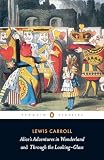
John Tenniel’s illustrations are inseparable from the text and remain the definitive visual interpretation.
Through the Looking-Glass (1871)
The sequel — a chess game instead of a card game, Tweedledum and Tweedledee, Humpty Dumpty on language and meaning. Carroll’s most systematically structured book; a natural continuation after the first.
Why Alice’s Adventures in Wonderland Is the Ideal First Book
For a reader new to Lewis Carroll, Alice’s Adventures in Wonderland is the ideal first book because it is his most famous and beloved work, one of the most celebrated children’s books ever written, and the fullest expression of his distinctive genius, the combination of nonsense, wordplay, logic, and imaginative invention. Alice’s Adventures in Wonderland follows a young girl who falls down a rabbit hole into a fantastical world governed by its own absurd logic, peopled by unforgettable characters and full of wordplay, paradox, and imaginative delight. As an entry point, it offers the purest and most beloved expression of Carroll’s genius, the nonsense and wordplay, the playful logic, and the imaginative invention that have delighted readers of all ages for generations. It welcomes the newcomer with its imaginative delight, its unforgettable characters, and its playful wit, drawing the reader into a fantastical world of endless invention. It is his most famous work and the one that best represents his genius, so that the new reader encounters Carroll at his most delightful. For the newcomer, then, Alice’s Adventures in Wonderland is the natural and ideal starting point.
What to Expect as a New Reader
As a new reader, you can expect Alice’s Adventures in Wonderland to be a work of pure imaginative delight, a fantastical journey full of nonsense, wordplay, playful logic, and unforgettable characters. You can expect a fantastical premise, a young girl who falls down a rabbit hole into a world governed by its own absurd logic, and you can expect this world to be peopled by unforgettable characters and full of strange and delightful incidents. You can expect nonsense and wordplay, for Carroll delights in paradox, puns, riddles, and the playful subversion of logic and language, and you can expect this verbal and logical play to be a central pleasure of the book. You can expect imaginative invention of endless delight, and you can expect, beneath the apparent nonsense, a sly intelligence, for Carroll, a mathematician, plays cleverly with logic and meaning. You can expect a book that delights readers of all ages, child and adult alike. Expect, in short, a work of pure imaginative delight, full of nonsense, wordplay, and unforgettable characters, a delightful introduction to Carroll’s genius.
Going Deeper After Your First Book
Once Alice’s Adventures in Wonderland has introduced you to Carroll’s imaginative world, the natural next step is its sequel, Through the Looking-Glass, which returns to the same delightful nonsense and wordplay in a new fantastical adventure. Through the Looking-Glass follows Alice into another fantastical world, this one structured around the logic of a chess game and a mirror world, and it offers the same imaginative invention, wordplay, and unforgettable characters as the first book, including some of Carroll’s most famous creations and verses. Reading it after the first book deepens your appreciation of Carroll’s distinctive genius, the nonsense and wordplay, the playful logic, and the imaginative invention that mark both books. His characteristic delights run through both works, and the reader who has been charmed by the first will find the same pleasures in the second. Building your reading journey through Carroll’s work is a matter of following Alice from Wonderland through the looking-glass, enjoying the imaginative delight and verbal play of both. The reader who begins with Alice’s Adventures in Wonderland and continues with Through the Looking-Glass will have encountered the full delight of Carroll’s imaginative genius.
Reading Lewis Carroll
Begin with Alice’s Adventures in Wonderland — it is his essential work and the most influential. Read Through the Looking-Glass immediately after; the two books are companion pieces and Carroll intended them to be read together.
For the full Lewis Carroll bibliography, reviews, and biography, visit the Lewis Carroll author page on Editors Reads.
Affiliate disclosure: Links to Amazon on this page are affiliate links. We earn a small commission at no extra cost to you.
Frequently Asked Questions
Where should I start with Lewis Carroll?
Alice's Adventures in Wonderland (1865) is the essential starting point — Carroll's story of Alice following a white rabbit down a hole and entering a world of dream logic, impossible physics, and anthropomorphic creatures who operate by rules that make internal sense but contradict the normal world. One of the most influential children's books ever written, read by adults as frequently as by children, and significant in the history of fantasy, surrealism, and logical nonsense.
What is Alice's Adventures in Wonderland about?
Alice falls down a rabbit hole and enters Wonderland, where she encounters the White Rabbit, the Cheshire Cat, the Mad Hatter and March Hare at their perpetual tea party, and the Queen of Hearts (whose response to everything is 'Off with their heads!'). The novel operates by dream logic — size changes arbitrarily, conversations lead nowhere, the rules keep changing — but Carroll's background as a mathematician means the illogic is systematically constructed. The book is as much about the nature of rules, identity, and language as it is about a girl having adventures.
What is Through the Looking-Glass about?
Through the Looking-Glass (1871) is Carroll's sequel — Alice passes through a mirror into a world that operates like a chess game, with the characters occupying positions on the board and the whole journey structured as a chess match. The book introduces Tweedledee and Tweedledum, Humpty Dumpty (whose lecture on the meaning of words is one of Carroll's most sustained philosophical jokes), and the Red and White Queens. Slightly more structured than the first book but equally rich in nonsense and logical paradox.
Are Carroll's books really for children?
Both Alice books are officially children's books but have been read by adults with as much pleasure and more comprehension since their publication. Carroll was a mathematician and logician; the nonsense in the books is not random but systematic, and the philosophical jokes (about identity, meaning, time, and the nature of rules) are funnier and more complex the more philosophical training the reader has. The books are children's classics that also function as sophisticated works of literary nonsense philosophy.