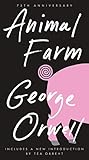
Editors Reads Verdict
Orwell's deceptively simple fable is the most accessible political satire in English — and the most devastating account of how revolutionary ideals are systematically corrupted by those who lead revolutions. In 128 pages it captures the entire arc of the Soviet experiment.
What We Loved
- The allegorical economy is perfect — every element maps onto the Soviet history it illuminates
- Accessible to any age without sacrificing intellectual or political seriousness
- Squealer's propaganda techniques remain a manual for how official narratives are constructed
- The ending is one of the most despairing in English literature, delivered with complete calm
Minor Drawbacks
- The historical allegory can overshadow the story's resonance for contexts beyond the Soviet Union
- The animals other than the pigs and Boxer are somewhat thinly characterised
- The political allegory is so precise that it can feel more historical document than living fiction
Key Takeaways
- → Every revolution risks repeating the power structure it overthrew — the pigs become the farmers
- → Language is the primary tool of political control — 'All animals are equal, but some are more equal than others'
- → Boxer — the loyal, hardworking, unquestioning worker — is the revolution's most exploited victim
- → Propaganda works by altering memory — 'You do not remember things as they were'
- → Violence and intimidation are tools of last resort; propaganda and gradual normalisation are more effective
| Author | George Orwell |
|---|---|
| Publisher | Signet Classics |
| Pages | 128 |
| Published | August 17, 1945 |
| Language | English |
| Genre | Fiction, Classic Literature, Political Satire, Fable |
| Difficulty | Beginner |
| Best For | Every reader — *Animal Farm* is short enough to read in an afternoon and significant enough to think about for years. The definitive introduction to political satire. |
How Animal Farm Compares
Animal Farm at a glance against 3 similar books readers weigh alongside it.
| Book | Author | Rating | Best for |
|---|---|---|---|
| Animal Farm (this book) | George Orwell | ★ 4.6 | Every reader — *Animal Farm* is short enough to read in an afternoon and |
| 1984 | George Orwell | ★ 4.7 | Every adult in a democracy |
| Brave New World | Aldous Huxley | ★ 4.5 | Readers of 1984 and other dystopian fiction, philosophy and ethics enthusiasts, |
| The Grapes of Wrath | John Steinbeck | ★ 4.7 | Readers who want serious literature with genuine social conscience — and anyone |
The Simplest Political Masterpiece
“All animals are equal, but some animals are more equal than others.” The final revision of the Seven Commandments in Animal Farm is one of the most perfectly constructed sentences in English — a logical impossibility that functions as a precise description of how authoritarian ideology actually operates.
Orwell wrote Animal Farm in 1943 and spent two years finding a publisher willing to release it — the wartime alliance with the Soviet Union made his satire politically inconvenient. When it appeared in August 1945, the Cold War was just beginning, and the fable’s targets were becoming available for explicit acknowledgement.
The story is told in the form of an English country fable: animals overthrow their farmer, establish a republic on the principles of “Animalism,” and within a few years find themselves governed by pigs who walk on two legs, carry whips, and wear human clothes. The trajectory is the Bolshevik Revolution to Stalinism, compressed into 128 pages and animal characters so perfectly chosen that the allegory becomes invisible and the fable feels autonomous.
The Mechanics of Corruption
Orwell’s account of how the revolution is corrupted operates through precise, recognisable stages. The first stage is the seizure of privilege: the pigs take the milk and apples, arguing that they need nutrition for the brainwork of management. The second stage is the consolidation of power through violence: Napoleon’s dogs, trained in secret, drive out Snowball — the Trotsky figure — and thereafter terrorism replaces persuasion. The third stage is the rewriting of history: Snowball’s contributions to the revolution are gradually erased, then revised to active villainy. The fourth stage is the revision of the Commandments themselves.
Squealer, Napoleon’s propagandist, is the novel’s most technically interesting character: a pig who can “turn black into white,” who uses statistical claims, historical revision, and the threat of Jones’s return to justify every abuse.
Boxer: The Tragedy of Loyal Labour
The most affecting character in Animal Farm is not Napoleon or Snowball but Boxer, the enormous, gentle carthorse whose loyalty to the revolution is absolute and whose understanding of its corruption is prevented by his own virtues. “Napoleon is always right” and “I will work harder” are Boxer’s two maxims — the maxims of a worker who has redirected his capacity for faith into a political system that exploits it without reciprocating it.
His death — sold to the knacker’s yard when he can no longer work, while Squealer reports that he died peacefully in hospital — is the fable’s emotional centre and its most bitter political argument.
Our rating: 4.6/5 — The most efficient political satire in English — a perfect fable that illuminates every authoritarian system that has ever promised liberation.
A Fable With a Specific Target
Animal Farm works on two levels, and the reader gains by holding both. On the surface it is a perfectly constructed fable: farm animals overthrow their human master, declare that all animals are equal, and watch their revolution curdle as the pigs consolidate power until the famous amendment — that some animals are more equal than others — completes the betrayal. Beneath it is a precise allegory of the Russian Revolution and its descent into Stalinist tyranny, with characters and events that map closely onto real history. Orwell wrote it as a warning against a specific betrayal, but its compression and clarity have let it outlive its occasion.
Why It Still Cuts
The novel endures because the mechanism it exposes is not confined to one revolution: the way idealistic language is hollowed out, the way enemies are invented to justify control, the way the past is quietly rewritten, the way the powerful come to resemble the masters they replaced. Orwell’s achievement is to make these abstractions concrete and unforgettable through animals a child could understand, which is why the book is read both as political history and as a permanent parable about how revolutions are betrayed.
A Short Book That Repays Rereading
Its brevity is deceptive. Animal Farm can be finished in an afternoon, but its economy is the point — every scene advances the slow corruption with fable-like inevitability, and the chill of the ending depends on how lightly the earlier ideals were established. Read young, it lands as a clear story about fairness; read later, it reveals how much political sophistication Orwell packed into so small a space. It remains one of the most effective political satires ever written, and a model of how much weight a simple story can carry.
Why It Outlived Its Occasion
Orwell aimed Animal Farm at a specific betrayal — the Soviet revolution’s descent into tyranny — yet the fable has long outlived the regime it satirised, because the mechanisms it exposes recur wherever power consolidates itself. The hollowing of idealistic language, the invented enemies, the quietly rewritten history, the slow transformation of liberators into a new ruling class: these are not confined to one country or century. That is why the book is read as a permanent parable rather than a period piece, and why its final image — the animals looking from pig to man and back, unable to tell the difference — retains its power to chill long after the historical specifics have faded into footnotes.
Reading Guides
- Books Like Animal Farm: Political Allegory, Power, and How Revolutions Eat Themselves
- Books Like Brave New World: Dystopia, Pleasure, and the Price of Happiness
- Books Like Fahrenheit 451: Censorship, Books, and the Rebellion of Reading
- Books Like Lord of the Flies: Civilization, Savagery, and What Boys Do Without Adults
- Books Like 1984: 10 Dystopian Novels That Will Shake You to the Core
- Books Like Catch-22: 11 Novels That Use Dark Comedy to Tell Hard Truths
- Books Like The Handmaid
Frequently Asked Questions
What is "Animal Farm" about?
The animals of Manor Farm overthrow their human farmer, establish a democracy, and watch helplessly as the pigs gradually become indistinguishable from the humans they replaced.
Who should read "Animal Farm"?
Every reader — *Animal Farm* is short enough to read in an afternoon and significant enough to think about for years. The definitive introduction to political satire.
What are the key takeaways from "Animal Farm"?
Every revolution risks repeating the power structure it overthrew — the pigs become the farmers Language is the primary tool of political control — 'All animals are equal, but some are more equal than others' Boxer — the loyal, hardworking, unquestioning worker — is the revolution's most exploited victim Propaganda works by altering memory — 'You do not remember things as they were' Violence and intimidation are tools of last resort; propaganda and gradual normalisation are more effective
Is "Animal Farm" worth reading?
Orwell's deceptively simple fable is the most accessible political satire in English — and the most devastating account of how revolutionary ideals are systematically corrupted by those who lead revolutions. In 128 pages it captures the entire arc of the Soviet experiment.
Ready to Read Animal Farm?
Check the current price on Amazon.
Check Price on Amazon (paid link)Prices and availability are subject to change. See Amazon for current price.
Review last updated: