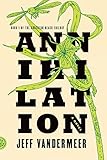
Editors Reads Verdict
Annihilation is one of the most fully realized works of weird fiction in recent literature — a slim, suffocating novel that succeeds by withholding rather than revealing, treating its mystery zone with the genuine strangeness that most genre fiction merely gestures at. VanderMeer's biologist narrator is an ideal vehicle: precise, observant, and slowly losing the ability to trust her own perceptions.
What We Loved
- The atmosphere of wrongness is sustained with extraordinary discipline throughout
- The unnamed narrator's psychological disintegration is rendered with scientific precision
- VanderMeer's prose captures the uncanny without resorting to explanation
- At 195 pages, it achieves maximum dread with minimum footprint
Minor Drawbacks
- The deliberate refusal to explain will frustrate readers who want resolution
- Character development is minimal by design, which limits emotional investment
- The sequels dilute the mystery rather than deepening it
Key Takeaways
- → Genuine strangeness in fiction requires a refusal to translate the unknown into the familiar
- → Nature at sufficient scale becomes incomprehensible — and incomprehension is a form of horror
- → Scientific observation is a psychological act, and observers inevitably alter what they observe
- → Identity is more fragile than we assume — environments can rewrite us
- → The most frightening thing Area X does is make its explorers doubt their own memories
| Author | Jeff VanderMeer |
|---|---|
| Publisher | Farrar, Straus and Giroux |
| Pages | 195 |
| Published | February 4, 2014 |
| Language | English |
| Genre | Science Fiction, Horror, Literary Fiction |
| Difficulty | Advanced |
| Best For | Readers drawn to literary horror and weird fiction, fans of Borges and Kafka, and anyone willing to sit with unresolved mystery in exchange for an atmosphere of genuine dread. |
How Annihilation Compares
Annihilation at a glance against 3 similar books readers weigh alongside it.
| Book | Author | Rating | Best for |
|---|---|---|---|
| Annihilation (this book) | Jeff VanderMeer | ★ 3.9 | Readers drawn to literary horror and weird fiction, fans of Borges and Kafka, |
| Dune | Frank Herbert | ★ 4.7 | Readers of ambitious fiction, fans of the films who want the deeper version, |
| Ender's Game | Orson Scott Card | ★ 4.7 | Science fiction readers from teenage years upward, fans of military fiction who |
| Frankenstein | Mary Shelley | ★ 4.8 | Horror |
The Grammar of the Uncanny
Jeff VanderMeer wrote the first draft of Annihilation in a single extended session, and it shows — not as a flaw but as a quality. The novel has the driven, feverish quality of something that arrived whole, and its prose has a hypnotic consistency that most novels assemble rather than inhabit.
The premise is deceptively simple: the Southern Reach organization has been sending expeditions into Area X, a section of the coastal United States quarantined after some unspecified environmental event. Eleven previous expeditions have returned changed, destroyed, or not at all. The twelfth expedition — four women identified only by profession (the Biologist, the Psychologist, the Surveyor, the Anthropologist) — is our point of entry.
Refusal as Method
VanderMeer’s most important artistic decision is refusal. Area X is not explained. Its phenomena are not catalogued into a taxonomy that would allow them to be processed. The tower that descends into the earth, the words written on its walls in living organisms, the Crawler that writes them, the lighthouse with its disturbing contents — these remain genuinely strange because VanderMeer understands that the moment strangeness is explained, it becomes merely unusual.
The Biologist narrator, observant and methodical by training, provides a naturalist’s precision about what she perceives without ever providing interpretation. Her descriptions are fascinatingly literal — she reports what she sees, not what it means — and the gap between her clinical language and the impossibility of what she observes generates the novel’s particular unease.
Transformation and Identity
Beneath the genre surface, Annihilation is about identity dissolution — the way environments, relationships, and traumatic experiences rewrite who we think we are. The Biologist’s memories of her marriage, her childhood, her scientific career are all called into question by Area X, which seems to reach into the past and alter how she understands herself. This makes the novel something more than an exercise in atmospheric horror: it is a meditation on the fragility of selfhood.
VanderMeer’s influence — Borges, Kafka, the New Weird tradition, Southern Gothic literature — is worn lightly but is legible throughout. Annihilation earns its place in their company.
The Southern Reach Trilogy
Annihilation is the first and shortest volume of VanderMeer’s Southern Reach trilogy, followed by Authority and Acceptance, both published in the same remarkable year, 2014. The trilogy’s structure is itself part of its meaning: where Annihilation plunges the reader into Area X with the twelfth expedition, Authority retreats to the bureaucratic offices of the Southern Reach agency tasked with studying it, and Acceptance braids timelines toward something like understanding without ever fully delivering it. Read alone, Annihilation works as a self-contained descent into the uncanny; read as an overture, it gains additional resonance as the most immediate and frightening entry into a larger meditation on knowledge, institutions, and the limits of human comprehension. That VanderMeer wrote all three in such close succession accounts for their hypnotic tonal unity.
The Biologist
The novel’s power is inseparable from its narrator. The Biologist is a reserved, emotionally guarded scientist whose marriage to a man who joined an earlier expedition haunts the narrative, and her temperament — her preference for observation over connection, for ecosystems over people — makes her uniquely suited to Area X. She does not panic where others would; she studies. VanderMeer uses her detachment to unsettling effect, letting the reader feel the wrongness she reports but does not emote about. As Area X works its transformation on her, the question of whether she is being destroyed or completed becomes genuinely ambiguous, and her growing kinship with the alien landscape — her sense that she belongs to it — is the trilogy’s most disturbing and most moving idea.
Ecological Horror
What distinguishes Annihilation from conventional horror or science fiction is its ecological vision. Area X is not a monster to be defeated but a landscape that has slipped the leash of human meaning — flourishing, beautiful, and utterly indifferent to the people who try to map it. The novel taps a deep contemporary anxiety: that nature is not a resource we manage but a force that will outlast and overwrite us, transforming our categories rather than submitting to them. The dread it generates is less the fear of being killed than the fear of being absorbed, of the boundary between self and environment dissolving. This places the book at the forefront of the “ecological weird,” a mode that uses the uncanny to register the strangeness of a planet humans no longer control.
VanderMeer and the New Weird
Jeff VanderMeer is often called the standard-bearer of the “New Weird,” a literary movement that fuses science fiction, horror, and fantasy while refusing the consolations of any of them. Annihilation is its most accessible masterpiece, drawing on Borges’s labyrinths, Kafka’s unexplained machinery, the Southern Gothic’s rot and humidity, and the cosmic indifference of Lovecraft stripped of his prejudices. The 2018 film adaptation by Alex Garland, starring Natalie Portman, translated the novel’s atmosphere into striking visual terms while necessarily inventing its own ending, and it introduced the story to a far wider audience. The book remains the superior experience precisely because its horror lives in language and irresolution — effects that resist the explanatory pressure of cinema. That refusal to explain, so frustrating to some readers and so thrilling to others, is finally the source of the book’s power: it returns to fiction a quality most of the genre has bargained away, the genuine, unmasterable mystery of an encounter with something the human mind was not built to hold.
Our rating: 3.9/5 — A masterwork of sustained uncanny atmosphere that demands acceptance of irresolution; readers who surrender to its mystery will find one of contemporary fiction’s most original experiences.
Reading Guides
Frequently Asked Questions
What is "Annihilation" about?
The twelfth expedition into the mysterious Area X sends four unnamed women scientists into an environment that defies biological and physical understanding.
Who should read "Annihilation"?
Readers drawn to literary horror and weird fiction, fans of Borges and Kafka, and anyone willing to sit with unresolved mystery in exchange for an atmosphere of genuine dread.
What are the key takeaways from "Annihilation"?
Genuine strangeness in fiction requires a refusal to translate the unknown into the familiar Nature at sufficient scale becomes incomprehensible — and incomprehension is a form of horror Scientific observation is a psychological act, and observers inevitably alter what they observe Identity is more fragile than we assume — environments can rewrite us The most frightening thing Area X does is make its explorers doubt their own memories
Is "Annihilation" worth reading?
Annihilation is one of the most fully realized works of weird fiction in recent literature — a slim, suffocating novel that succeeds by withholding rather than revealing, treating its mystery zone with the genuine strangeness that most genre fiction merely gestures at. VanderMeer's biologist narrator is an ideal vehicle: precise, observant, and slowly losing the ability to trust her own perceptions.
Ready to Read Annihilation?
Check the current price on Amazon.
Check Price on Amazon (paid link)Prices and availability are subject to change. See Amazon for current price.
Review last updated: