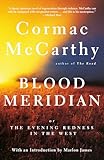
Editors Reads Verdict
Blood Meridian is one of the most ambitious and disturbing novels in American literature — a nihilistic Western epic that has influenced virtually every serious writer of the last forty years, yet remains profoundly challenging and not for all readers.
What We Loved
- Judge Holden is one of the great villains in world literature
- McCarthy's prose at its most incandescent — the landscape writing is extraordinary
- A genuine philosophical challenge that rewards serious engagement
- Historically grounded — based on actual events of the Glanton Gang
Minor Drawbacks
- The relentless, graphic violence is deeply difficult to read for many
- The nameless kid as protagonist offers almost no interiority to hold on to
- Not recommended as a first McCarthy novel
- The philosophical implications are genuinely bleak — there is no redemption
Key Takeaways
- → Violence is not aberration in McCarthy's West but the fundamental condition of human history
- → Judge Holden embodies a philosophy of war as the highest human activity
- → The landscape is morally indifferent — beauty and horror coexist without contradiction
- → Historical atrocity (the Glanton Gang was real) underpins the novel's philosophical claims
- → McCarthy denies the reader the comfort of a redemptive narrative
| Author | Cormac McCarthy |
|---|---|
| Publisher | Random House |
| Pages | 337 |
| Published | January 1, 1985 |
| Language | English |
| Genre | Fiction, Western, Literary Fiction |
| Difficulty | Advanced |
| Best For | Serious readers of literary fiction willing to engage with extreme content and philosophical challenge — not a first McCarthy, and not for the faint of heart. |
How Blood Meridian Compares
Blood Meridian at a glance against 3 similar books readers weigh alongside it.
| Book | Author | Rating | Best for |
|---|---|---|---|
| Blood Meridian (this book) | Cormac McCarthy | ★ 4.2 | Serious readers of literary fiction willing to engage with extreme content and |
| All the Pretty Horses | Cormac McCarthy | ★ 4.3 | Literary fiction readers, fans of American novels, and anyone looking for a |
| No Country for Old Men | Cormac McCarthy | ★ 4.3 | Literary fiction readers |
| The Road | Cormac McCarthy | ★ 4.3 | Literary fiction readers who can engage with sustained grimness in service of |
Harold Bloom called Blood Meridian one of the greatest American novels ever written. He also acknowledged that it was almost unreadable in places. Both assessments are correct. Based on historical records of the Glanton Gang — a real group of scalp-hunters who terrorised the US-Mexico border region in the late 1840s — the novel follows a nameless teenage boy known only as the kid as he falls in with this company of murderers. What follows is a relentless, hallucinatory journey through a landscape of almost incomprehensible violence, rendered in McCarthy’s most incandescent prose: Biblical cadences, no quotation marks, sentences that move from documentary precision to visionary grandeur within a single paragraph.
The novel’s philosophical centre is Judge Holden — a pale, hairless, enormous man of apparent omniscience who dances, plays the fiddle, speaks multiple languages, and delivers speeches that amount to the most coherent defence of absolute evil in literary fiction. Holden believes that war is God. That the earth is a blood pudding. That whoever has the capacity for violence and the will to exercise it is the true inheritor of history. He is terrifying precisely because his argument is never refuted within the novel. McCarthy does not provide a counter-voice that defeats Holden’s philosophy. The reader is forced to sit with his claims and find independent reasons to reject them, which makes Blood Meridian a more genuinely philosophical novel than most works that announce themselves as philosophical.
What the book offers against Holden’s nihilism is, perhaps, the prose itself. McCarthy’s description of the Southwestern landscape — its vast skies, its brutal desert beauty, its ancient and utterly indifferent geology — is some of the most extraordinary nature writing in American literature. The beauty exists alongside the horror without cancelling it. This coexistence is the novel’s most radical formal claim: that the sublime and the atrocious share the same world, that there is no vantage point outside history from which one can be separated from the other, and that the landscape simply continues regardless of what happens within it.
Blood Meridian is not a novel for casual readers or those sensitive to graphic violence. The violence is unrelenting and is meant to be — it is the argument, not decoration. But for readers willing to engage with it on its own terms, this is a genuinely transformative experience, one that changes how you think about American history, the mythology of the West, and the claims that literary fiction can make about the nature of existence. It is not recommended as a first McCarthy; begin with No Country for Old Men or The Road and return to it. When you do, come prepared.
Reading Guides
- 25 Best Books for Men (That Are Actually Worth Reading)
- Best Books of All Time: 30 Titles Every Reader Should Know (2026)
The Historical Foundation
Blood Meridian is not invented. The Glanton Gang — the scalp-hunting company at the novel’s centre — was a real historical group that operated on the Texas-Mexico border in 1849-1850. John Joel Glanton was a real person; his gang murdered hundreds of Native Americans (and eventually non-Native Americans, including the operators of a Colorado River ferry) before being destroyed in an 1850 massacre at the Yuma Crossing. McCarthy spent years researching the historical record before writing the novel, and the violence he depicts, while rendered in extreme stylistic terms, reflects documented historical atrocity rather than pure invention.
Judge Holden may also have a historical basis. A figure called “Judge Holden” appears briefly in a period account of the Glanton Gang by a man named Samuel Chamberlain, described in terms that overlap with McCarthy’s character. Whether McCarthy developed his Judge from this source or whether the overlap is coincidental remains debated by scholars.
Why McCarthy Wrote This Novel
McCarthy has said very little about his intentions — he gave almost no interviews throughout his career — but Blood Meridian can be read as a direct attack on the mythology of the American West. Western fiction and Western films had, by 1985, constructed a genre mythology in which the violence of frontier expansion was heroic, purposeful, and productive of civilisation. McCarthy’s novel refuses every element of that mythology. There are no heroes. The violence is not purposeful. Civilisation does not emerge from the massacre — only more massacre. The Judge’s claim that war is God is not refuted within the novel because McCarthy does not believe the mythology offers a genuine refutation.
The Prose Style
The novel’s prose is unlike anything else in American fiction: Biblical in cadence, vast in its geographic sweep, capable of moving from documentary precision to apocalyptic vision within a single sentence. The landscape writing is extraordinary — the Sonoran Desert, the Chihuahuan Desert, the Rio Grande, the border mountains — rendered with a geological attention that makes the human violence seem small against its backdrop. This is not accidental. McCarthy’s landscapes are moral statements: the earth existed before humanity and will continue after it, and human claims to significance register against that backdrop as vanishingly brief.
Reading Blood Meridian
This is not a novel to read casually. The violence is relentless and graphic, and some readers will not be able to continue. McCarthy was born July 20, 1933 and published Blood Meridian in 1985, when he was fifty-two. It accumulated critical recognition over the following decades until Harold Bloom and others established it as one of the great American novels. Begin with No Country for Old Men (2005) or All the Pretty Horses (1992) before attempting it.
Frequently Asked Questions
What is "Blood Meridian" about?
A nameless teenager joins a gang of mercenary scalp-hunters in the 1850s Southwest, entering a world of almost incomprehensible violence presided over by the monstrous Judge Holden.
Who should read "Blood Meridian"?
Serious readers of literary fiction willing to engage with extreme content and philosophical challenge — not a first McCarthy, and not for the faint of heart.
What are the key takeaways from "Blood Meridian"?
Violence is not aberration in McCarthy's West but the fundamental condition of human history Judge Holden embodies a philosophy of war as the highest human activity The landscape is morally indifferent — beauty and horror coexist without contradiction Historical atrocity (the Glanton Gang was real) underpins the novel's philosophical claims McCarthy denies the reader the comfort of a redemptive narrative
Is "Blood Meridian" worth reading?
Blood Meridian is one of the most ambitious and disturbing novels in American literature — a nihilistic Western epic that has influenced virtually every serious writer of the last forty years, yet remains profoundly challenging and not for all readers.
Ready to Read Blood Meridian?
Check the current price on Amazon.
Check Price on Amazon (paid link)Prices and availability are subject to change. See Amazon for current price.
Review last updated: