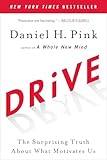
Editors Reads Verdict
Drive synthesizes decades of research on intrinsic motivation — autonomy, mastery, and purpose — into a practical framework for managers and anyone designing work environments. It makes a compelling case that most organizations are using a motivational operating system designed for the wrong century.
What We Loved
- The autonomy-mastery-purpose framework is memorable, applicable, and well-evidenced
- Pink translates research by Deci, Ryan, and Csikszentmihalyi accessibly without distorting it
- The practical toolkit sections make the ideas immediately usable for managers
- The critique of 'if-then' rewards for creative work is both important and counterintuitive
Minor Drawbacks
- Some research citations are simplified to the point of overgeneralization
- The framework works better for knowledge workers than for roles with clear measurable outputs
- The final third is less substantive than the opening chapters
Key Takeaways
- → External rewards can undermine intrinsic motivation for tasks that require creativity and complex thinking
- → Autonomy — control over task, time, technique, and team — is the most powerful driver of high performance
- → Mastery, the desire to get better at things that matter, is a fundamental human need that good work can satisfy
- → Purpose — connecting work to something larger than the self — is increasingly important as economic conditions improve
- → The carrot-and-stick model works for routine, algorithmic tasks but actively damages performance for heuristic, creative ones
| Author | Daniel H. Pink |
|---|---|
| Publisher | Riverhead Books |
| Pages | 260 |
| Published | December 29, 2009 |
| Language | English |
| Genre | Psychology, Business, Self-Help |
| Difficulty | Beginner |
| Best For | Managers, HR professionals, educators, and anyone who wants to understand what actually motivates people to do their best work. |
How Drive Compares
Drive at a glance against 3 similar books readers weigh alongside it.
| Book | Author | Rating | Best for |
|---|---|---|---|
| Drive (this book) | Daniel H. Pink | ★ 4.3 | Managers, HR professionals, educators, and anyone who wants to understand what |
| A Whole New Mind | Daniel H. Pink | ★ 4.2 | Business professionals, educators, career-changers, and anyone wondering how to |
| To Sell Is Human | Daniel H. Pink | ★ 4.2 | Sales professionals, managers, teachers, entrepreneurs, and anyone whose work |
| When: The Scientific Secrets of Perfect Timing | Daniel H. Pink | ★ 4.2 | Anyone interested in optimizing their daily schedule, managers designing work |
The Wrong Operating System
Most businesses, Pink argues, are running on a motivational operating system designed for the twentieth century — one based on extrinsic rewards and punishments that behavioral science has shown to be counterproductive for the kinds of work that now drive value. Drive is the case for upgrading.
Pink traces the history of motivational theory through two inadequate models: Motivation 1.0, the biological drives of hunger and safety, and Motivation 2.0, the reward-and-punishment model that industrialization required. The problem is that a third drive — intrinsic motivation, the desire to do things because they are interesting, challenging, or meaningful — has been documented by researchers for decades while being systematically ignored by management practice.
The Research Behind the Argument
The scientific foundation of Drive rests heavily on the work of Edward Deci and Richard Ryan, whose self-determination theory distinguishes between controlled motivation (doing something because of external pressure) and autonomous motivation (doing it because you genuinely want to). A long series of experiments shows that external rewards, when applied to tasks people already find intrinsically motivating, reduce that motivation over time.
The “candle problem” experiment, devised by Karl Duncker and used by Sam Glucksberg, demonstrates this concretely: offering a financial reward for solving a creative spatial reasoning problem actually produces slower solutions than offering no reward at all. The reward narrows attention when the task requires broad thinking.
Autonomy, Mastery, Purpose
Pink organizes the positive case around three elements of intrinsic motivation:
Autonomy — the desire to direct our own lives. Not independence, but self-direction. The success of results-only work environments, 20% time policies, and open-source software all point to what happens when people control how, when, where, and with whom they work.
Mastery — the urge to get better at things that matter. Mastery is a mindset; it requires tolerating the frustration of the learning curve and treating effort as a path to improvement. Organizations that create conditions for mastery outperform those that don’t.
Purpose — the desire to do something in service of something larger than yourself. This is the element Pink sees growing in importance as economic conditions improve and workers seek meaning alongside compensation.
Practical Implications
The book concludes with a toolkit: specific suggestions for redesigning workplaces, schools, and even individual careers around Type I (intrinsically motivated) rather than Type X (extrinsically motivated) thinking.
Our rating: 4.3/5 — A well-researched, clearly written case for redesigning how we motivate people to do their best creative and cognitive work.
Why the Old Model Fails the New Work
The most counterintuitive claim in Drive (2009) is also its most consequential: that the carrot-and-stick incentives most organisations rely on do not merely fail to help with creative work — they actively harm it. Pink’s distinction is between algorithmic tasks, which follow a set procedure to a known answer, and heuristic tasks, which require experimentation and the discovery of novel solutions. For the former, “if-then” rewards work tolerably well. For the latter, they backfire, because the promise of a reward narrows attention precisely when the task demands the broad, exploratory thinking that creativity requires. As more and more economically valuable work becomes heuristic rather than routine, the mismatch between how we actually motivate people and what the work now requires becomes a serious organisational liability.
The Evidence
Pink builds the argument on a substantial body of research, most centrally the self-determination theory of Edward Deci and Richard Ryan, which distinguishes controlled motivation (acting under external pressure) from autonomous motivation (acting from genuine interest). A long line of experiments shows that applying external rewards to tasks people already find intrinsically motivating erodes that motivation over time. The candle problem — devised by Karl Duncker and deployed by Sam Glucksberg — gives the effect a memorable concrete form: offering a cash reward for solving a creative spatial-reasoning puzzle produces slower solutions than offering nothing, because the reward focuses attention too narrowly for a task that requires seeing past the obvious. Pink’s gift is for translating this research accessibly without distorting it, drawing as well on Mihaly Csikszentmihalyi’s work on flow to describe what optimal engagement actually feels like from the inside.
The Framework’s Real Strength
The autonomy-mastery-purpose triad is the book’s lasting contribution, and its strength is that each element is both memorable and operationally specific. Autonomy is not vague freedom but control over the four T’s — task, time, technique, and team — and Pink illustrates it with concrete experiments in workplace design, from results-only environments to the “20% time” policies that let employees pursue self-directed projects. Mastery is reframed as a mindset that treats effort as the path to improvement and tolerates the frustration of the learning curve. Purpose — the desire to serve something larger than oneself — is the element Pink sees growing in importance as material conditions improve and workers increasingly seek meaning alongside compensation. The framework is genuinely usable, which is why it has been so widely adopted by managers.
The Honest Limits
Drive is not without weaknesses, and a fair assessment should name them. Some of Pink’s research citations are simplified to the edge of overgeneralisation, presenting tidy conclusions where the underlying literature is more contested. The framework also fits knowledge work far better than it fits roles with clear, measurable outputs, where extrinsic incentives may be more appropriate than Pink’s blanket scepticism allows. And the book’s final third — the practical toolkit for redesigning workplaces, schools, and careers around intrinsically motivated “Type I” rather than extrinsically driven “Type X” behaviour — is noticeably less substantive than the sharp, well-evidenced opening chapters. The toolkit’s suggestions are sensible but thinner than the argument that precedes them, leaving the reader convinced of the diagnosis while somewhat under-equipped for the cure. None of this undoes the central case, which has reshaped how a generation of managers thinks about motivation, but it does mean the book is best read as a powerful reframing rather than a complete operating manual.
Reading Guides
Frequently Asked Questions
What is "Drive" about?
Daniel Pink argues that the science of human motivation has been ignored by business, which relies on carrot-and-stick incentives that actually undermine performance for complex work.
Who should read "Drive"?
Managers, HR professionals, educators, and anyone who wants to understand what actually motivates people to do their best work.
What are the key takeaways from "Drive"?
External rewards can undermine intrinsic motivation for tasks that require creativity and complex thinking Autonomy — control over task, time, technique, and team — is the most powerful driver of high performance Mastery, the desire to get better at things that matter, is a fundamental human need that good work can satisfy Purpose — connecting work to something larger than the self — is increasingly important as economic conditions improve The carrot-and-stick model works for routine, algorithmic tasks but actively damages performance for heuristic, creative ones
Is "Drive" worth reading?
Drive synthesizes decades of research on intrinsic motivation — autonomy, mastery, and purpose — into a practical framework for managers and anyone designing work environments. It makes a compelling case that most organizations are using a motivational operating system designed for the wrong century.
Ready to Read Drive?
Check the current price on Amazon.
Check Price on Amazon (paid link)Prices and availability are subject to change. See Amazon for current price.
Review last updated: