Editors Reads Verdict
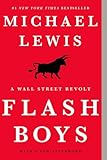
Lewis brings his trademark narrative drive to the world of high-frequency trading, building the story around Brad Katsuyama's quest to understand why his trades always seemed to move against him. A genuinely alarming account of how speed advantages transformed American financial markets into something that favored insiders over ordinary investors.
What We Loved
- Explains microsecond trading and fiber-optic arbitrage with remarkable clarity
- Brad Katsuyama is a genuinely compelling protagonist — principled and credible
- The story of IEX's founding is an unusual good-news arc in financial journalism
- Technical concepts are woven into the narrative rather than explained in chunks
Minor Drawbacks
- The book's claim that markets are 'rigged' overstates a more nuanced reality
- HFT defenders have substantial counterarguments that go largely unexamined
- Some character introductions feel rushed in the later chapters
Key Takeaways
- → Milliseconds of latency advantage can be monetized into billions in profit at the expense of ordinary investors
- → Regulatory fragmentation of U.S. stock markets created arbitrage opportunities that HFT firms exploited
- → Transparency is the first casualty when financial complexity serves the interests of insiders
- → IEX's 'speed bump' demonstrated that market structure choices are not neutral or inevitable
- → The people who understand a system's flaws are rarely the ones with power to fix them
| Author | Michael Lewis |
|---|---|
| Publisher | W. W. Norton & Company |
| Pages | 274 |
| Published | March 31, 2014 |
| Language | English |
| Genre | Finance, Non-Fiction, Technology |
| Difficulty | Intermediate |
| Best For | Investors, technology professionals, and general readers interested in how modern financial markets actually function beneath the surface. |
How Flash Boys Compares
Flash Boys at a glance against 3 similar books readers weigh alongside it.
| Book | Author | Rating | Best for |
|---|---|---|---|
| Flash Boys (this book) | Michael Lewis | ★ 4.3 | Investors, technology professionals, and general readers interested in how |
| Liar's Poker | Michael Lewis | ★ 4.4 | Anyone curious about Wall Street culture, the origins of mortgage-backed |
| Moneyball | Michael Lewis | ★ 4.5 | Business readers, sports analytics enthusiasts, baseball fans, and anyone |
| The Big Short | Michael Lewis | ★ 4.5 | Anyone seeking to understand the 2008 financial crisis through the lens of the |
When Milliseconds Become Money
Brad Katsuyama, a Royal Bank of Canada trader, noticed something strange: whenever he tried to buy a large block of stock, the price moved against him the moment he entered his order. He wasn’t imagining it. He was losing money in trades that looked good on paper to the invisible advantage of traders who could react faster than the market could register his intentions.
Flash Boys is built around Katsuyama’s investigation into that phenomenon and his eventual founding of IEX, a stock exchange specifically designed to neutralize the speed advantages that high-frequency trading firms had spent hundreds of millions of dollars acquiring.
The Physics of Financial Advantage
Lewis explains how HFT firms had, over a decade, quietly purchased the fastest possible data connections between exchanges — including a $300 million fiber optic cable laid in the straightest possible line between Chicago and New Jersey purely to shave 1.4 milliseconds off trading times. They co-located servers inside exchange data centers and used sophisticated algorithms to detect and front-run large institutional orders.
The technical exposition is where Lewis excels. Concepts like latency arbitrage, dark pools, and co-location are explained through the experiences of the people building and fighting these systems, making what could be a dry technology story genuinely suspenseful.
The IEX Story
The heart of the book is the founding of IEX, where Katsuyama assembled a team of exchange technologists, traders, and coders to build a market with a deliberate 350-microsecond delay — the “speed bump” — that neutralized the advantages HFT firms depended on. The description of their regulatory battles, their effort to sign up broker-dealers, and their eventual launch is one of the more hopeful narratives in financial journalism.
Controversy and Nuance
Flash Boys generated significant pushback from economists and HFT defenders who argued that Lewis had framed a complex issue too simply. High-frequency trading has also arguably reduced bid-ask spreads, benefiting ordinary investors. These counterarguments are worth weighing — the book presents one side of a genuine debate with considerable force but limited balance.
That said, the structural question Lewis raises — who benefits from market complexity, and who designed these systems to work the way they do — remains unanswered and important.
Our rating: 4.3/5 — A gripping examination of market microstructure that will change how you think about every stock trade you make.
The Technical Infrastructure of Speed
The most technically specific section of Flash Boys concerns the Spread Networks fiber optic cable laid in 2010 between Chicago and New Jersey. The cable ran in the straightest possible path — blasting through mountains rather than routing around them — to achieve a round-trip transmission time of 13 milliseconds, compared to roughly 17 milliseconds for the existing routes. The $300 million cost was justified entirely by the trading advantage this provided. Traders who could receive market information from the Chicago futures exchanges and act on it in New York before rivals using slower connections could make risk-free profits on the difference.
Lewis uses this cable as a concrete illustration of an abstract argument: that the arms race in market latency had reached a point where the investment being made in speed was not productive in any broader economic sense. The cable did not help any company produce a product, allocate capital more efficiently, or discover a genuine price. It helped certain traders extract rent from other traders at the expense of the markets’ function as price-discovery mechanisms.
Brad Katsuyama and IEX
The founding of IEX is the book’s most hopeful narrative arc, and Lewis is transparent about his admiration for what Katsuyama built. Katsuyama, a former RBC trader, assembled a team that included Ronan Ryan (who had worked at the HFT firms he would later compete against), Don Bollerman, Rob Park, and others with deep knowledge of how market microstructure actually worked. Their solution — a 350-microsecond deliberate delay built into IEX’s order processing, implemented physically as a coil of fiber optic cable in a box — was simple in concept and technically precise in execution. It neutralized the latency arbitrage that HFT firms depended on without requiring regulatory intervention.
IEX was approved as a full stock exchange in 2016, two years after the book’s publication. Its market share has remained relatively small, but its existence forced a broader industry conversation about exchange structure that would not otherwise have occurred.
The Counterarguments Lewis Doesn’t Make
Lewis is upfront that Flash Boys presents a case rather than a complete analysis. The economists and HFT defenders who pushed back after publication had substantive points. High-frequency trading has, in aggregate, reduced bid-ask spreads significantly since the early 2000s, which benefits retail investors on every trade. The question of whether the specific practices Lewis documents — latency arbitrage, front-running institutional orders — are harmful enough to offset these general benefits is genuinely contested.
The structural question Lewis raises — who owns the market’s infrastructure, who benefits from its design choices, and whether those design choices are made in the interest of the market’s users or its operators — is real and important regardless of how the quantitative debate is resolved. It is a question about accountability rather than about net economic welfare, and it is the question that Flash Boys answers most convincingly.
Flash Boys was published in March 2014 and became a number-one New York Times bestseller. IEX, the exchange Katsuyama founded as the book’s hopeful counternarrative, was approved as a full stock exchange by the SEC in June 2016, two years after publication — a real-world outcome that gave the book’s argument about market structure reform a concrete, if partial, vindication.
Frequently Asked Questions
What is "Flash Boys" about?
An investigation into high-frequency trading and how a small group of Wall Street outsiders fought to expose a rigged stock market.
Who should read "Flash Boys"?
Investors, technology professionals, and general readers interested in how modern financial markets actually function beneath the surface.
What are the key takeaways from "Flash Boys"?
Milliseconds of latency advantage can be monetized into billions in profit at the expense of ordinary investors Regulatory fragmentation of U.S. stock markets created arbitrage opportunities that HFT firms exploited Transparency is the first casualty when financial complexity serves the interests of insiders IEX's 'speed bump' demonstrated that market structure choices are not neutral or inevitable The people who understand a system's flaws are rarely the ones with power to fix them
Is "Flash Boys" worth reading?
Lewis brings his trademark narrative drive to the world of high-frequency trading, building the story around Brad Katsuyama's quest to understand why his trades always seemed to move against him. A genuinely alarming account of how speed advantages transformed American financial markets into something that favored insiders over ordinary investors.
Ready to Read Flash Boys?
Check the current price on Amazon.
Check Price on Amazon (paid link)Prices and availability are subject to change. See Amazon for current price.
Review last updated: