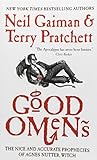
Editors Reads Verdict
The funniest fantasy novel ever written — and beneath the comedy, a genuinely warm and philosophically serious meditation on good and evil, free will, and the peculiar pleasures of earthly existence.
What We Loved
- The comic partnership of Pratchett and Gaiman is one of literature's great one-offs
- The humour is both broad and precise — it works on multiple levels simultaneously
- The love for humanity that underlies the satire gives the book genuine warmth
- The footnotes — a Pratchett signature — are consistently funnier than they have any right to be
Minor Drawbacks
- The ensemble of supporting characters can be hard to track
- The plot mechanics occasionally disappear beneath the comedy
- The satire of apocalyptic Christianity requires some familiarity with the source material
Key Takeaways
- → Good and evil are less opposed than they are co-dependent — an angel and a demon who need each other
- → Humanity is stranger, more creative, and more resilient than any supernatural plan accounts for
- → The Antichrist may just be a normal eleven-year-old from Tadfield who quite likes his friends
- → Free will is the wild card that makes prophecy unreliable
- → The world is worth saving — that is the book's deepest and most consistent message
| Author | Terry Pratchett & Neil Gaiman |
|---|---|
| Publisher | HarperTorch |
| Pages | 432 |
| Published | May 10, 1990 |
| Language | English |
| Genre | Fantasy, Comedy, Satire |
| Difficulty | Beginner |
| Best For | Fans of Pratchett, Gaiman, or British comedy who want a genuinely funny fantasy with surprising warmth and philosophical depth. |
How Good Omens Compares
Good Omens at a glance against 3 similar books readers weigh alongside it.
| Book | Author | Rating | Best for |
|---|---|---|---|
| Good Omens (this book) | Terry Pratchett & Neil Gaiman | ★ 4.6 | Fans of Pratchett, Gaiman, or British comedy who want a genuinely funny fantasy |
| American Gods | Neil Gaiman | ★ 4.5 | Fantasy readers with an interest in mythology, American culture, and literary |
| The Hitchhiker's Guide to the Galaxy | Douglas Adams | ★ 4.7 | Anyone who needs to laugh |
| The Night Circus | Erin Morgenstern | ★ 4.4 | Fantasy readers who prioritise immersive atmosphere and beautiful prose over |
The Funniest Fantasy Novel Ever Written
Good Omens was written in a burst of collaborative energy between Terry Pratchett (creator of Discworld) and Neil Gaiman (creator of Sandman) in 1990. The collaboration was famously productive and famously chaotic — neither author was entirely sure who had written which lines — and the result is a novel that combines Pratchett’s satirical invention and perfect timing with Gaiman’s mythological imagination and dark emotional undertow.
The premise: the Apocalypse is scheduled for Saturday. An angel named Aziraphale and a demon named Crowley — who have spent six thousand years on Earth growing extremely fond of it — have independently decided that they would rather it didn’t happen. The problem is that they have misplaced the Antichrist.
Aziraphale and Crowley
The central relationship of the novel is the friendship — cautiously, belatedly, eventually undeniably admitted as such — between Aziraphale (the angel, fond of books, fine dining, and occultism) and Crowley (the demon, fond of fast cars, sunglasses, and plants that live in fear of their owner). They have spent six thousand years doing each other’s jobs — occasionally warding off temptations that Crowley was supposed to be providing, occasionally providing ineffable blessings that Aziraphale was supposed to arrange — on the grounds that it saved on paperwork.
Their fondness for humanity — and specifically for Earth, with its sushi and M25 and Beethoven — is the book’s emotional core. They don’t want it to end. This is both funny and, in its accumulation over 432 pages, genuinely moving.
The Humour
The comedy of Good Omens operates on multiple levels simultaneously. The footnotes are Pratchett at his best — digressions that are funnier than the main text and that illuminate the main text by contrast. The Witchfinder Army (two people, including Sergeant Shadwell, who lives on a diet of condensed milk and righteous indignation) is a perfect satirical creation.
But the humour is not just comic — it is philosophical. The book’s understanding of good and evil (as mutually constituting, co-dependent, impossible without each other) is a genuine theological position, rendered in jokes.
The Antichrist Problem
Adam Young, the Antichrist, is an eleven-year-old boy from Tadfield who has been accidentally raised as an ordinary human child by the wrong family. He has powers he doesn’t know how to use, and his ideas about what makes the world better are the ideas of a clever, well-read, imaginative child who loves his friends and his dog. The Apocalypse, when it approaches him, encounters something it was not designed to handle: genuine free will.
The Collaboration
The circumstances of the collaboration between Terry Pratchett and Neil Gaiman have become literary legend. Gaiman had an idea about an angel and a demon who had become friends over six thousand years; Pratchett had an idea about the Antichrist as an ordinary English schoolboy. They discovered they had been developing complementary premises and decided to write the novel together, exchanging drafts by fax. The collaboration was so organic that, by the time the novel was finished, neither of them could reliably identify which lines they had each written.
This authorial merger is part of what gives Good Omens its particular texture: the Pratchett elements — the satirical worldbuilding, the footnotes, the comedic timing, the deep love of and exasperation with England and humanity — are so thoroughly blended with the Gaiman elements — the mythological seriousness, the emotional undertow, the quiet horror beneath the comedy — that the book feels like a single voice.
Pratchett’s Footnotes
The novel’s footnotes are a Pratchett signature, adapted from the Discworld novels, and they may be the book’s most consistent source of comedy. They digress from the main text to explain the cosmological underpinnings of the plot, the personal histories of minor characters, and the precise operation of supernatural bureaucracy in ways that are both funnier and more philosophically rigorous than the sections they interrupt. The footnote about Crowley’s M25 — which he designed as a demonic sigil, the largest ever created, to sow low-level rage and misery across the southeast of England — is among the most celebrated in contemporary comic fiction.
The Amazon Prime Television Series
The 2019 Amazon Prime Video adaptation, starring David Tennant as Crowley and Michael Sheen as Aziraphale, received widespread praise and substantial viewership. It was produced with Gaiman as showrunner (Pratchett died in 2015), and Gaiman has said that bringing the project to screen felt like an act of loyalty to his collaborator. The series expanded significantly on the source material, including new scenes that develop Aziraphale and Crowley’s relationship across centuries. A second season was released in 2023, continuing beyond the novel’s ending. The casting of Tennant and Sheen was considered inspired: both actors managed to convey the centuries-deep mutual affection of their characters while maintaining the comedic register the material demands.
Good Omens has remained continuously in print since 1990 and found its largest readership after the television adaptation brought new readers to the source material.
Final Verdict
Good Omens is a masterpiece of comic fantasy — funny on every page, warm at its core, and philosophically richer than it first appears. It has been beloved for thirty years and will be beloved for thirty more.
Our rating: 4.6/5 — The funniest fantasy novel ever written. A joy from first page to last.
Reading Guides
- Books Like Good Omens: 11 Novels of Divine Comedy, Unlikely Friendship, and Cosmic Chaos
- Books Like American Gods: 11 Dark, Mythological Fantasies With Big Ideas
- Books Like The Hitchhiker
- Discworld Books in Order: How to Read Terry Pratchett
- 20 Best Funny Books: Novels and Non-Fiction That Are Genuinely Comic
Frequently Asked Questions
What is "Good Omens" about?
An angel and a demon who have grown rather fond of the Earth team up to prevent the Apocalypse, while a small boy in Tadfield may or may not be the Antichrist.
Who should read "Good Omens"?
Fans of Pratchett, Gaiman, or British comedy who want a genuinely funny fantasy with surprising warmth and philosophical depth.
What are the key takeaways from "Good Omens"?
Good and evil are less opposed than they are co-dependent — an angel and a demon who need each other Humanity is stranger, more creative, and more resilient than any supernatural plan accounts for The Antichrist may just be a normal eleven-year-old from Tadfield who quite likes his friends Free will is the wild card that makes prophecy unreliable The world is worth saving — that is the book's deepest and most consistent message
Is "Good Omens" worth reading?
The funniest fantasy novel ever written — and beneath the comedy, a genuinely warm and philosophically serious meditation on good and evil, free will, and the peculiar pleasures of earthly existence.
Ready to Read Good Omens?
Check the current price on Amazon.
Check Price on Amazon (paid link)Prices and availability are subject to change. See Amazon for current price.
Review last updated: