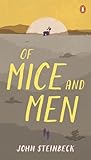
Editors Reads Verdict
Steinbeck's most perfectly crafted short novel compresses immense human sadness into 180 pages of prose that reads like a stage direction for tragedy. The dream of the small farm — the rabbits, the land, the independence — is one of literature's most affecting images of hope in a context designed to extinguish it.
What We Loved
- The compression and economy of the novella form is used with masterful precision
- The George-Lennie relationship is one of literature's most moving male friendships
- The ending is prepared from the opening scene — the inevitability is the tragedy
- The Depression-era setting is rendered with documentary accuracy and genuine compassion
Minor Drawbacks
- Curley's wife is sometimes felt to be a type rather than a fully realised character
- The symbolism can be somewhat heavy-handed — Candy's dog is Lennie is obvious
- Its brevity, while a strength, means some dimensions feel underdeveloped
Key Takeaways
- → The dream of independence and self-sufficiency is what makes poverty bearable — its destruction is the final violence
- → Lennie's strength and Lennie's innocence cannot coexist with a world designed for neither
- → George's act of mercy is the novel's most terrible and most loving act
- → The 'best-laid plans' of mice and men are subject to forces — economic, social, physical — that individuals cannot control
- → Loneliness is the Depression's defining social condition — George and Lennie's partnership is radical in its context
| Author | John Steinbeck |
|---|---|
| Publisher | Penguin Books |
| Pages | 187 |
| Published | January 1, 1937 |
| Language | English |
| Genre | Fiction, Classic Literature, Tragedy |
| Difficulty | Beginner |
| Best For | Readers who want to understand the Great Depression's human cost through a perfectly crafted tragedy — and those who appreciate what a master craftsman can do in under 200 pages. |
How Of Mice and Men Compares
Of Mice and Men at a glance against 3 similar books readers weigh alongside it.
| Book | Author | Rating | Best for |
|---|---|---|---|
| Of Mice and Men (this book) | John Steinbeck | ★ 4.5 | Readers who want to understand the Great Depression's human cost through a |
| East of Eden | John Steinbeck | ★ 4.7 | Readers who enjoy ambitious family sagas and multigenerational narratives — and |
| The Grapes of Wrath | John Steinbeck | ★ 4.7 | Readers who want serious literature with genuine social conscience — and anyone |
| To Kill a Mockingbird | Harper Lee | ★ 4.8 | Everyone |
The Perfect Tragedy
John Steinbeck wrote Of Mice and Men in the summers of 1936 and 1937, after years of writing about California’s agricultural workers — the dispossessed, the itinerant, the men who moved from ranch to ranch with nothing but their bindles and their willingness to work. He had intended to write a longer novel but the manuscript was eaten by his dog, and what he produced from the reconstruction was something more perfectly shaped: a novella so precisely crafted that nothing can be removed or added without damaging it.
The title comes from Robert Burns: “The best-laid schemes o’ mice an’ men / Gang aft agley” — go often awry. It announces the novel’s tragic fatalism: the dream of George and Lennie is laid out clearly, it is good and reasonable, and it will not be achieved.
George and Lennie: The Impossible Partnership
George Milton is sharp, wiry, restless — the kind of man who might have made something of himself if he did not have Lennie Small to look after. Lennie is large, gentle, immensely strong, and intellectually limited — a man who loves to pet soft things and cannot control the strength of his own hands. Their partnership is simultaneously a burden (Lennie’s accidental violence has lost them jobs, driven them from towns) and a grace: in a world of solitary, itinerant men, they have each other.
Their dream — a small farm, a few acres, some chickens, some rabbits for Lennie to tend — is not grandiose but it is real. It is the dream of security and belonging in a world designed to provide neither. Every character who hears about it wants in. Old Candy, who fears being thrown off the ranch when his working days end, offers his life savings. Crooks, the Black stable hand who has been segregated from the other workers, briefly allows himself to believe in it before his isolation closes back around him.
The Inexorable Structure
From the novel’s first scene — George and Lennie stopping by a pool before their first day at the ranch — to its last, the structure is a closing trap. The mouse Lennie accidentally kills in the opening pages predicts the puppy, and the puppy predicts Curley’s wife. The story of what happened in Weed — where Lennie touched a woman’s dress and wouldn’t let go — predicts the ending with complete precision. Steinbeck wants us to see the catastrophe coming. The tragedy is not the surprise but the inevitability.
George’s act — shooting Lennie as the other men close in, in the same place by the pool, with Lennie hearing one more time about the rabbits and the farm — is the novel’s final terrible mercy: the dream maintained in the last seconds of the dreamer’s life.
Our rating: 4.5/5 — One of American literature’s most perfectly crafted tragedies, heartbreaking in its economy and its inevitability.
Reading Guides
The Stage Play and the Novella-Play Form
Steinbeck wrote Of Mice and Men with the intention of adapting it for the stage, and the novel reflects this intention throughout: it is divided into six sections corresponding to dramatic scenes, each beginning with a precise setting description, each taking place in a single location, with the action conducted almost entirely through dialogue. Steinbeck called it a “play-novella” and considered the form experimental — a work that could be read as a novel or staged with minimal adaptation.
The Broadway production opened in November 1937, directed by George S. Kaufman, with Wallace Ford as George and Broderick Crawford as Lennie. It won the Drama Critics’ Circle Award for Best American Play and ran for 207 performances. The play’s success confirmed that the novella’s formal instincts were correct: the compression that some readers find a limitation is precisely what gives the work its theatrical power. Staged, the ending — George’s final act of mercy — has the impact of classical tragedy; the audience knows what is coming before it arrives, and the inevitability is the point.
The Depression Context
Steinbeck had spent years writing about California’s agricultural workers before Of Mice and Men, including the sketches collected in The Pastures of Heaven (1932) and the novel In Dubious Battle (1936). He had visited the labor camps, walked the rows with the workers, understood the specific social conditions — the bindle stiffs, the itinerant labor market, the hierarchies of race and ability on the California ranch — that Of Mice and Men renders with documentary accuracy.
George and Lennie’s situation — moving from ranch to ranch, carrying their bedrolls, always one accident away from losing their place — was the normal condition of California’s agricultural workforce in the 1930s. The dream of “a little place of their own” was not a fantasy but a widely shared aspiration among itinerant workers who had nothing, and its destruction in the novel is the destruction of what makes that kind of labor bearable: the possibility, however remote, of eventual independence.
Crooks: The Novel’s Unseen Dimension
The stable hand Crooks — Black, educated, isolated in his own room by the ranch’s segregationist customs — is the novel’s most painful minor character and the one Steinbeck is most careful with. His scene with Lennie, in which he briefly allows himself to believe in the farm dream before pulling back into the isolation that has taught him better, is the novel’s most politically direct moment. His remark — “I seen hundreds of men come by on the road an’ on the ranches, with their bindles on their back an’ that same damn thing in their heads… an’ never a God damn one of ‘em ever gets it” — is a statement about the dream’s general impossibility, not only for Lennie and George but for everyone like them.
John Steinbeck’s Nobel Prize
Steinbeck received the Nobel Prize in Literature in 1962, and the Swedish Academy’s citation mentioned Of Mice and Men alongside The Grapes of Wrath and East of Eden as the central works. He died in New York on December 20, 1968, having never matched the critical reception of his 1930s and early 1940s work. Of Mice and Men remains the most frequently taught of his novels in American schools and the most frequently produced on stage — its economy and emotional clarity making it ideal for classroom reading and for audiences encountering serious American literature for the first time.
Frequently Asked Questions
What is "Of Mice and Men" about?
Two itinerant ranch workers in Depression-era California — the clever George and the big, gentle Lennie — share a dream of their own land that the world will not allow them to reach.
Who should read "Of Mice and Men"?
Readers who want to understand the Great Depression's human cost through a perfectly crafted tragedy — and those who appreciate what a master craftsman can do in under 200 pages.
What are the key takeaways from "Of Mice and Men"?
The dream of independence and self-sufficiency is what makes poverty bearable — its destruction is the final violence Lennie's strength and Lennie's innocence cannot coexist with a world designed for neither George's act of mercy is the novel's most terrible and most loving act The 'best-laid plans' of mice and men are subject to forces — economic, social, physical — that individuals cannot control Loneliness is the Depression's defining social condition — George and Lennie's partnership is radical in its context
Is "Of Mice and Men" worth reading?
Steinbeck's most perfectly crafted short novel compresses immense human sadness into 180 pages of prose that reads like a stage direction for tragedy. The dream of the small farm — the rabbits, the land, the independence — is one of literature's most affecting images of hope in a context designed to extinguish it.
Ready to Read Of Mice and Men?
Check the current price on Amazon.
Check Price on Amazon (paid link)Prices and availability are subject to change. See Amazon for current price.
Review last updated: