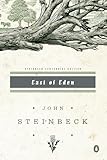
Editors Reads Verdict
Steinbeck's most ambitious novel — the one he considered his masterpiece — takes the Cain and Abel story as the template for a multigenerational California saga. The word *timshel* ('thou mayest') is its moral: freedom lies in the possibility of choosing good, not in its inevitability.
What We Loved
- The Cathy Ames character is one of American fiction's most disturbing — and most analysed — villains
- The 'timshel' interpretation is philosophically rich and surprisingly moving
- The Salinas Valley landscape is rendered with the devotion of a love letter
- The Hamilton family chapters (Steinbeck's own ancestors) have a warmth missing from his other work
Minor Drawbacks
- At 600 pages, the structure can feel uneven — some sections are much more compelling than others
- Cathy's psychopathy is overdone — she feels less like a character than an embodiment of evil
- The interjected authorial commentary can feel intrusive in a novel that otherwise shows rather than tells
Key Takeaways
- → 'Timshel' — thou mayest — is the moral of the novel: freedom consists in the possibility of goodness, not its necessity
- → The Cain and Abel story recurs across generations because it maps a permanent human tendency
- → Evil can be so thorough as to be almost incomprehensible — but good is equally possible
- → A person's character is not fixed at birth but shaped by choice — this is Steinbeck's argument against determinism
- → The land — the Salinas Valley — is not passive backdrop but active shaper of the people who work it
| Author | John Steinbeck |
|---|---|
| Publisher | Penguin Books |
| Pages | 608 |
| Published | September 19, 1952 |
| Language | English |
| Genre | Fiction, Classic Literature, Family Saga |
| Difficulty | Intermediate |
| Best For | Readers who enjoy ambitious family sagas and multigenerational narratives — and those interested in how biblical archetypes can illuminate American history. |
How East of Eden Compares
East of Eden at a glance against 3 similar books readers weigh alongside it.
| Book | Author | Rating | Best for |
|---|---|---|---|
| East of Eden (this book) | John Steinbeck | ★ 4.7 | Readers who enjoy ambitious family sagas and multigenerational narratives — and |
| Of Mice and Men | John Steinbeck | ★ 4.5 | Readers who want to understand the Great Depression's human cost through a |
| One Hundred Years of Solitude | Gabriel García Márquez | ★ 4.6 | Readers of literary fiction interested in the most celebrated novel in Spanish, |
| The Grapes of Wrath | John Steinbeck | ★ 4.7 | Readers who want serious literature with genuine social conscience — and anyone |
Steinbeck’s Most Personal Novel
John Steinbeck dedicated East of Eden to his two sons and told them it was “everything I have, everything I am.” Published in 1952, it was his attempt to write the great California novel — to capture the Salinas Valley of his childhood and, through it, to say something fundamental about the human capacity for choice between good and evil.
The novel is explicitly structured around the story of Cain and Abel, which Steinbeck read as the foundational human myth: the pattern of rejection and resentment that recurs because it is not accidental but structural, built into the human family by the fact that love is not distributed equally and the loved and unloved respond accordingly.
The Trasks and the Hamiltons
The novel follows two families across three generations: the Trasks, who enact the Cain-Abel pattern with mechanical inevitability, and the Hamiltons, Steinbeck’s own Irish immigrant ancestors, who provide warmth and vitality against the Trasks’ tragic determinism. Cyrus Trask and his sons Adam and Charles; Adam Trask and his sons Cal and Aron; and between generations, the monstrous presence of Cathy Ames.
Cathy is one of American fiction’s most discussed villains: a woman presented as constitutionally incapable of empathy or love, who uses her beauty and intelligence to destroy those who care for her. She has been read as a personification of evil, as a representation of psychopathy, and as a misogynist caricature — all with some justification. Steinbeck himself seems uncertain whether she is a fully human character or a symbol of the anti-human principle in the novel’s moral scheme.
Timshel: The Novel’s Great Word
The novel’s philosophical centre is the debate among Adam Trask’s farmhand Lee, his neighbour Samuel Hamilton, and Adam himself over the Hebrew word in Genesis that God speaks to Cain: timshel. Is it a command (“thou shalt”), a promise (“thou wilt”), or a possibility (“thou mayest”)? Lee, who has spent months researching the question with Chinese scholars, concludes that it is a possibility — and that this changes everything.
If “thou mayest” rather than “thou shalt” overcome sin, then goodness is not promised or commanded but possible — the most important thing in the world is the possibility of choosing it. This interpretation is the novel’s moral spine: against all determinism, against the recurrence of the Cain pattern, against Cathy’s apparent proof that some people are simply evil, Steinbeck insists on the possibility of timshel.
Cal’s Story
The novel’s most moving section is Cal Trask’s — the Cain figure of the third generation, who knows what he is and tries anyway to be otherwise. His desperate effort to buy his father’s love with money earned from the war, his father’s rejection, his brother Aron’s destruction — these are rendered with a pain that exceeds the novel’s mythological framework.
Our rating: 4.7/5 — Steinbeck’s most ambitious and most personal novel, a multigenerational saga driven by one of American fiction’s most profound moral questions.
Reading Guides
- Books Like East of Eden
- Books Like Les Misérables: Epic Justice, Redemption, and the Struggle of the Dispossessed
- Books Like Moby Dick: Epic Obsession, the Sea, and America
- Books Like Pachinko: Multigenerational Sagas, Immigration, and the Weight of History
- Books Like The Grapes of Wrath: Epic Social Fiction About Poverty, Migration, and Survival
- Books Like The Great Gatsby: The American Dream, Class, and Longing
- Books Like The Overstory: Trees, Ecology, and the Human Failure to See What Matters
The Composition and Dedication
Steinbeck wrote East of Eden in 1951 in a single sustained effort, keeping a daily journal of the composition — published as Journal of a Novel: The East of Eden Letters (1969) — in which he wrote to his editor Pascal Covici each morning before beginning the day’s work on the novel. The journal is one of the most revealing accounts of a major novel’s composition in American literary history: Steinbeck describes his intentions, his doubts, his methods, his sense of what the book was for.
He dedicated the novel to his sons Thom and John, telling them it was “everything I have, everything I am.” It was his most personal novel — the Salinas Valley of the Hamilton family chapters was his own family history, his mother’s Hamilton family with their Irish immigrant energy and their California dreams — and he regarded it as the summation of his career. He was forty-nine when it was published, and he never again wrote anything of equivalent ambition. East of Eden is both his last major work and his most ambitious statement of what fiction could do.
The 1955 Film and James Dean
The 1955 film adaptation, directed by Elia Kazan, is both one of the great Hollywood films of the 1950s and a radical transformation of its source: Kazan and screenwriter Paul Osborn adapted only the novel’s final third — the story of Cal and Aron Trask — and cast James Dean as Cal in his first major film role. Dean’s performance — restless, searching, beautiful, desperate for a love he cannot quite accept — became one of the definitive images of post-war American youth, and the film launched his career months before his death in September 1955.
For readers of the novel, the film’s focus on the final section clarifies what the Cain-Abel structure is building toward while leaving aside the first two-thirds of Steinbeck’s architecture. The Hamilton family chapters — which Steinbeck’s novel interleaves with the Trask narrative throughout — are almost entirely absent from the film. What the film gains in dramatic intensity (Dean’s Cal is among the great performances of 1950s American cinema) it loses in the philosophical range of Steinbeck’s full vision.
Timshel and the Philosophical Argument
The debate over the word timshel — which occupies Steinbeck for several of the novel’s most extended passages — is based on his own research into the Hebrew of Genesis. He genuinely consulted the text, genuinely interrogated the different possible translations, and the conclusion that Lee, Samuel Hamilton, and Adam arrive at — that “thou mayest” is the most accurate rendering, and that this changes the entire moral meaning of the passage — is Steinbeck’s own.
The argument against determinism that timshel carries is Steinbeck’s response to the naturalism that dominated American fiction in the 1930s, including his own earlier work. The Grapes of Wrath and Of Mice and Men are novels in which economic and social forces overwhelm individual will; East of Eden insists that this is not the complete picture, that choice remains possible, that Cal Trask is not simply doomed to repeat his father’s and his grandfather’s patterns. Timshel is Steinbeck’s declaration of independence from the determinism his own best work seemed to endorse.
Frequently Asked Questions
What is "East of Eden" about?
Two families — the Trasks and the Hamiltons — live parallel lives in California's Salinas Valley over three generations, reenacting the story of Cain and Abel with tragic consequence.
Who should read "East of Eden"?
Readers who enjoy ambitious family sagas and multigenerational narratives — and those interested in how biblical archetypes can illuminate American history.
What are the key takeaways from "East of Eden"?
'Timshel' — thou mayest — is the moral of the novel: freedom consists in the possibility of goodness, not its necessity The Cain and Abel story recurs across generations because it maps a permanent human tendency Evil can be so thorough as to be almost incomprehensible — but good is equally possible A person's character is not fixed at birth but shaped by choice — this is Steinbeck's argument against determinism The land — the Salinas Valley — is not passive backdrop but active shaper of the people who work it
Is "East of Eden" worth reading?
Steinbeck's most ambitious novel — the one he considered his masterpiece — takes the Cain and Abel story as the template for a multigenerational California saga. The word *timshel* ('thou mayest') is its moral: freedom lies in the possibility of choosing good, not in its inevitability.
Ready to Read East of Eden?
Check the current price on Amazon.
Check Price on Amazon (paid link)Prices and availability are subject to change. See Amazon for current price.
Review last updated: