Editors Reads Verdict
The most psychologically intense of Shakespeare's tragedies — a play in which a great man is systematically dismantled by a genius of malice, and in which the audience knows everything and can do nothing.
What We Loved
- Iago is the most fully developed villain in the canon — his intelligence, patience, and pleasure in his own work are terrifyingly credible
- The dramatic irony is sustained at an almost unbearable pitch throughout Acts III and IV — we know what Othello does not
- Desdemona's passive suffering is a deliberate formal choice that sharpens the horror rather than diminishing her agency
Minor Drawbacks
- Othello's credulity is required by the plot to a degree that some productions struggle to make fully convincing
- The play's concentration on the domestic sphere can make it feel smaller than Hamlet or Lear, though this is also its greatest strength
Key Takeaways
- → Jealousy is presented not as a character flaw but as a cognitive trap — a story that, once lodged in the mind, makes all evidence confirm it
- → Iago's motives are kept ambiguous by design — the play refuses the comfort of a clear reason for radical evil
- → Race and otherness are central to the play's dynamics in ways that each era must honestly confront rather than smooth over
- → The final scene, in which Othello recovers his self-knowledge too late, is one of literature's most devastating structural ironies
| Author | William Shakespeare |
|---|---|
| Publisher | Simon & Schuster |
| Pages | 336 |
| Published | January 1, 1603 |
| Language | English |
| Genre | Drama, Classic Literature, Classic Fiction |
How Othello Compares
Othello at a glance against 3 similar books readers weigh alongside it.
| Book | Author | Rating | Best for |
|---|---|---|---|
| Othello (this book) | William Shakespeare | ★ 4.7 | Drama |
| Hamlet | William Shakespeare | ★ 4.9 | Every reader and theatregoer — Hamlet is the central work of English literature |
| King Lear | William Shakespeare | ★ 4.8 | Drama |
| Macbeth | William Shakespeare | ★ 4.8 | Anyone seeking Shakespeare's most dramatically intense and psychologically |
Othello Review
Of all Shakespeare’s major tragedies, Othello is the most airtight. Hamlet has its digressions, Lear its subplot, Macbeth its witches and its politics — but Othello is a machine with no loose parts: from the moment Iago announces in the first scene that he is not what he seems, the play proceeds with the remorseless logic of a proof. We watch a great man destroyed, and we know at every step exactly how it is happening and why, and we cannot stop it.
The play’s central mechanism is dramatic irony deployed at maximum pressure. The audience holds the truth that Othello does not; Iago feeds him manufactured evidence, and we watch Othello transform each piece of it into confirmation of what he now believes. The handkerchief — a trivial object, a domestic prop — becomes the hinge on which a marriage and two lives turn. Shakespeare understood, four centuries before cognitive psychology, how motivated reasoning works: once the story of betrayal takes hold, everything becomes evidence for it.
Iago remains the play’s great interpretive problem. He offers several motives — professional resentment, racial contempt, suspected cuckolding — but none of them fully accounts for the sustained, creative malice he directs at Othello. Coleridge’s phrase “motiveless malignity” is too strong, but it points at something real: that Iago seems to take a craftsman’s pleasure in destruction that exceeds any grievance. He is the play’s terrifying argument that some damage to the world is done not from need but from the satisfaction of doing it.
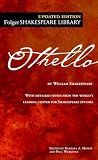
This Folger Shakespeare Library edition provides a reliable text with thorough glosses and substantial critical apparatus.
Reviewed edition: Folger Shakespeare Library / Simon & Schuster (ISBN 0743477553)
What Distinguishes This Book
Among the qualities that set Othello apart: Iago is the most fully developed villain in the canon — his intelligence, patience, and pleasure in his own work are terrifyingly credible; The dramatic irony is sustained at an almost unbearable pitch throughout Acts III and IV — we know what Othello does not; and Desdemona’s passive suffering is a deliberate formal choice that sharpens the horror rather than diminishing her agency. These strengths are evident from the first pages and sustain across the whole work.
Themes
The thematic concerns of Othello give it weight beyond its surface narrative. Jealousy is presented not as a character flaw but as a cognitive trap — a story that, once lodged in the mind, makes all evidence confirm it. Iago’s motives are kept ambiguous by design — the play refuses the comfort of a clear reason for radical evil. Race and otherness are central to the play’s dynamics in ways that each era must honestly confront rather than smooth over. The final scene, in which Othello recovers his self-knowledge too late, is one of literature’s most devastating structural ironies. These ideas emerge from the texture of the work rather than explicit statement, which is the mark of ambitious fiction done well.
The Reading Experience
Othello is the kind of book that changes slightly depending on when you read it. The surface — plot, character, setting — remains constant, but the reader brings different things to it at different points in life, and the book meets them there. This is a property of enduring work, and it distinguishes Othello from titles that are consumed once and not returned to.
Limitations
Othello’s credulity is required by the plot to a degree that some productions struggle to make fully convincing. The play’s concentration on the domestic sphere can make it feel smaller than Hamlet or Lear, though this is also its greatest strength. These are worth knowing before starting, though they are unlikely to diminish the experience for the readers the book is written for.
Sources, Early Performance, and Critical Reception
Othello was performed at the court of King James I on 1 November 1604; the text was first published in quarto in 1622, a year before the First Folio. The primary source is Giovanni Battista Giraldi Cinthio’s “Un Capitano Moro” from Hecatommithi (1565), which Shakespeare followed closely in plot while transforming the characters.
Orson Welles directed and starred in a 1952 film version — shot over three years across multiple European locations, with production repeatedly interrupted by funding crises; the film won the Palme d’Or at the 1952 Cannes Film Festival. Welles reportedly shot some scenes in bathhouse towels because the costumes had been impounded by an unpaid supplier. Laurence Olivier’s Othello at the National Theatre (1964, filmed 1965), performed in blackface and with pronounced physical transformation, was controversial in its own time and has become a reference point in debates about race and casting in Shakespeare productions.
William Empson’s essay on Iago’s motivations in The Structure of Complex Words (1951) remains one of the most influential readings in Shakespearean criticism, arguing that Iago’s “honest” is the play’s most charged word — that Iago’s claim to honesty, and the other characters’ acceptance of it, is the precise mechanism through which Othello’s destruction is achieved. The play’s examination of how jealousy works as a corrosive epistemological condition — Othello’s demand for “ocular proof” — has made it a central text in both psychological and feminist Shakespeare criticism.
The play is also, it is worth noting, set partly in Cyprus — a frontier posting, away from Venice’s civilized center — and the dislocation of setting is part of what makes Othello vulnerable: removed from the context in which his authority was established and recognized, he is more susceptible to the story Iago builds around him.
Final Verdict
Our rating: 4.7/5 — The most psychologically intense of Shakespeare’s tragedies — a play in which a great man is systematically dismantled by a genius of malice, and in which the audience knows everything and can do nothing.
Frequently Asked Questions
What is "Othello" about?
Othello, the Moorish general of Venice, is manipulated by his ensign Iago into believing his wife Desdemona has been unfaithful. Shakespeare's most claustrophobic tragedy is a study in the anatomy of jealousy and the mechanics of manipulation — Iago is arguably the most intelligent villain in literature, and the most chilling precisely because his motives remain so obscure.
What are the key takeaways from "Othello"?
Jealousy is presented not as a character flaw but as a cognitive trap — a story that, once lodged in the mind, makes all evidence confirm it Iago's motives are kept ambiguous by design — the play refuses the comfort of a clear reason for radical evil Race and otherness are central to the play's dynamics in ways that each era must honestly confront rather than smooth over The final scene, in which Othello recovers his self-knowledge too late, is one of literature's most devastating structural ironies
Is "Othello" worth reading?
The most psychologically intense of Shakespeare's tragedies — a play in which a great man is systematically dismantled by a genius of malice, and in which the audience knows everything and can do nothing.
Ready to Read Othello?
Check the current price on Amazon.
Check Price on Amazon (paid link)Prices and availability are subject to change. See Amazon for current price.
Review last updated: