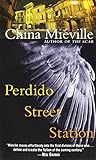
Editors Reads Verdict
Perdido Street Station is a landmark of imaginative fiction: Miéville's New Crobuzon is one of the most fully realized secondary worlds in fantasy, and his willingness to use that world as the site of genuine philosophical and political inquiry distinguishes the novel from almost everything else in its genre.
What We Loved
- New Crobuzon is one of fantasy's great world-building achievements — sprawling, specific, and ideologically coherent
- Miéville's prose is genuinely literary, with a density and ambition rare in genre fiction
- The novel's creatures — the slake-moths, the Weaver, the Remade — are startlingly original
- The political dimension of the world is embedded in its texture rather than stated as theme
Minor Drawbacks
- At 710 pages, the novel's middle section sags under the weight of its own world-building
- The pacing is deliberately non-commercial — readers expecting thriller momentum will be challenged
- Some characters receive less development than the world they inhabit
Key Takeaways
- → World-building is most powerful when it embeds its political and philosophical commitments in texture rather than plot
- → The horror of capitalism is legible in the bodies of those it has most damaged
- → Genuine science and genuine magic can coexist in a world with its own consistent metaphysics
- → Cities accumulate history in their architecture, their districts, and their underclasses
| Author | China Miéville |
|---|---|
| Publisher | Del Rey |
| Pages | 710 |
| Published | October 1, 2000 |
| Language | English |
| Genre | Fantasy, Science Fiction, Weird Fiction, Fiction |
| Difficulty | Advanced |
| Best For | Ambitious fantasy readers willing to engage with dense world-building, literary prose, and speculative fiction that takes ideas seriously; readers interested in the New Weird movement. |
How Perdido Street Station Compares
Perdido Street Station at a glance against 3 similar books readers weigh alongside it.
| Book | Author | Rating | Best for |
|---|---|---|---|
| Perdido Street Station (this book) | China Miéville | ★ 4.1 | Ambitious fantasy readers willing to engage with dense world-building, literary |
| American Gods | Neil Gaiman | ★ 4.5 | Fantasy readers with an interest in mythology, American culture, and literary |
| Annihilation | Jeff VanderMeer | ★ 3.9 | Readers drawn to literary horror and weird fiction, fans of Borges and Kafka, |
| Neuromancer | William Gibson | ★ 4.3 | Science fiction readers interested in the foundational texts of cyberpunk and |
New Crobuzon: A City as an Argument
China Miéville’s New Crobuzon is one of fantasy’s most fully realized secondary worlds, and also one of its most deliberately uncomfortable ones. The city — a sprawling, fog-choked, gaslit Victorian-inflected metropolis populated by humans, khepri, vodyanoi, garuda, cactacae, and the Remade (criminals and dissidents whose bodies have been biologically and mechanically altered as punishment) — is not a backdrop but the novel’s central argument. New Crobuzon is capitalism made visible in flesh and architecture.
Perdido Street Station, Miéville’s breakthrough second novel, follows Isaac Dan der Grimnebulin, a renegade human scientist commissioned by a garuda — a bird-person exiled from his people — to restore his ability to fly. Isaac’s research into flight eventually leads him to acquire caterpillars representing different kinds of exotic creature, one of which hatches into a slake-moth: a creature that feeds on dreams and consciousness, rapidly becoming an existential threat to the city’s entire sentient population.
The Weaver and the Nightmare
Miéville’s creature design is the novel’s most spectacular achievement. The slake-moths are genuinely terrifying — creatures whose wings display a pattern that induces catatonia in anyone who sees them, whose predation is not physical but cognitive — and Miéville renders their hunting sequences with a horror-movie precision that is also philosophically unsettling. What they steal is not life but inner life: the dreamers they consume continue to exist as empty, functional bodies.
The Weaver, a spider-entity of immense power that moves through the fabric of space-time and speaks only in free-associative monologue, is the novel’s most extraordinary creation: an entity so alien that every interaction with it carries genuine cognitive unease. Miéville is interested in the limits of comprehension as well as the limits of power, and the Weaver represents a form of intelligence so different from human intelligence that no moral framework applies.
Politics in the Texture
Miéville is a Marxist, and his politics are embedded in New Crobuzon’s world-building rather than its plot. The Remade — people whose bodies have been publicly disfigured as criminal punishment, forced to live in the city’s poorest districts — are the novel’s most persistent political image: a literalization of how societies mark and segregate those who threaten their order. The city’s bureaucracy of control, its militia, its racial hierarchies between species, are all rendered with a specificity that makes them feel like analysis rather than allegory.
The novel’s ending is deliberately, almost aggressively anti-consolatory. Isaac does not save the city heroically; he survives by making choices that cost others everything, and he leaves New Crobuzon diminished. Miéville refuses the genre convention of triumphant resolution because the problems his world dramatizes — exploitation, state violence, the costs borne by the powerless — are not the kind that individual heroism resolves.
A Landmark with Weight
At 710 pages, Perdido Street Station demands significant investment, and Miéville’s prose — dense, digressive, and occasionally intoxicated by its own invention — will not suit every reader. But for those willing to enter New Crobuzon on its own terms, the novel offers something that most fantasy cannot: a secondary world that genuinely thinks, that uses its imaginative freedom to say something about the real world that realism cannot.
Our rating: 4.1/5
New Crobuzon
Perdido Street Station is the central transportation hub of New Crobuzon, a city of two million on the planet Bas-Lag that serves as the setting for all three novels in Miéville’s Bas-Lag series. The city’s geography — its rivers, its districts (Brock Marsh, Spit Hearth, Smog Bend, Dog Fenn), its population of humans alongside the arthropod Khepri, the aquatic Vodyanoi, the cactus-people, and the mechanical Constructs — was developed over several years before the novel was written. Miéville has described New Crobuzon as a deliberate rejection of the medieval-European default of fantasy worldbuilding, designed instead on the model of a Victorian industrial city.
Awards and Critical Reception
Perdido Street Station won the BSFA Award for Best Novel (2000) and the Arthur C. Clarke Award (2001), British science fiction’s most prestigious award, given annually to the best science fiction novel published in the UK. It was also shortlisted for the Hugo Award for Best Novel (2002). The Clarke Award judges described the novel as “an extraordinary achievement in world-building” and cited its political engagement — Miéville is a member of the Socialist Workers Party and has published academic work on Marxism and international law — as part of what made it more than accomplished genre fiction.
Miéville’s Career
China Miéville published King Rat (1998) before Perdido Street Station; the novel established his ability to integrate horror and urban fantasy but attracted modest attention. Perdido Street Station was the breakthrough. The subsequent Bas-Lag novels — The Scar (2002) and Iron Council (2004) — each won the BSFA Award, making Miéville the only writer to win the award three consecutive times. He has since worked across multiple genres and forms, winning the Hugo Award, Locus Award, and World Fantasy Award for various works.
The Handlingers and the Weaver
New Crobuzon’s alien population in Perdido Street Station includes some of Miéville’s most original inventions: the Weaver, a spider-like extradimensional being that communicates through obscure monologue and operates entirely according to its own aesthetic principles, is among the most memorable. The Slake-moths — dream-feeding creatures that reduce their victims to empty husks — provide the novel’s central threat and force an unlikely alliance between Isaac Dan der Grimnebulin and figures from across New Crobuzon’s underworld. Miéville’s world-building is distinguished by its refusal to make the exotic comfortable: the Weaver is helpful in the same way a natural disaster is helpful if it happens to destroy your enemy.
Frequently Asked Questions
What is "Perdido Street Station" about?
In the sprawling city of New Crobuzon, scientist Isaac Dan der Grimnebulin is hired to restore a garuda's flight — and inadvertently unleashes nightmare creatures on the city. A landmark of New Weird fiction.
Who should read "Perdido Street Station"?
Ambitious fantasy readers willing to engage with dense world-building, literary prose, and speculative fiction that takes ideas seriously; readers interested in the New Weird movement.
What are the key takeaways from "Perdido Street Station"?
World-building is most powerful when it embeds its political and philosophical commitments in texture rather than plot The horror of capitalism is legible in the bodies of those it has most damaged Genuine science and genuine magic can coexist in a world with its own consistent metaphysics Cities accumulate history in their architecture, their districts, and their underclasses
Is "Perdido Street Station" worth reading?
Perdido Street Station is a landmark of imaginative fiction: Miéville's New Crobuzon is one of the most fully realized secondary worlds in fantasy, and his willingness to use that world as the site of genuine philosophical and political inquiry distinguishes the novel from almost everything else in its genre.
Ready to Read Perdido Street Station?
Check the current price on Amazon.
Check Price on Amazon (paid link)Prices and availability are subject to change. See Amazon for current price.
Review last updated: