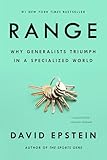
Editors Reads Verdict
A well-researched, compellingly argued counterweight to 10,000-hours mythology, Epstein demonstrates that breadth of experience and late specialization are not disadvantages but crucial assets in complex, unpredictable fields.
What We Loved
- Rigorous research base that challenges compelling but oversimplified narratives
- Excellent case studies spanning science, sports, art, and business
- The distinction between kind and wicked learning environments is genuinely useful
- Practically relevant for career decisions and parenting
Minor Drawbacks
- The argument against early specialization may go too far in some domains
- Some case studies receive more nuance than others
- Readers seeking a how-to guide will find this more descriptive than prescriptive
Key Takeaways
- → Kind learning environments (chess, golf) favor early specialization; wicked ones do not
- → Broad sampling in early career often leads to better long-term outcomes in complex fields
- → The most creative solutions often come from applying knowledge from one domain to another
- → Late specialization and career switching are not failures but potential advantages
- → Analogical thinking — applying solutions from distant domains — is a learnable skill
| Author | David Epstein |
|---|---|
| Publisher | Riverhead Books |
| Pages | 352 |
| Published | May 28, 2019 |
| Language | English |
| Genre | Psychology, Self-Help, Non-Fiction |
| Difficulty | Beginner |
| Best For | Career changers; parents; anyone who has felt pressure to specialize early. |
How Range Compares
Range at a glance against 3 similar books readers weigh alongside it.
| Book | Author | Rating | Best for |
|---|---|---|---|
| Range (this book) | David Epstein | ★ 4.3 | Career changers |
| Grit | Angela Duckworth | ★ 4.5 | Students, athletes, educators, parents, and anyone seeking to understand what |
| Mindset | Carol S. Dweck | ★ 4.6 | Parents, teachers, managers, athletes, and anyone who has ever told themselves |
| Outliers | Malcolm Gladwell | ★ 4.5 | Anyone curious about the sociology of success, parents thinking about their |
Tiger vs. Roger
Epstein opens with a comparison that has become the book’s signature: Tiger Woods, who began playing golf at eighteen months and was dominant by his teens, versus Roger Federer, who played multiple sports as a teenager and came to tennis specialization late. Both became the greatest of their era. Conventional wisdom holds that Tiger’s early specialization was the model. Epstein argues that Roger’s broad sampling was an equally valid path — and in many domains, the superior one.
Kind and Wicked Learning Environments
The book’s most useful conceptual contribution is the distinction between “kind” and “wicked” learning environments. Kind environments (golf, chess) have clear rules, repetitive patterns, and immediate feedback — early specialization works well here. Wicked environments (medicine, business, science) have unclear rules, changing patterns, and delayed, ambiguous feedback — breadth and analogical thinking are more valuable here. Most important human endeavors, Epstein argues, are wicked environments that we have mistakenly treated as kind.
The Evidence for Range
Epstein marshals case studies across domains: researchers who solved major scientific problems by applying techniques from fields the specialists didn’t know; business leaders whose breadth allowed them to see connections specialists missed; artists who produced their most innovative work after exposure to multiple traditions. The pattern is consistent: in complex, unpredictable fields, the person who has seen many different problems is often better positioned than the person who has optimized for one.
Match Quality and the Virtue of Quitting
One of the book’s most liberating ideas concerns what economists call “match quality” — the fit between a person’s interests and aptitudes and the work they do. Epstein argues that you cannot know your match quality in advance; you can only discover it by trying things, and so a “sampling period” of exploration is not wasted time but essential data-gathering. From this follows his most countercultural claim: that quitting, far from being a character flaw, is often a sign of intelligence. He cites research suggesting that people who switch paths after discovering a poor fit frequently end up with more fulfilling and successful careers than those who doggedly persist down a road chosen too early. In a culture that fetishises grit and “never giving up,” Epstein’s defence of the strategic quit — of having the courage to change course when the evidence says you should — is genuinely freeing, especially for anyone who has felt like a failure for not having found their single calling.
Late Bloomers and Analogical Thinkers
Much of the book is a gallery of people who succeeded because of their winding paths. Epstein profiles late-blooming artists like Vincent van Gogh, who failed at several careers before discovering painting in his late twenties; scientists who solved problems precisely because they imported tools from distant fields; and inventors whose breadth let them see connections specialists missed. His chapter on analogical thinking — using structural similarities between unrelated domains to crack hard problems, as Johannes Kepler did in reasoning about planetary orbits — is among the book’s richest. The recurring lesson is that in wicked, fast-changing domains, the ability to range across fields and reason by analogy beats the deep but narrow groove of the specialist. Epstein also turns this into a warning, examining disasters like the Challenger explosion and the 2008 financial crisis as cases where rigid, over-specialised expertise and an inability to “drop one’s tools” led smart people badly astray.
Where the Argument Strains
Range is not above criticism, and a fair reading acknowledges its limits. Like many big-idea books — and Epstein is explicitly writing as a counterweight to Malcolm Gladwell’s Outliers and the popular “10,000 hours” gospel — it can select the case studies that flatter its thesis, and skeptics note that for every Roger Federer there is a Tiger Woods, for every late bloomer a child prodigy. Epstein is careful and intellectually honest about this, conceding that early specialisation genuinely is the right path in “kind” domains, but the breezy momentum of the storytelling can still imply a more universal verdict than the evidence supports. The book is also more descriptive than prescriptive; readers hoping for a step-by-step guide to building range will find inspiration rather than instruction.
Practical Implications
The book’s practical message — that breadth is valuable, career switching is not failure, late blooming is a real phenomenon — is both reassuring and generative. Epstein, a former Sports Illustrated writer whose previous book The Sports Gene tackled adjacent questions, doesn’t argue against expertise; he argues against premature closure, the decision to specialize before you have sampled enough to know what you are actually best at and most drawn to. In a world that increasingly pressures children to specialize early and young adults to commit early, this message is both countercultural and evidence-based — and the book became a number-one bestseller, championed by readers from Bill Gates to athletes, precisely because so many people felt its permission to have taken the scenic route.
For students choosing a major, professionals contemplating a pivot, and parents tempted to funnel a child into a single pursuit at age seven, it offers both reassurance and a genuinely useful framework for thinking about how excellence actually develops — and a reminder that the winding path is not a detour from success but, for many people, the road to it.
Our rating: 4.3/5 — A rigorous, practically important challenge to the gospel of early specialization, arguing that breadth is not a disadvantage but often a crucial edge.
Reading Guides
Frequently Asked Questions
What is "Range" about?
David Epstein argues that in a complex world, generalists who develop broad knowledge and late specialization often outperform narrow specialists — challenging the prevailing gospel of early specialization.
Who should read "Range"?
Career changers; parents; anyone who has felt pressure to specialize early.
What are the key takeaways from "Range"?
Kind learning environments (chess, golf) favor early specialization; wicked ones do not Broad sampling in early career often leads to better long-term outcomes in complex fields The most creative solutions often come from applying knowledge from one domain to another Late specialization and career switching are not failures but potential advantages Analogical thinking — applying solutions from distant domains — is a learnable skill
Is "Range" worth reading?
A well-researched, compellingly argued counterweight to 10,000-hours mythology, Epstein demonstrates that breadth of experience and late specialization are not disadvantages but crucial assets in complex, unpredictable fields.
Ready to Read Range?
Check the current price on Amazon.
Check Price on Amazon (paid link)Prices and availability are subject to change. See Amazon for current price.
Review last updated: