Editors Reads Verdict
Margaret Atwood's most culturally penetrating novel reads differently in every decade since its publication — a dystopia built entirely from documented historical precedents that becomes more rather than less relevant as political conditions shift.
What We Loved
- The world-building derives every horror from real historical precedents — nothing is invented
- Offred's narrative voice is among the most distinctive in dystopian literature
- The novel's ambiguity (the Historical Notes) is formally sophisticated and philosophically serious
- Atwood's restraint — what is not shown — makes the horror more rather than less effective
- The political analysis embedded in the fiction remains acute decades later
Minor Drawbacks
- The deliberate withholding of backstory can frustrate readers who want more context
- The pace is slow by thriller standards — it is a literary novel in dystopian clothing
- Some male characters feel more archetypal than fully rendered
Key Takeaways
- → Every dystopia in fiction is built from precedents found in human history
- → Oppressive systems require the complicity of the oppressed to sustain themselves
- → Memory and language are the first things authoritarian systems work to control
- → The body is always a political site, regardless of ideology
- → Resistance can be internal even when external resistance is impossible
| Author | Margaret Atwood |
|---|---|
| Publisher | Anchor Books |
| Pages | 311 |
| Published | June 1, 1985 |
| Language | English |
| Genre | Dystopian Fiction, Literary Fiction, Feminist Fiction |
| Difficulty | Intermediate |
| Best For | Readers of literary dystopia, feminist fiction, and political novels who want a canonical text that rewards close reading and contemporary application. |
How The Handmaid's Tale Compares
The Handmaid's Tale at a glance against 3 similar books readers weigh alongside it.
| Book | Author | Rating | Best for |
|---|---|---|---|
| The Handmaid's Tale (this book) | Margaret Atwood | ★ 4.5 | Readers of literary dystopia, feminist fiction, and political novels who want a |
| 1984 | George Orwell | ★ 4.7 | Every adult in a democracy |
| Brave New World | Aldous Huxley | ★ 4.5 | Readers of 1984 and other dystopian fiction, philosophy and ethics enthusiasts, |
| The Testaments | Margaret Atwood | ★ 4.2 | Readers of The Handmaid's Tale who want resolution and context, and who are |
A Dystopia Built from History
Margaret Atwood has been clear since The Handmaid’s Tale’s 1985 publication that she invented nothing in Gilead’s horror. Every element of the theocratic Republic — the forced fertility rituals, the color-coded hierarchy, the destruction of women’s property rights, the historical erasure of dissidents — derives from documented historical practice, whether from Puritan New England, the Romanian Ceaușescu regime’s fertility mandates, or the treatment of women under various fundamentalist governments.
This is the novel’s central intellectual proposition: Gilead is not a warning about what might happen. It is a diagnosis of what has happened and what remains possible. The framing device of the Historical Notes — a 2195 academic conference analyzing Offred’s testimony as an artifact — makes this explicit. Scholars of the future study Gilead with the same detached curiosity historians apply to past atrocities, already having forgotten its lessons.
Offred’s Voice
The narrative voice of the Handmaid called Offred (a patronymic, for the Commander she is assigned to) is one of the defining voices in contemporary literature. It is careful, observant, layered with irony and grief, sometimes unreliable in ways she acknowledges. She is not a heroic narrator — she is a person trying to survive, editing her own story as she tells it, sometimes lying to herself, sometimes to us.
Atwood gives her genuine interiority without making her a vehicle for political commentary. She has desires, memories, humor — a full person who has been reduced by system to a function, and who persists in her personhood anyway.
The Historical Notes
The final section of the novel — a transcript of an academic conference paper — is Atwood’s masterstroke. It places Gilead in the category of concluded historical atrocity, viewed with academic detachment by scholars who note with wry irony that they cannot verify Offred’s account. The questions they don’t think to ask — about the Commander’s complicity, about the system’s victims — mirror the blind spots of actual historiography. It is formally innovative and morally serious.
1985 to Now
The novel’s cultural life has been remarkably consistent: there is always a political context in which it feels newly urgent. The Hulu adaptation expanded its reach to audiences who encountered it first as television, and many returned to the novel with fresh eyes.
Our rating: 4.5/5 — One of the essential political novels of the twentieth century, built on the terrifying observation that dystopia is not speculation but documentation.
Reading Guides
- Books Like The Handmaid
- Books Like A Thousand Splendid Suns: Women
- Books Like Animal Farm: Political Allegory, Power, and How Revolutions Eat Themselves
- Books Like Beloved: Historical Fiction About Trauma, Memory, and Survival
- Books Like Brave New World: Dystopia, Pleasure, and the Price of Happiness
- Books Like Fahrenheit 451: Censorship, Books, and the Rebellion of Reading
- Books Like Frankenstein: Creation, Responsibility, and the Ethics of Playing God
Publication History
The Handmaid’s Tale was published in 1985 by McClelland & Stewart in Canada and Houghton Mifflin in the United States. Atwood wrote the novel while living in West Berlin and travelling in East Germany, Afghanistan, and other countries where women’s rights were severely restricted; she has described the experience of writing in a city divided by a wall as directly shaping the novel’s sense of a society sealed off from the world it replaced.
The novel won the Governor General’s Award for English-language fiction in Canada (1985) and the Arthur C. Clarke Award in the UK (1987). It was shortlisted for the Booker Prize in 1986. It was not an immediate commercial success; its sales built steadily through the late 1980s and 1990s before the Hulu series transformed it into a cultural phenomenon.
The Hulu Series
The Hulu adaptation, created by Bruce Miller, began streaming in April 2017 with Elisabeth Moss as Offred/June. The timing — three months after the inauguration of Donald Trump — gave the series an immediate political resonance that drove extraordinary audience response. The series won the Primetime Emmy Award for Outstanding Drama Series in 2017, the first streaming series to win the award. It ran for six seasons through 2025 and spawned a sequel series, The Testaments, based on Atwood’s 2019 sequel novel.
The Testaments
Atwood published The Testaments in September 2019, thirty-four years after the original novel, narrated from three perspectives including an aged Aunt Lydia. It won the Booker Prize in 2019 — which Atwood had previously won for The Blind Assassin in 2000 — making her one of only three authors to have won the Booker twice. The dual timing (the sequel published as the Hulu series intensified, and winning the Booker at age 79) made 2019 one of the most remarkable years in any living author’s career.
Atwood’s Framing
Atwood has insisted since publication that every element in The Handmaid’s Tale has a historical precedent: no event in the novel was invented without a real-world source. The novel’s epigraph from Jonathan Swift’s A Modest Proposal signals that it belongs to the tradition of speculative satire in which the worst-case is assembled from actual events, arranged into a logical sequence.
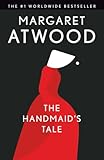
Atwood has insisted since publication that every element in the novel has a historical precedent; no practice in Gilead was invented without a real-world source. The Hulu adaptation’s timing — beginning three months after the 2017 presidential inauguration — gave it an immediate political resonance that drove the series’ Emmy win and transformed Offred’s red habit into a symbol at political demonstrations across the United States and internationally.
Frequently Asked Questions
What is "The Handmaid's Tale" about?
In the theocratic Republic of Gilead, women have been stripped of all rights and assigned to roles based on their fertility, one of whom narrates her life as a state-assigned Handmaid.
Who should read "The Handmaid's Tale"?
Readers of literary dystopia, feminist fiction, and political novels who want a canonical text that rewards close reading and contemporary application.
What are the key takeaways from "The Handmaid's Tale"?
Every dystopia in fiction is built from precedents found in human history Oppressive systems require the complicity of the oppressed to sustain themselves Memory and language are the first things authoritarian systems work to control The body is always a political site, regardless of ideology Resistance can be internal even when external resistance is impossible
Is "The Handmaid's Tale" worth reading?
Margaret Atwood's most culturally penetrating novel reads differently in every decade since its publication — a dystopia built entirely from documented historical precedents that becomes more rather than less relevant as political conditions shift.
Ready to Read The Handmaid's Tale?
Check the current price on Amazon.
Check Price on Amazon (paid link)Prices and availability are subject to change. See Amazon for current price.
Review last updated: