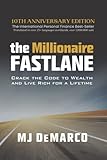
Editors Reads Verdict
The Millionaire Fastlane is a brash, unpolished, and genuinely contrarian business book that makes a compelling argument against the dominant personal finance orthodoxy of frugality plus index funds plus decades of patience. DeMarco's core insight — that most wealth-building advice optimizes for the wrong thing — is correct even when his solutions overreach.
What We Loved
- The critique of conventional personal finance wisdom ('the Slowlane') is incisive and largely correct
- The Commandments of Entry, Control, Scale, Time, and Need are useful business filters
- DeMarco writes with authentic frustration rather than performed guru enthusiasm
- The book correctly identifies that employee income cannot create significant wealth quickly
Minor Drawbacks
- The author's voice is aggressive and occasionally alienating
- The business advice is sound as far as it goes but underestimates execution difficulty
- The success story framing obscures survivorship bias
Key Takeaways
- → The Slowlane (job + savings + index funds) does create wealth but only after decades — after most of your active life
- → The Fastlane requires building a business with scale, where income is not directly tied to time
- → The five Commandments of the Fastlane: Need, Entry, Control, Scale, Time
- → Produce more than you consume — the wealth formula requires creating value, not just saving it
- → Most financial advice is written by people on a Slowlane, which explains why it prescribes a Slowlane
| Author | MJ DeMarco |
|---|---|
| Publisher | Viperion Publishing |
| Pages | 322 |
| Published | January 4, 2011 |
| Language | English |
| Genre | Business, Investing, Self-Help |
| Difficulty | Beginner |
| Best For | Entrepreneurs and aspiring business builders who find conventional financial advice unsatisfying, younger readers skeptical of the 40-year wealth-building timeline, and anyone who wants an honest critique of the personal finance orthodoxy. |
How The Millionaire Fastlane Compares
The Millionaire Fastlane at a glance against 3 similar books readers weigh alongside it.
| Book | Author | Rating | Best for |
|---|---|---|---|
| The Millionaire Fastlane (this book) | MJ DeMarco | ★ 4.3 | Entrepreneurs and aspiring business builders who find conventional financial |
| The 4-Hour Workweek | Tim Ferriss | ★ 4.4 | Employees questioning the 9-5 default, aspiring entrepreneurs, digital nomads, |
| The Personal MBA | Josh Kaufman | ★ 4.2 | Aspiring entrepreneurs and professionals who want broad business literacy |
| The Psychology of Money | Morgan Housel | ★ 4.7 | Anyone who earns money and wonders why smart people make poor financial |
The Critique That Lands
The most valuable thing The Millionaire Fastlane does is articulate clearly something that many people sense but cannot express: that conventional financial advice — spend less than you earn, maximize your 401k, invest in index funds, wait 40 years — is technically correct but practically useless if your goal is financial freedom in your thirties rather than your sixties. DeMarco calls this the “Slowlane,” and his critique of it is accurate even when his prescriptions overreach.
The Slowlane trades time for money and then money for more time. If you spend 40 productive years executing the Slowlane, you might retire in comfort — but you spent 40 years doing it, which is most of your adult life. The conventional advice is optimized for risk minimization rather than life quality, and DeMarco is not wrong to notice.
The Fastlane Framework
DeMarco’s alternative is the Fastlane: building a business with the characteristics that allow wealth to scale beyond individual time investment. He identifies five commandments for evaluating whether a business qualifies:
Need — does it solve a genuine problem for customers? Entry — are the barriers to entry high enough to prevent immediate commoditization? Control — do you own and control the asset rather than depending on a platform? Scale — can revenue grow without proportional growth in your time? Time — is the income eventually detached from your hours worked?
These are sound filters. Many businesses that feel like Fastlane businesses fail the scale or time tests — service businesses, in particular, tend to be high-income but not scalable.
The Honest Assessment
DeMarco’s voice is more genuine than most in the personal finance genre — frustrated, impatient, and occasionally abrasive rather than aspirationally cheerful. His credentials (he built and sold a business and became wealthy in his early thirties) are specific rather than vague.
The book’s weakness is typical of entrepreneurship literature: it correctly identifies the destination without adequately acknowledging how difficult the journey is. Most businesses fail. The Fastlane is real; getting onto it is another matter.
The Three Roadmaps
DeMarco organizes his argument around three “financial roadmaps,” and the framework is the book’s most useful contribution. The Sidewalk is the path of those who live for the moment, spending everything they earn and often more, with no plan and no wealth — a lifestyle of perpetual financial fragility regardless of income. The Slowlane is the conventional path of frugality, employment, and slow compounding toward a distant retirement. The Fastlane is DeMarco’s alternative: building a scalable business that detaches income from time. By naming these paths so vividly, DeMarco gives readers a quick diagnostic for their own situation and a clear picture of why high earners on the Sidewalk stay broke and why disciplined savers on the Slowlane stay tethered to decades of labor. The taxonomy is simplistic, but it is memorable and clarifying in exactly the way popular finance frameworks need to be.
The Math of Wealth
One genuinely sharp section concerns what DeMarco calls the “wealth equation” and the limits of linear earning. A salary, he argues, is capped by time — there are only so many hours to sell — which is why no amount of frugality alone produces rapid wealth. Real fortunes come from controlling assets whose value scales independently of hours worked: a business that serves millions, a product that sells while you sleep, equity that appreciates. He drives home the difference between a “wealth event” (selling an asset, an equity windfall) and a wage, and insists that the magnitude of a business’s reach — measured by how many people it affects and how much — sets the ceiling on its returns. This emphasis on scale and asset ownership over thrift is the book’s intellectual core, and it is broadly correct, even if DeMarco overstates how readily ordinary people can achieve it.
The Persuasive Voice and Its Risks
DeMarco’s tone sets the book apart from the genre’s aspirational cheerfulness. He is frustrated, blunt, impatient, occasionally abrasive — the voice of someone who built and sold a real company (a web-based limousine-booking service) and became wealthy in his early thirties, and who has little patience for what he sees as the comforting lies of mainstream advice. This specificity lends credibility; he is not a guru selling a course but an operator describing what worked. The risk is the familiar one of entrepreneurship literature: by focusing on the destination, the book underplays how brutally hard and statistically unlikely the journey is. Most businesses fail. The Fastlane is real, but the on-ramp is treacherous, and readers energized by DeMarco’s critique should pair his diagnosis with a sober understanding of the odds.
Who Should Read It
The Millionaire Fastlane is best read not as a literal blueprint but as a corrective lens. For a reader who has absorbed the standard advice — index funds, 401(k)s, forty-year horizons — and feels a vague dissatisfaction with it, DeMarco names the source of that dissatisfaction and offers a different framework for thinking about time, money, and freedom. It is most valuable for the entrepreneurially inclined, those willing to accept higher risk for the possibility of compressed timelines, and least useful for readers seeking safe, step-by-step instructions. Taken as provocation and reframing rather than gospel, it earns its place: a brash, flawed, but genuinely thought-provoking challenge to the assumption that the only respectable path to wealth is the slow one.
Our rating: 4.3/5 — A brash but genuinely insightful critique of conventional financial wisdom, most valuable for its accurate diagnosis of the Slowlane’s limits and its specific framework for evaluating business models.
Reading Guides
Frequently Asked Questions
What is "The Millionaire Fastlane" about?
MJ DeMarco challenges the conventional wisdom of slow, patient wealth-building and argues for building scalable businesses that generate wealth rapidly.
Who should read "The Millionaire Fastlane"?
Entrepreneurs and aspiring business builders who find conventional financial advice unsatisfying, younger readers skeptical of the 40-year wealth-building timeline, and anyone who wants an honest critique of the personal finance orthodoxy.
What are the key takeaways from "The Millionaire Fastlane"?
The Slowlane (job + savings + index funds) does create wealth but only after decades — after most of your active life The Fastlane requires building a business with scale, where income is not directly tied to time The five Commandments of the Fastlane: Need, Entry, Control, Scale, Time Produce more than you consume — the wealth formula requires creating value, not just saving it Most financial advice is written by people on a Slowlane, which explains why it prescribes a Slowlane
Is "The Millionaire Fastlane" worth reading?
The Millionaire Fastlane is a brash, unpolished, and genuinely contrarian business book that makes a compelling argument against the dominant personal finance orthodoxy of frugality plus index funds plus decades of patience. DeMarco's core insight — that most wealth-building advice optimizes for the wrong thing — is correct even when his solutions overreach.
Ready to Read The Millionaire Fastlane?
Check the current price on Amazon.
Check Price on Amazon (paid link)Prices and availability are subject to change. See Amazon for current price.
Review last updated: