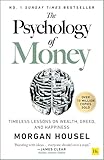
Editors Reads Verdict
The most accessible and insightful personal finance book of the last decade. Housel's short, punchy chapters reframe how you think about money in ways that stick long after you close the book.
What We Loved
- 19 stand-alone chapters — perfect for reading in any order
- Timeless principles over market timing advice
- Elegant prose that makes complex ideas feel obvious
- Challenges conventional financial wisdom in refreshing ways
Minor Drawbacks
- Light on specific investment tactics (intentionally so)
- US-centric examples in several chapters
Key Takeaways
- → Getting wealthy and staying wealthy require different skills — humility is key
- → Compounding needs time above all else — don't interrupt it
- → Save without needing a specific reason — savings is a hedge against uncertainty
- → Reasonable over rational — a strategy you'll stick to beats an optimal one you won't
- → Wealth is what you don't spend — it's invisible and often misunderstood
| Author | Morgan Housel |
|---|---|
| Publisher | Harriman House |
| Pages | 256 |
| Published | September 8, 2020 |
| Language | English |
| Genre | Finance, Psychology, Personal Finance |
| Difficulty | Beginner |
| Best For | Anyone who earns money and wonders why smart people make poor financial decisions — which is everyone. No investment experience required. |
How The Psychology of Money Compares
The Psychology of Money at a glance against 3 similar books readers weigh alongside it.
| Book | Author | Rating | Best for |
|---|---|---|---|
| The Psychology of Money (this book) | Morgan Housel | ★ 4.7 | Anyone who earns money and wonders why smart people make poor financial |
| Die with Zero | Bill Perkins | ★ 4.1 | Financially secure readers who are over-saving relative to their remaining life |
| The Intelligent Investor | Benjamin Graham | ★ 4.7 | Anyone who wants to invest in equities with a long-term, principled framework |
| Thinking, Fast and Slow | Daniel Kahneman | ★ 4.6 | Investors, doctors, lawyers, managers, policymakers, and any curious person who |
The Book About Money That Isn’t Really About Money
Morgan Housel wrote The Psychology of Money because he noticed something puzzling: brilliant people — physicists, surgeons, engineers — routinely make terrible financial decisions, while people with modest incomes and no financial training sometimes build extraordinary wealth. The difference, he argues, isn’t intelligence, education, or access to information. It’s behaviour. His central claim is that doing well with money is roughly 80% how you behave and only 20% what you know — and that behaviour, unlike knowledge, is genuinely hard to teach, even to very smart people. A former columnist at The Motley Fool and The Wall Street Journal, Housel writes with the brevity of a journalist and the curiosity of a historian, and the book has become one of the defining personal-finance titles of its era.
19 Short Lessons on Wealth and Behaviour
Housel structures the book as 19 standalone essays, each illuminating a different facet of the psychology behind financial decision-making. This makes it unusually accessible — you can read a chapter on a coffee break and walk away with a fresh mental model — and it is part of why the book rewards re-reading and dipping in at random.
Standout chapters include:
“No One’s Crazy”
Different generations have lived through radically different financial histories. The person who grew up during the Great Depression and hoards cash isn’t irrational — they’re acting on the data their experience provided. Understanding this builds empathy for financial behaviour that looks strange from the outside.
”Getting Wealthy vs. Staying Wealthy”
Getting money requires optimism and risk-taking. Keeping it requires paranoia and frugality. These are almost opposite skills, and many people who excel at the first fail spectacularly at the second.
”Tails, You Win”
The most important financial events are tail events — rare, unpredictable, disproportionately large. Your investment strategy and emergency fund should be sized for the world that occasionally delivers financial catastrophe, not the world most spreadsheets model.
”Wealth Is What You Don’t Spend”
The most counterintuitive chapter in the book. We conflate income with wealth, but wealth is accumulated savings — invisible by definition. The person driving a Porsche may be far less wealthy than the neighbour driving a ten-year-old Honda.
”Room for Error”
The best financial plans leave significant margin for the unexpected. Housel argues that the biggest risk isn’t getting the future wrong — it’s being forced to give up when times are bad because you had no buffer. Room for error lets you survive long enough for the odds, and compounding, to work in your favour.
”Luck & Risk”
Housel insists that luck and risk are siblings — both the result of forces outside any individual’s control. He uses the example of Bill Gates, whose path ran through one of the only high schools in the world with a computer in the late 1960s, alongside a classmate of equal talent whose luck ran the other way. The lesson is humility: be careful who you praise and admire, and be careful who you look down on, because outcomes are rarely as deserved as they appear. Focus less on specific individuals and case studies and more on broad patterns.
”Never Enough”
Some of the wealthiest, most capable people in the world — Housel cites figures like Rajat Gupta and Bernie Madoff — risked everything they had for things they did not need. The most valuable financial skill, he argues, is knowing when you have enough and getting the goalposts to stop moving. There is no reason to risk what you have and need for what you don’t have and don’t need.
Freedom: The Highest Dividend Money Pays
For Housel, the greatest intrinsic value of money is not the things it buys but the control over your time it provides. The ability to wake up and do what you want, with whom you want, for as long as you want, is the highest form of wealth — and it explains the book’s preference for savings and flexibility over status symbols. He punctures the urge to spend on display with the “Man in the Car Paradox”: no one is as impressed by your possessions as you imagine, because onlookers skip past the owner and simply imagine themselves in the car. Spending money to show people how much money you have, he notes drily, is the fastest way to have less of it.
Reasonable Beats Rational, and Save Without a Reason
Two practical threads run through the later chapters. First, aim to be reasonable rather than rational: a coldly optimal strategy you abandon in a panic is worse than a slightly imperfect one you can stick with through every market cycle, because staying in the game is what allows compounding to do its work. Second, save without needing a specific reason. Savings earmarked only for a car or a house miss the point; an open-ended buffer is a hedge against life’s inevitable surprises and the price of independence and options.
The Compounding Argument
Housel makes what may be the most compelling case ever written for leaving your investments alone. Warren Buffett’s net worth is almost entirely the product of investments made after his 50th birthday — not because he improved his strategy, but because compounding had decades to work. Starting early and not interrupting compounding is worth more than any investment insight.
Why This Book Stands Apart
Most personal finance books are about tactics: which index fund, how much to save, what to do in a downturn. The Psychology of Money is about the mental models underneath those decisions. That makes it both more durable and more practically useful — because no tactic works unless the behaviour is right.
Our rating: 4.7/5 — The one personal finance book we’d recommend to someone who has never read one before, and equally to someone who has read dozens.
Reading Guides
Frequently Asked Questions
What is "The Psychology of Money" about?
Doing well with money isn't necessarily about what you know. It's about how you behave. And behaviour is hard to teach, even to really smart people.
Who should read "The Psychology of Money"?
Anyone who earns money and wonders why smart people make poor financial decisions — which is everyone. No investment experience required.
What are the key takeaways from "The Psychology of Money"?
Getting wealthy and staying wealthy require different skills — humility is key Compounding needs time above all else — don't interrupt it Save without needing a specific reason — savings is a hedge against uncertainty Reasonable over rational — a strategy you'll stick to beats an optimal one you won't Wealth is what you don't spend — it's invisible and often misunderstood
Is "The Psychology of Money" worth reading?
The most accessible and insightful personal finance book of the last decade. Housel's short, punchy chapters reframe how you think about money in ways that stick long after you close the book.
Ready to Read The Psychology of Money?
Check the current price on Amazon.
Check Price on Amazon (paid link)Prices and availability are subject to change. See Amazon for current price.
Review last updated: