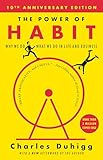
Editors Reads Verdict
Duhigg's exploration of the habit loop (cue-routine-reward) is the most readable account of habit science ever published. The organisational and social habit chapters are as interesting as the individual ones.
What We Loved
- The habit loop framework is simple, memorable, and scientifically grounded
- The organisational and societal habit chapters are fascinating and often overlooked
- The Appendix 'A Reader's Guide to Using These Ideas' is a model of practical advice
- Engaging narrative journalism — reads like a series of compelling stories
Minor Drawbacks
- Some chapters meander into case study territory at the expense of practical guidance
- The cue identification process is harder than Duhigg makes it sound
- Less focused than Atomic Habits as a practical guide
Key Takeaways
- → Every habit has a three-part loop: cue, routine, and reward
- → You can't extinguish a habit — you can only replace the routine while keeping the cue and reward
- → Keystone habits create cascading changes in other areas of life
- → The Golden Rule of habit change: identify the cue, keep the reward, insert a new routine
- → Willpower is a muscle that fatigues with use — design your environment to reduce its demand
| Author | Charles Duhigg |
|---|---|
| Publisher | Random House |
| Pages | 416 |
| Published | February 28, 2012 |
| Language | English |
| Genre | Psychology, Self-Help, Science |
| Difficulty | Beginner |
| Best For | Anyone interested in the science of behaviour change, from individuals trying to alter their own habits to managers and marketers shaping organisational behaviour. |
How The Power of Habit Compares
The Power of Habit at a glance against 3 similar books readers weigh alongside it.
| Book | Author | Rating | Best for |
|---|---|---|---|
| The Power of Habit (this book) | Charles Duhigg | ★ 4.5 | Anyone interested in the science of behaviour change, from individuals trying |
| Atomic Habits | James Clear | ★ 4.8 | Anyone who wants to build better habits, break bad ones, or improve personal |
| Predictably Irrational | Dan Ariely | ★ 4.4 | Anyone interested in why people make the decisions they do — consumers, |
| Thinking, Fast and Slow | Daniel Kahneman | ★ 4.6 | Investors, doctors, lawyers, managers, policymakers, and any curious person who |
The Science of Behaviour Change
Charles Duhigg, a Pulitzer Prize-winning journalist, spent years immersed in the academic literature on habits before writing this book. The result is one of the most engaging accounts of habit science ever published — combining rigorous research with the narrative skill of a long-form journalist.
The book moves through three scales: individual habits, organisational habits, and social habits. This structure distinguishes it from most habit books and gives it breadth that rewards reading all the way through rather than just the self-help sections.
The Habit Loop
The foundational framework is the habit loop: a three-part neural circuit of cue (the trigger), routine (the behaviour), and reward (the reinforcement). MIT researchers discovered this loop studying rats navigating mazes, but Duhigg traces its operation through human behaviour with dozens of compelling examples.
The key insight: once a habit loop is established in the basal ganglia, it does not disappear when you stop performing the routine. The neurological groove remains. This is why relapse is so common — the cue still triggers the craving even years after the routine was last performed. The implication for habit change is profound: you cannot eliminate habits, only replace the routine while preserving the cue and reward.
Keystone Habits
One of the book’s most insightful concepts is the keystone habit: a habit that, when changed, triggers cascading changes in other areas of life. Duhigg’s example is exercise: studies consistently show that people who begin a regular exercise habit spontaneously change their eating, sleeping, and drinking behaviour, improve their productivity at work, and report higher patience in relationships.
Identifying the keystone habits that have the widest leverage — in your own life or in an organisation — is the highest-value application of habit science.
Organisational and Social Habits
Duhigg’s most original contribution is applying habit theory beyond the individual. Organisations have habits — standard operating procedures, cultural norms, decision-making routines — that determine outcomes as reliably as individual behaviours. Companies like Alcoa transformed their safety performance by targeting a single keystone habit (safety reporting) that cascaded into broader organisational change.
The Golden Rule of Habit Change
Duhigg distills his practical advice into what he calls the Golden Rule of habit change: to break a habit, keep the same cue and the same reward, but insert a new routine in the middle. His vivid example is the football coach Tony Dungy, who transformed struggling NFL teams not by installing new plays but by changing the automatic responses his players reached for under pressure. Crucially, Duhigg adds two ingredients that pure mechanics miss: belief and community. Studying Alcoholics Anonymous and patients recovering from brain injury, he argues that lasting change usually requires believing that change is possible — and that this belief is far easier to sustain inside a supportive group than alone. It is a humane corrective to the purely engineering view of behaviour.
Willpower, Marketing, and the Ethics of Habit
Some of the book’s most memorable chapters roam far beyond self-improvement. Duhigg recounts how Starbucks built an entire training philosophy around the finding that willpower behaves like a muscle that fatigues with use — and can be strengthened through routine. He pulls back the curtain on how companies like Target mine purchasing data to detect and exploit consumer habits (famously inferring a teenager’s pregnancy before her family knew), and how Febreze nearly failed until marketers attached it to an existing habit loop. He even probes the unsettling ethical frontier of habit through the story of a sleepwalker and a compulsive gambler, asking how responsible we are for behaviour that has become automatic. These detours are what make the book more than a manual: they are a genuine inquiry into how much of life runs on autopilot.
Power of Habit vs. Atomic Habits
Readers often ask how this compares to James Clear’s Atomic Habits, and the honest answer is that they are complementary. Duhigg is the journalist and storyteller, richer in science, organisational insight, and narrative sweep; Clear is the practitioner, tighter and more actionable as a step-by-step manual for personal change. If you want to understand habits — including how they shape companies and societies — start here. If you want a concise toolkit for changing your own, pair it with Clear.
Final Verdict
The Power of Habit is the most readable, well-researched, and broadly applicable book on habit science available. It is somewhat less prescriptive than Atomic Habits but considerably richer in its scientific grounding and organisational insights — a Pulitzer-winning journalist’s genuinely illuminating tour of why we do what we do.
More than a decade after publication, it remains the book most often credited with bringing habit science into popular consciousness — the work that taught a general audience to see the invisible loops running quietly beneath their days, and to recognise that changing a life, a company, or even a community often begins with changing a single, well-chosen routine. For readers who want to understand the machinery of human behaviour before they try to rewire their own, it is the natural place to begin.
Our rating: 4.5/5 — The scientific and narrative foundation for understanding habits. Read alongside Atomic Habits for complete coverage.
Reading Guides
Frequently Asked Questions
What is "The Power of Habit" about?
An examination of the science of habit formation and how habits operate in individuals, organisations, and societies — and how to change them.
Who should read "The Power of Habit"?
Anyone interested in the science of behaviour change, from individuals trying to alter their own habits to managers and marketers shaping organisational behaviour.
What are the key takeaways from "The Power of Habit"?
Every habit has a three-part loop: cue, routine, and reward You can't extinguish a habit — you can only replace the routine while keeping the cue and reward Keystone habits create cascading changes in other areas of life The Golden Rule of habit change: identify the cue, keep the reward, insert a new routine Willpower is a muscle that fatigues with use — design your environment to reduce its demand
Is "The Power of Habit" worth reading?
Duhigg's exploration of the habit loop (cue-routine-reward) is the most readable account of habit science ever published. The organisational and social habit chapters are as interesting as the individual ones.
Ready to Read The Power of Habit?
Check the current price on Amazon.
Check Price on Amazon (paid link)Prices and availability are subject to change. See Amazon for current price.
Review last updated: