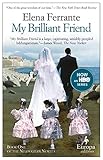
Editors Reads Verdict
The first volume of Ferrante's Neapolitan quartet is a masterpiece of female friendship and Italian social history — intense, specific, psychologically brilliant, and utterly addictive. Reading it feels like receiving a great secret.
What We Loved
- Female friendship rendered with unprecedented psychological specificity
- Postwar Naples is one of fiction's most richly evoked settings
- Ferrante's interior characterization is unlike anything else in contemporary fiction
- Structurally irresistible — each chapter ends in a way that demands the next
Minor Drawbacks
- The first novel ends mid-story — the full experience requires the quartet
- The social world is extremely specific to its time and place
- Some readers find Elena's submission to Lila's brilliance frustrating
Key Takeaways
- → Female friendship can be as fierce, competitive, and consuming as any romantic love
- → Intelligence in women is simultaneously valued and punished by the societies that possess it
- → Class and neighborhood shape possibility more than individual talent
- → Brilliance recognized but not educated is its own particular tragedy
- → The observer in a friendship is not necessarily the less significant partner
| Author | Elena Ferrante |
|---|---|
| Publisher | Europa Editions |
| Pages | 331 |
| Published | September 25, 2012 |
| Language | English |
| Genre | Literary Fiction, Historical Fiction |
| Difficulty | Intermediate |
| Best For | Literary fiction readers; anyone who has had an intense female friendship; Italian literature enthusiasts. |
How My Brilliant Friend Compares
My Brilliant Friend at a glance against 3 similar books readers weigh alongside it.
| Book | Author | Rating | Best for |
|---|---|---|---|
| My Brilliant Friend (this book) | Elena Ferrante | ★ 4.4 | Literary fiction readers |
| Conversations with Friends | Sally Rooney | ★ 3.9 | Literary fiction readers who want an intellectually demanding debut, especially |
| Normal People | Sally Rooney | ★ 4.1 | Literary fiction readers interested in contemporary Irish society, millennial |
| The Story of a New Name | Elena Ferrante | ★ 4.4 | Readers who finished My Brilliant Friend |
The Missing Lila
Elena Greco is in her sixties when her friend Lila Cerullo disappears completely — methodically erasing every trace of herself. Elena begins writing the story of their friendship from the beginning, as both a search for understanding and an act of witness. What follows is the Neapolitan quartet: four novels spanning sixty years of two women’s lives, set against the social and political transformation of Italy from postwar poverty to contemporary life.
The Neighborhood
The rione — the Naples neighborhood where Elena and Lila grow up — is one of fiction’s most fully realized settings. It is poor, violent, internally hierarchical, governed by the Solara family’s casual brutality, and alive with the specific texture of working-class postwar Italian life. Ferrante renders this world with the authority of someone who knows it from the inside, and the neighborhood becomes a force in the story as powerful as any character — shaping what is possible, what is permissible, and who gets to leave.
Two Girls, One Story
The novel’s central relationship — between Elena, the narrator, and Lila, the brilliant friend — is one of the most psychologically complex female friendships in all of fiction. Lila is dazzling: she teaches herself to read, grasps mathematics intuitively, has a mind that processes the world at a speed Elena can barely follow. Elena is also intelligent, but in the presence of Lila she always feels insufficient. Their friendship is love and competition and mutual formation, each girl shaping herself partly in response to the other’s example.
Why You Cannot Stop Reading
Ferrante writes with a compression and directness that removes the usual distance between reader and text — her narrators speak from inside their experience rather than from above it. The result is a reading experience of unusual intensity: the neighborhood feels real, the friendship feels real, the stakes feel real. By the final pages of the first novel, the reader is helplessly committed to the entire quartet.
Our rating: 4.4/5 — One of the great literary achievements of this century, the beginning of a quartet that will consume and transform every reader who enters it.
Reading Guides
- Books Like My Brilliant Friend
- Books Like The Secret History: 11 Dark Academia Reads for Fans of Donna Tartt
- Books Like A Little Life: 11 Novels That Devastate and Endure
- Books Like Normal People: 11 Literary Novels About Love, Class, and Missing Each Other
- Books Like It Ends With Us: 11 Novels About Love, Pain, and Hard Choices
- Books Like Educated: 11 Memoirs About Survival, Family, and Finding Yourself
- Books Like The Seven Husbands of Evelyn Hugo: 11 Sweeping, Unforgettable Reads
The World of the Rione
The Naples neighbourhood of My Brilliant Friend is not romanticised. It is poor, violent, governed by informal hierarchies that operate through fear and obligation, and shaped by the specific texture of postwar Italian working-class life: the courtyard architecture, the food vendors, the family feuds conducted across generations, the Solara family’s casual brutality that functions as a low-grade permanent emergency. Ferrante renders this world with the authority of someone who knows it from the inside, and the rione becomes as fully drawn as any of the novel’s characters — a force that shapes what is possible, what is thinkable, and who gets to leave.
The novel’s historical setting — the late 1950s and early 1960s in Naples — is not merely backdrop. The economic miracle of postwar Italy, which was beginning to transform northern cities while leaving the south behind, creates the precise conditions of possibility and constraint that govern both girls’ lives. Lila and Elena are living at the moment when escape has become theoretically imaginable for the first time, and the novel tracks the difference between theoretical and actual possibility with relentless accuracy.
The Friendship’s Psychological Grammar
Elena and Lila’s friendship operates according to a grammar that Ferrante makes explicit enough to analyse but never schematic enough to reduce. Lila is the engine: dazzling, magnetic, constitutionally incapable of accepting limits, a presence so intense that Elena describes her repeatedly in the vocabulary of light. Elena is the witness: intelligent, persistent, determined, but always with a part of her consciousness occupied by the question of what Lila thinks and how she compares.
This asymmetry is productive rather than simple. Elena is not just Lila’s satellite; she has her own intelligence and her own ambitions, and the novel tracks the ways in which being Lila’s friend has both stimulated and constrained those ambitions. The observer in a friendship is not the lesser partner; without Elena’s witness, Lila’s brilliance would have no record. The novel’s existence is Elena’s act of reciprocation, written from sixty years’ distance.
Ferrante’s Italian Original
My Brilliant Friend was published in Italian in 2011 as L’amica geniale and appeared in English translation by Ann Goldstein in 2012. Goldstein’s translation — of all four volumes — is widely considered a model of literary translation: faithful to Ferrante’s syntax and rhythm while producing idiomatic English that carries the full weight of the original. The English-language success of the Neapolitan quartet, which became a genuine cultural phenomenon, owes significantly to Goldstein’s work.
The Italian original’s title — L’amica geniale — is slightly more ambiguous than the English. Geniale means brilliant, but it also carries connotations of genius, inspiration, and the quality of being touched by something beyond ordinary ability. The title is Elena’s assessment of Lila, stated simply at the outset, and the novel is the account of what that assessment has meant across a lifetime.
Why the Series Became a Cultural Phenomenon
The Neapolitan quartet’s success — millions of copies sold across dozens of languages, a major television adaptation, sustained literary discussion — is not simply a matter of plot or setting. What makes the series unusual is that it describes a relationship between two women — a friendship between women — with the full psychological depth, complexity, and moral seriousness that literature has historically reserved for the relationships between men. The competition, the admiration, the resentment, the mutual formation, the way each woman’s life is shaped by the other’s even when they are not speaking: this is territory that literature had largely left unexplored, and Ferrante’s decision to occupy it produced a body of work that felt genuinely new.
The HBO Adaptation
The HBO/RAI television adaptation of My Brilliant Friend, which premiered in 2018, brought the novel to an even wider audience. Directed by Saverio Costanzo for the first two seasons, the series is filmed on location in Naples and is notable for its refusal to soften the neighbourhood’s violence or the protagonists’ complexity. Margherita Mazzucco and Gaia Girace, who play the adult Elena and Lila across the first two seasons, give performances of extraordinary precision; the casting of unknown young actors rather than established stars was itself a statement of fidelity to the novels’ insistence on specificity over glamour. The series ran to four seasons, completing its adaptation of the quartet.
Frequently Asked Questions
What is "My Brilliant Friend" about?
Elena Greco narrates her lifelong friendship with the brilliant, volatile Lila Cerullo, beginning in their postwar Naples neighborhood and following both girls through childhood and into their teenage years.
Who should read "My Brilliant Friend"?
Literary fiction readers; anyone who has had an intense female friendship; Italian literature enthusiasts.
What are the key takeaways from "My Brilliant Friend"?
Female friendship can be as fierce, competitive, and consuming as any romantic love Intelligence in women is simultaneously valued and punished by the societies that possess it Class and neighborhood shape possibility more than individual talent Brilliance recognized but not educated is its own particular tragedy The observer in a friendship is not necessarily the less significant partner
Is "My Brilliant Friend" worth reading?
The first volume of Ferrante's Neapolitan quartet is a masterpiece of female friendship and Italian social history — intense, specific, psychologically brilliant, and utterly addictive. Reading it feels like receiving a great secret.
Ready to Read My Brilliant Friend?
Check the current price on Amazon.
Check Price on Amazon (paid link)Prices and availability are subject to change. See Amazon for current price.
Review last updated: