Editors Reads Verdict
Plenty More confirms Ottolenghi's status as the most influential cookbook author of the early twenty-first century — a collection of vegetable recipes so inventive and delicious that they have permanently changed how many cooks think about plant-based cooking.
What We Loved
- The recipes are genuinely inventive — Ottolenghi consistently finds combinations no one else has thought of
- Every recipe is photographed beautifully and the food actually looks like the photographs
- The book works for vegetarians and non-vegetarians alike
- The range of influences — Middle Eastern, Asian, Mediterranean — gives the book unusual breadth
Minor Drawbacks
- Some recipes require specialty ingredients that may be difficult to source outside major cities
- The recipes are generally more complex than weeknight cooking allows
- Portions can be difficult to scale for smaller households
Key Takeaways
- → Vegetables become the most satisfying food in the world when treated with the same care and technique as meat
- → Ottolenghi's signature move: take a familiar vegetable and pair it with an unexpected flavour combination
- → Charring, caramelising, and roasting develop flavours in vegetables that boiling destroys
- → Herbs, spices, and condiments are not additions but structural elements of a dish
- → Middle Eastern and Mediterranean cuisines offer the most interesting vocabulary for vegetable cookery
| Author | Yotam Ottolenghi |
|---|---|
| Publisher | Ten Speed Press |
| Pages | 352 |
| Published | October 7, 2014 |
| Language | English |
| Genre | Cooking |
| Difficulty | Intermediate |
| Best For | Confident home cooks who want to expand their vegetable cooking repertoire — particularly those willing to invest time and seek out specialty ingredients for exceptional results. |
How Plenty More Compares
Plenty More at a glance against 3 similar books readers weigh alongside it.
| Book | Author | Rating | Best for |
|---|---|---|---|
| Plenty More (this book) | Yotam Ottolenghi | ★ 4.6 | Confident home cooks who want to expand their vegetable cooking repertoire — |
| An Everlasting Meal | Tamar Adler | ★ 4.5 | Home cooks who want to cook more intuitively, food writers, and anyone who |
| Salt, Fat, Acid, Heat | Samin Nosrat | ★ 4.8 | Home cooks from beginners to intermediate who want to move beyond following |
| The Barefoot Contessa Cookbook | Ina Garten | ★ 4.7 | Home cooks who want reliable, impressive recipes for entertaining — |
Vegetables as the Main Event
When Yotam Ottolenghi published Plenty in 2010, it changed the conversation about vegetarian cooking. Here was a cookbook that made vegetables genuinely exciting — not as health food or as compromise but as the most interesting ingredients in the kitchen. Plenty More continues that project with 150 additional recipes that demonstrate there is no limit to what can be done with plant ingredients.
Ottolenghi’s background — a Palestinian Israeli who trained in London and opened restaurants there — gives him access to a uniquely rich culinary vocabulary. His cooking draws on Levantine, North African, Persian, Turkish, and Southeast Asian traditions simultaneously, combining them with European technique to produce flavour profiles that are immediately recognisable and unlike anything else.
The Signature Move
Every experienced Ottolenghi reader knows the move: take a vegetable that everyone thinks they know, apply unexpected technique or flavour combination, and produce something that makes you wonder why you never did it that way before. Burnt eggplant with pomegranate and tahini. Roasted squash with chilli, lime, and seeds. Braised green beans with tomato and cinnamon. The pairings seem obvious in retrospect because they are so precisely right.
The technique underlying all of this is the use of char, caramelisation, and concentrated roasting. Ottolenghi does not steam or boil his vegetables into submission. He finds the cooking method that develops maximum flavour — usually high heat, usually longer than you expect — and then adds layers of acid, heat, sweetness, and freshness.
Organised by Method, Not Ingredient
The single most distinctive thing about Plenty More is its structure. Where the original Plenty grouped its recipes by ingredient, the sequel arranges its 150-plus dishes by cooking method — twelve chapters running Tossed, Steamed, Blanched, Simmered, Braised, Grilled, Roasted, Fried, Mashed, Cracked, Baked, and Sweetened. The conceit is more than a gimmick: it quietly reframes vegetable cookery as a discipline of technique rather than a list of ingredients, encouraging the reader to think about how heat and handling transform produce. The honest drawback, as more than one reviewer has noted, is that almost nobody walks into the kitchen hungry and thinks “I fancy something blanched tonight,” so the organisation can make the book harder to browse for a specific craving. But as a way of teaching how a single carrot or cauliflower can become a dozen different dishes, it works beautifully.
The Ottolenghi Effect
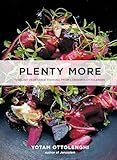
By the time Plenty More appeared in 2014, Ottolenghi had become arguably the most influential cookbook author of his generation. Across Plenty, the bestselling Jerusalem, and the books that followed, he did more than anyone to move ingredients like za’atar, sumac, pomegranate molasses, tahini, preserved lemon, and harissa from specialist shops into ordinary home kitchens — a shift so pronounced that food writers simply call it “the Ottolenghi effect.” Plenty More extends his palette further still, folding in flavours and ideas from Southeast Asia, India, New York, and Britain alongside the Levantine and Mediterranean core, and closing with a genuinely tempting “Sweetened” chapter that proves his inventiveness survives the move into dessert. As ever, the photography is gorgeous and, crucially, honest: the finished dishes actually look like the pictures.
Cooking From It
What ultimately matters in a cookbook is whether the food delivers, and here Plenty More excels. The recipes are reliable as well as inventive: written with the precision of a professional kitchen but tested for the home cook, they reward you with dishes that taste exactly as vivid as they look. This is unmistakably the work of a man who loves vegetables and understands, better than almost anyone, how to layer flavour and texture so that a plate of produce feels as satisfying and complete as any meat-centred meal. Dishes build in stages — a charred or roasted base, then acid, then heat, then a scatter of herbs, nuts, or a spiced oil — so that a single mouthful carries several distinct notes. The measured balance is part of the genius: Ottolenghi keeps just enough of the familiar to anchor each recipe while introducing just enough of the unexpected to make it feel like a discovery. Crucially, the book is not aimed only at vegetarians; omnivores find that these dishes work as generous mains in their own right, not as worthy side-plates. Cook a few of them and a quiet shift happens — vegetables stop being the obligatory accompaniment and start becoming the part of dinner you actually plan the meal around. That reorientation, more than any single recipe, is the book’s lasting gift, and it is why so many cooks return to it years after buying it.
The Investment Required
These recipes take time. Most require thirty minutes to an hour of active preparation, good equipment, and ingredients that may require some searching — and while Ottolenghi usually suggests more common substitutes for the Iranian limes, barberries, and other rarities he favours, a handful of dishes still demand enough unusual components to discourage a casual cook. This is not weeknight cooking but Sunday cooking — the kind that produces the food you think about the following week. For confident cooks willing to make the investment, the payoff is a vegetable repertoire that feels permanently expanded — and a standing reminder that “vegetarian” need never mean second-best.
Whether you cook meat or not, it earns its place on the shelf as one of the defining cookbooks of its era.
Our rating: 4.6/5 — Ottolenghi at his most inventive: a vegetable cookbook that permanently changes how you think about plant-based cooking.
Reading Guides
Frequently Asked Questions
What is "Plenty More" about?
The follow-up to Ottolenghi's game-changing Plenty, featuring more vegetable-focused recipes that combine Middle Eastern, Mediterranean, and Asian influences with his signature bold flavours.
Who should read "Plenty More"?
Confident home cooks who want to expand their vegetable cooking repertoire — particularly those willing to invest time and seek out specialty ingredients for exceptional results.
What are the key takeaways from "Plenty More"?
Vegetables become the most satisfying food in the world when treated with the same care and technique as meat Ottolenghi's signature move: take a familiar vegetable and pair it with an unexpected flavour combination Charring, caramelising, and roasting develop flavours in vegetables that boiling destroys Herbs, spices, and condiments are not additions but structural elements of a dish Middle Eastern and Mediterranean cuisines offer the most interesting vocabulary for vegetable cookery
Is "Plenty More" worth reading?
Plenty More confirms Ottolenghi's status as the most influential cookbook author of the early twenty-first century — a collection of vegetable recipes so inventive and delicious that they have permanently changed how many cooks think about plant-based cooking.
Ready to Read Plenty More?
Check the current price on Amazon.
Check Price on Amazon (paid link)Prices and availability are subject to change. See Amazon for current price.
Review last updated: