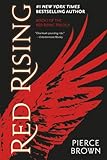
Editors Reads Verdict
Red Rising is the rare science fiction debut that arrives fully formed: a brutal, propulsive narrative with genuine emotional intelligence, a society built on Roman mythology translated to interplanetary caste hierarchy, and a protagonist whose intelligence and grief make him impossible not to follow.
What We Loved
- Darrow's grief is established with enough specificity to sustain a trilogy of motivation
- The Hunger Games-style academy sequence is more complex than its apparent predecessor
- Brown's prose style — elevated, classical — matches the Roman-inflected world-building
- The political intelligence of the society is detailed enough to feel real rather than constructed
Minor Drawbacks
- The first quarter moves more slowly than what follows
- Some of the academy alliances and betrayals require careful tracking
- The world-building density front-loads significant exposition
Key Takeaways
- → A caste system's cruelest trick is convincing its lowest members they deserve their position
- → Infiltration requires becoming something close enough to the enemy that the difference becomes hard to locate
- → Grief can be the most durable source of motivation when all other reasons prove insufficient
- → Power structures are maintained as much by their subjects' consent as by their rulers' force
- → Excellence within a corrupt system can be both survival skill and moral compromise
| Author | Pierce Brown |
|---|---|
| Publisher | Del Rey Books |
| Pages | 382 |
| Published | January 28, 2014 |
| Language | English |
| Genre | Science Fiction, Dystopian Fiction, Fantasy, Fiction |
| Difficulty | Intermediate |
| Best For | Fans of dystopian fiction ready for something more complex than YA fare; science fiction readers who enjoy political world-building; anyone who loved The Hunger Games and wants something darker. |
How Red Rising Compares
Red Rising at a glance against 3 similar books readers weigh alongside it.
| Book | Author | Rating | Best for |
|---|---|---|---|
| Red Rising (this book) | Pierce Brown | ★ 4.5 | Fans of dystopian fiction ready for something more complex than YA fare |
| Ender's Game | Orson Scott Card | ★ 4.7 | Science fiction readers from teenage years upward, fans of military fiction who |
| Golden Son | Pierce Brown | ★ 4.5 | Readers who have completed Red Rising |
| The Hunger Games | Suzanne Collins | ★ 4.5 | Young adult and adult readers who want dystopian fiction with genuine political |
Revolution in the Color Caste
Pierce Brown’s debut novel opens on Mars, where humanity has colonized the solar system under a society organized by color caste. Golds rule; Reds mine. Darrow is a Red, drilling beneath Mars’s surface in the belief that his labor contributes to terraforming a planet that his people will one day inhabit freely. When he discovers the terraforming was completed centuries ago — that the surface blooms while his people are kept in ignorance underground — the grief of that revelation, compounded by personal loss, drives him to volunteer for something extraordinary: surgical transformation into a Gold, infiltration of the Institute where Gold children compete to become commanders of civilization, and the beginning of a long game aimed at dismantling everything.
Roman Mythology, Reinvented
Brown’s most distinctive world-building choice is grounding his interplanetary society in Roman mythology — the castes named by color, the Golds organized around Roman family structures, the military culture built on Roman military hierarchy. The Institute where much of the novel takes place functions like a Roman war game elevated to lethal seriousness: competing houses, shifting alliances, conquest of territory, the slow emergence of command from chaos.
This gives the narrative a classical weight that purely science-fictional frameworks often lack. Darrow isn’t just navigating a school — he’s moving through a mythological structure whose rules and values determine who survives to rule worlds.
Grief as Foundation
The personal loss that drives Darrow is established in the novel’s opening section with enough emotional specificity to sustain motivation across three books. Brown doesn’t simply tell us Darrow is grieving; he makes the grief’s particular texture — its guilt, its rage, its transforming effect on what Darrow values — an active presence in every decision the character makes.
The betrayals and alliances that unfold at the Institute are morally complex in ways the genre doesn’t always attempt. Darrow’s choices to become something that contradicts his values in order to protect those values is the novel’s central psychological tension.
Our rating: 4.5/5 — A remarkably assured debut: a brutal, intelligent dystopian narrative with genuine emotional depth, set in a world-building achievement that gets richer with each volume.
Reading Guides
- Books Like Red Rising: 12 Brutal, Epic Reads for Fans of Pierce Brown
- Books Like Ender
- Books Like The Hunger Games: 13 Dystopian Novels to Read Next
- 15 Books Like Wheel of Time: Best Epic Fantasy Series for WoT Fans (2026)
- 15 Books Like Game of Thrones: Best Epic Fantasy for ASOIAF Fans (2026)
- Red Rising Books in Order: Pierce Brown
Publication History
Red Rising was published in January 2014 by Del Rey Books, a division of Penguin Random House. Pierce Brown had initially self-published a version of the novel, which attracted attention from agents; the Del Rey deal followed, with the first novel revised substantially for commercial publication. Brown was twenty-five at publication — one of the younger authors to launch a major science fiction series with a traditional publisher.
The novel draws on Suzanne Collins’s The Hunger Games trilogy (particularly the training and competition sections) and on Ender Wiggin’s immersive training environment in Ender’s Game, while setting these competitive structures within a more explicitly Marxist political framework. The caste system of the Society — with Reds at the bottom performing the labour that enables the Golds at the top to maintain their dominance — is stated as such, rather than disguised as mere social hierarchy.
The Institute
The Institute sequence, which occupies most of the first novel, sends students of the Gold caste through a competitive programme designed to identify and develop future leaders. Darrow — a Red disguised surgically as a Gold — enters the Institute and must learn to think and act as a Gold to dismantle the system from within. The irony that the revolution requires its agent to become what he opposes gives the novel its central tension, sustained across three novels.
The Trilogy and Beyond
Red Rising was followed by Golden Son (2015) and Morning Star (2016), completing the original trilogy. Brown extended the series with Iron Gold (2018), Dark Age (2019), and Light Bringer (2023), expanding the cast and the scope. The trilogy has sold more than five million copies; a television and film adaptation has been in development, with Amazon in early negotiation stages as of the mid-2020s.
The Hunger Games Comparison
Red Rising was immediately compared to The Hunger Games (2008) on publication, and Brown has acknowledged Collins’s influence while distinguishing his project: where Collins’s Panem is a straightforward tyranny using spectacle to control a population, Brown’s Society is a meritocracy that uses competitive violence to reproduce its own hierarchy. The Golds who run the Institute believe they deserve their position because they won it; the system’s cruelty is not arbitrary but systematic. This distinction — between spectacle-tyranny and meritocracy-tyranny — gives the trilogy a different political argument from its most obvious predecessor.
The Society’s Caste System
The Society’s fourteen castes — each assigned a colour and a function, from the Gold rulers to the Red labourers — is explicitly modelled on Hindu varna theory filtered through a Platonic framework: each person is born into their function and expected to perform it. Darrow’s transformation from Red to Gold requires not just physical modification but the adoption of an entirely different relationship to the world — the entitlement, the casual violence, the assumption of superiority that Golds carry as naturally as their colouring. Brown’s interest in how social identity is embodied rather than merely believed gives the trilogy its psychological depth alongside its action-plot momentum.
Frequently Asked Questions
What is "Red Rising" about?
A young miner from Mars's lowest caste disguises himself as one of the ruling class and infiltrates their elite military academy to bring down the society that enslaved his people.
Who should read "Red Rising"?
Fans of dystopian fiction ready for something more complex than YA fare; science fiction readers who enjoy political world-building; anyone who loved The Hunger Games and wants something darker.
What are the key takeaways from "Red Rising"?
A caste system's cruelest trick is convincing its lowest members they deserve their position Infiltration requires becoming something close enough to the enemy that the difference becomes hard to locate Grief can be the most durable source of motivation when all other reasons prove insufficient Power structures are maintained as much by their subjects' consent as by their rulers' force Excellence within a corrupt system can be both survival skill and moral compromise
Is "Red Rising" worth reading?
Red Rising is the rare science fiction debut that arrives fully formed: a brutal, propulsive narrative with genuine emotional intelligence, a society built on Roman mythology translated to interplanetary caste hierarchy, and a protagonist whose intelligence and grief make him impossible not to follow.
Ready to Read Red Rising?
Check the current price on Amazon.
Check Price on Amazon (paid link)Prices and availability are subject to change. See Amazon for current price.
Review last updated: