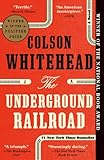
Editors Reads Verdict
The Underground Railroad is a work of controlled moral imagination — Whitehead uses the device of a literal railroad to traverse not just geography but the full range of American anti-Black racism across different historical modes. It is harrowing, precise, and essential.
What We Loved
- The literal underground railroad conceit transforms metaphor into mechanism with brilliant effect
- Each state Cora passes through represents a distinct historical mode of racial oppression
- Whitehead's prose is exact and unsparing without being sensationalist
- Ridgeway, the slave catcher, is one of American fiction's most fully theorised antagonists
Minor Drawbacks
- The alternate-history elements may disorient readers expecting straight historical fiction
- The episodic structure means some sections feel less developed than others
- The emotional register is deliberately controlled — readers seeking catharsis may feel kept at distance
Key Takeaways
- → American anti-Black racism has no single form — it adapts its methods to whatever the historical moment permits
- → Freedom is not a destination but a condition that must be actively maintained against continuous threat
- → The American mythology of progress conceals the cyclical recurrence of racial violence beneath different names
- → Survival requires complicity in systems one opposes — the ethical costs of this are never simple
| Author | Colson Whitehead |
|---|---|
| Publisher | Doubleday |
| Pages | 306 |
| Published | August 2, 2016 |
| Language | English |
| Genre | Literary Fiction, Historical Fiction, Fiction |
| Difficulty | Intermediate |
| Best For | Readers of literary and historical fiction; anyone seeking to understand the range of American racial history through fiction; fans of Toni Morrison, Octavia Butler, and speculative historical fiction. |
How The Underground Railroad Compares
The Underground Railroad at a glance against 3 similar books readers weigh alongside it.
| Book | Author | Rating | Best for |
|---|---|---|---|
| The Underground Railroad (this book) | Colson Whitehead | ★ 4.3 | Readers of literary and historical fiction |
| Beloved | Toni Morrison | ★ 4.5 | Serious readers of literary fiction with the patience for challenging, |
| Homegoing | Yaa Gyasi | ★ 4.6 | Anyone interested in African and African-American history |
| Kindred | Octavia Butler | ★ 4.5 | Readers interested in science fiction's literary possibilities, students of |
A Literal Act of Imagination
The underground railroad was never literal: it was a network of abolitionists, safe houses, and secret routes that helped enslaved people escape to freedom. Colson Whitehead’s decision to make it literal — actual tunnels bored under the earth, actual trains running between actual stations — is not whimsy but method. By making the metaphor physical, he transforms the geography of escape into a structural device that lets him move his protagonist, Cora, across not just space but the full range of American anti-Black racism across different historical periods and modes.
Cora begins on a Georgia cotton plantation, the novel’s most realist section and its most brutal. The plantation is rendered without mitigation: the violence, the hierarchies among enslaved people, the specific texture of a world in which every human relationship has been contaminated by the logic of ownership. When she and Caesar escape, they descend into the literal underground and emerge in South Carolina — which looks, at first, like progress.
Each State, a Different System
This is the novel’s architectural genius. Each state Cora passes through — South Carolina, North Carolina, Tennessee, Indiana — represents not just a different geography but a different historical mode of racial control. South Carolina offers paternalistic “uplift” that conceals forced sterilisation and medical experimentation. North Carolina has simply eliminated its Black population entirely. Tennessee is apocalyptic ruin. Indiana is a fragile interracial utopia whose fragility is itself the point.
Whitehead is mapping the varieties of anti-Black racism across American history without requiring historical sequence. The novel is simultaneously about the antebellum period and about every period — including the present. The alternate history is not escapism but a structural permission to make this argument directly.
Ridgeway and the Philosophy of Capture
Ridgeway, the slave catcher who pursues Cora across the novel, is among American fiction’s most chilling antagonists precisely because Whitehead grants him a coherent worldview. Ridgeway believes in the “American imperative” — the proposition that what America is, is the conquest and use of everything weaker than itself, and that the slave catcher who returns the escaped to bondage is the truest expression of American identity. He is not a monster but a logician.
Cora
The centre of the novel is Cora herself — resourceful, damaged, capable of love and capable of violence, refusing to be reducible to her suffering. Whitehead renders her interiority with the same precision he applies to the systems that surround her. Her journey is not a triumphant escape narrative; it is a survival story, which is both more honest and more demanding.
Our rating: 4.3/5
Reading Guides
- Books Like The Underground Railroad: Slavery, Freedom, and the Impossible Journey North
- Best Books About Race in America: 16 Essential Reads
- Barack Obama
Whitehead and the Double Prize
The Underground Railroad made Colson Whitehead the first author since Ralph Ellison — whose Invisible Man won the National Book Award in 1953 — to win both the Pulitzer Prize and the National Book Award for the same novel. The National Book Award came first, in November 2016; the Pulitzer followed in May 2017. The recognition placed Whitehead unmistakably at the centre of American literary fiction at a moment when the questions his novel raises — about the varieties of racial oppression and the persistence of American mythology — were being debated with new urgency.
The novel was adapted as a limited television series by director Barry Jenkins, released on Amazon Prime in 2021. Jenkins, working across ten episodes, preserved the novel’s episodic structure and its visual commitment to a particular quality of stillness: long, quiet takes that force the viewer into the same relationship with horror that Whitehead’s prose achieves through restraint. The adaptation was widely acclaimed.
The Place of The Underground Railroad in Whitehead’s Work
For readers coming to Whitehead through this novel — which many do — it is worth understanding its place in a career that began with the allegorical noir of The Intuitionist in 1999, moved through the formally ambitious John Henry Days and the zombie novel Zone One, and then, with The Underground Railroad, found a wider audience without sacrificing any of its formal intelligence. The novel is accessible in ways that his earlier work is not — the alternate-history premise is made legible immediately — but the demands it makes on the reader’s willingness to sit with unresolved moral weight are as serious as anything in his work.
Why It Endures
What ensures that The Underground Railroad will be read long after the prizes are memory is its structural argument: that American anti-Black racism is not a single thing with a beginning and an end but a repertoire of methods, each adapted to the ideological requirements of its historical moment. Whitehead has built this argument into the architecture of the novel itself, so that the form is the argument. That is what literary fiction at its best can do that no other mode of expression can.
The Railroad Made Literal
Whitehead’s central conceit is to take the Underground Railroad’s metaphor at its word: in his telling it is a genuine subterranean network of tracks and locomotives, and each state Cora passes through on her flight from a Georgia plantation becomes a distinct allegorical regime — a sanitised “model” town concealing forced sterilisation, a state that has outlawed Black presence entirely. The device frees Whitehead to compress the full range of American racial terror into one fugitive’s journey. The novel won both the Pulitzer Prize and the National Book Award in 2016, was chosen for Oprah’s Book Club, and was adapted by Barry Jenkins into a 2021 limited series.
Frequently Asked Questions
What is "The Underground Railroad" about?
Cora, a slave on a Georgia plantation, escapes on a literal underground railroad — a secret network of actual trains and tunnels — and is hunted across an alternate-history antebellum America. Winner of the Pulitzer Prize and National Book Award.
Who should read "The Underground Railroad"?
Readers of literary and historical fiction; anyone seeking to understand the range of American racial history through fiction; fans of Toni Morrison, Octavia Butler, and speculative historical fiction.
What are the key takeaways from "The Underground Railroad"?
American anti-Black racism has no single form — it adapts its methods to whatever the historical moment permits Freedom is not a destination but a condition that must be actively maintained against continuous threat The American mythology of progress conceals the cyclical recurrence of racial violence beneath different names Survival requires complicity in systems one opposes — the ethical costs of this are never simple
Is "The Underground Railroad" worth reading?
The Underground Railroad is a work of controlled moral imagination — Whitehead uses the device of a literal railroad to traverse not just geography but the full range of American anti-Black racism across different historical modes. It is harrowing, precise, and essential.
Ready to Read The Underground Railroad?
Check the current price on Amazon.
Check Price on Amazon (paid link)Prices and availability are subject to change. See Amazon for current price.
Review last updated: