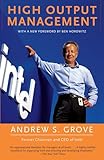
Editors Reads Verdict
High Output Management is the management book that serious managers actually recommend to other serious managers. Grove's engineering background gives the book an unusual rigor — management is treated as a process with inputs, outputs, and measurable leverage points — without sacrificing the human dimension of leadership.
What We Loved
- The managerial leverage concept is immediately useful and changes how you think about time allocation
- The one-on-one meeting framework alone is worth the book's price
- Grove writes from genuine operational experience — the examples are real, not constructed
- The book works for managers at every level, from new team leads to senior executives
Minor Drawbacks
- Some examples date from the semiconductor industry of the 1980s and require translation
- The production/factory metaphors will feel foreign to managers in service or creative industries
- The writing style is functional rather than engaging — not a book to read for pleasure
Key Takeaways
- → A manager's output is the output of their team and the teams they influence — not individual work product
- → Managerial leverage means identifying the activities that have disproportionate impact on team output and prioritizing them
- → One-on-ones are the manager's most powerful tool — they are the employee's meeting, not the manager's
- → Decision-making should happen at the level where relevant information lives, which is often not the top
- → A manager's most important task is increasing team performance, which requires addressing motivation and capability separately
| Author | Andrew Grove |
|---|---|
| Publisher | Vintage |
| Pages | 272 |
| Published | January 1, 1983 |
| Language | English |
| Genre | Business, Management, Leadership |
| Difficulty | Intermediate |
| Best For | Managers and aspiring managers at any level, particularly those in technical organizations or startups, who want a rigorous framework rather than motivational anecdotes. |
How High Output Management Compares
High Output Management at a glance against 3 similar books readers weigh alongside it.
| Book | Author | Rating | Best for |
|---|---|---|---|
| High Output Management (this book) | Andrew Grove | ★ 4.5 | Managers and aspiring managers at any level, particularly those in technical |
| Drive | Daniel H. Pink | ★ 4.3 | Managers, HR professionals, educators, and anyone who wants to understand what |
| Only the Paranoid Survive | Andrew Grove | ★ 4.3 | Senior business leaders, entrepreneurs, and strategy professionals in any |
| The Culture Code | Daniel Coyle | ★ 4.3 | Non-Fiction |
Management as Engineering
Andy Grove was an engineer before he was a manager, and High Output Management is structured like an engineering document: systematic, metric-driven, built on clearly stated assumptions. This distinguishes it from most management books, which tend to be organized around stories, inspiration, and advice that doesn’t quite connect to the actual problems of running a team.
Grove’s central question is deceptively simple: what does a manager actually produce? The answer — the output of the team they manage, plus the output of the teams they influence — reframes the entire management function. If you manage twenty people, your output is whatever those twenty people produce. Your job is to maximize that output. Everything else follows from this.
Leverage
The concept of managerial leverage is the book’s most practically useful contribution. Grove argues that a manager’s time should be allocated based on leverage — the ratio of output produced to time invested. Activities with high leverage (training someone who will train others, making a decision that unblocks a team, attending a meeting where your input will change outcomes) deserve priority over activities with low leverage regardless of which is more comfortable.
This framework immediately generates the right questions: What is the highest-leverage thing I could do right now? Am I spending time on work I could delegate? Are there tasks that only I can do that I’m deferring?
One-on-Ones
Grove’s treatment of the one-on-one meeting has become canonical in Silicon Valley management practice. His core insight: the one-on-one is the employee’s meeting. Its agenda should come from the employee. The manager’s job is to listen, ask questions, and remove obstacles — not to check in, assign tasks, or perform authority.
Done correctly, one-on-ones are the most effective information-gathering and relationship-building tool a manager has. Done incorrectly — as a status update the manager conducts for their own purposes — they waste everyone’s time.
The Performance Review
Grove’s approach to performance reviews is systematic in a way that most managers find helpful: separate the question of whether someone is meeting the job’s requirements from the question of whether the job is the right fit, and address capability and motivation separately because they require different interventions.
Legacy
Grove wrote this book in 1983 about managing in a semiconductor company, and it has been recommended by virtually every serious technology executive since. The fact that it works across industries and eras is evidence that it’s identifying something real about management rather than describing Intel’s particular culture.
Our rating: 4.5/5 — The management book that serious managers recommend to each other, built on engineering rigor and genuine operational experience.
Management as a Production Process
Andrew Grove, who led Intel through its defining decades, wrote High Output Management from the perspective of an engineer, and that sensibility runs through the whole book. Grove treats management not as an art of personality but as a discipline with measurable inputs and outputs, applying the logic of a production process to the work of running teams and organisations. His central metric is leverage — the idea that a manager’s job is to maximise the output of the team and of everyone they influence, and that the highest-leverage activities are the ones that affect the most people. This framing gives the book a rigour and clarity rare in management writing.
Concrete Tools, Not Platitudes
What has kept the book a favourite of serious operators for decades is its concreteness. Grove offers specific, usable tools and frameworks — how to run a productive meeting, how to conduct a useful one-on-one, how to give performance reviews, how to think about training as a high-leverage task, and how to measure what matters with the right indicators. These are not vague inspirational ideas but practical techniques drawn from running one of the most demanding companies in the world, and they translate readily to managers in any field.
The Origins of OKRs
Grove’s thinking on goal-setting and measurement, developed at Intel, became the foundation for the goal-management system later popularised across the technology industry as objectives and key results. Reading High Output Management is in part reading the source — the original articulation of ideas about alignment, measurement, and focus that have shaped how modern companies operate. That intellectual lineage is part of why the book remains required reading in so many technology companies.
Why It Endures
Decades after publication, High Output Management is still recommended by leading executives and investors as one of the best books ever written on the actual work of managing. It is clear, practical, and grounded in real experience rather than theory, and its core insight — that management is a discipline aimed at producing output through leverage — has not dated. For anyone moving into management or seeking to do it better, it remains a genuinely useful and rigorous guide, and one of the few business books that practitioners return to again and again.
Who Should Read It
This is a book for working managers and aspiring ones rather than for casual readers seeking general life lessons. Its examples are drawn from the specific world of technology and manufacturing, but its principles generalise widely, and its no-nonsense, engineer’s clarity is exactly what makes it valuable. Read as a practical manual for the real, often unglamorous work of getting the most out of a team, it stands among the most respected and durable management books ever written.
Reading Guides
Frequently Asked Questions
What is "High Output Management" about?
Intel CEO Andrew Grove's systematic guide to management as a measurable, improvable discipline, organized around the concept of managerial output and leverage.
Who should read "High Output Management"?
Managers and aspiring managers at any level, particularly those in technical organizations or startups, who want a rigorous framework rather than motivational anecdotes.
What are the key takeaways from "High Output Management"?
A manager's output is the output of their team and the teams they influence — not individual work product Managerial leverage means identifying the activities that have disproportionate impact on team output and prioritizing them One-on-ones are the manager's most powerful tool — they are the employee's meeting, not the manager's Decision-making should happen at the level where relevant information lives, which is often not the top A manager's most important task is increasing team performance, which requires addressing motivation and capability separately
Is "High Output Management" worth reading?
High Output Management is the management book that serious managers actually recommend to other serious managers. Grove's engineering background gives the book an unusual rigor — management is treated as a process with inputs, outputs, and measurable leverage points — without sacrificing the human dimension of leadership.
Ready to Read High Output Management?
Check the current price on Amazon.
Check Price on Amazon (paid link)Prices and availability are subject to change. See Amazon for current price.
Review last updated: