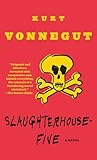
Editors Reads Verdict
The greatest American anti-war novel. Vonnegut's time-travel structure is not a gimmick but a formal embodiment of traumatic memory — and 'So it goes' is one of literature's most devastating refrains.
What We Loved
- The non-linear structure is not a gimmick but a psychological necessity — trauma doesn't unfold in order
- Vonnegut's dark humour makes the unbearable bearable without minimising it
- The first chapter — Vonnegut himself trying to write this book — is among the finest in American literature
- At 215 pages, it is perfectly compressed
Minor Drawbacks
- The Tralfamadore science fiction elements may seem absurdist to readers expecting realism
- Some readers find the narrative discontinuity frustrating rather than illuminating
Key Takeaways
- → 'So it goes': the Tralfamadorian acceptance of death as just another moment in the unchanging structure of time
- → Traumatic memory is non-linear — it intrudes, it circles back, it refuses the comfort of narrative
- → War is not heroic; it is absurd, brutal, and most harmful to those with the least power
- → The firebombing of Dresden killed more civilians than Hiroshima — and is almost unknown in American culture
- → Free will may be an illusion, but how you respond to that knowledge is the ethical question
| Author | Kurt Vonnegut |
|---|---|
| Publisher | Dell |
| Pages | 215 |
| Published | March 31, 1969 |
| Language | English |
| Genre | Science Fiction, Literary Fiction, Anti-War |
| Difficulty | Intermediate |
| Best For | Literary fiction readers, antiwar literature enthusiasts, and anyone seeking one of the twentieth century's most formally inventive and morally serious novels. |
How Slaughterhouse-Five Compares
Slaughterhouse-Five at a glance against 3 similar books readers weigh alongside it.
| Book | Author | Rating | Best for |
|---|---|---|---|
| Slaughterhouse-Five (this book) | Kurt Vonnegut | ★ 4.5 | Literary fiction readers, antiwar literature enthusiasts, and anyone seeking |
| Catch-22 | Joseph Heller | ★ 4.5 | Readers of literary fiction with appetite for dark satire, formally inventive |
| Flowers for Algernon | Daniel Keyes | ★ 4.6 | Readers of both literary fiction and science fiction who can handle deep |
| The Left Hand of Darkness | Ursula K. Le Guin | ★ 4.4 | Science fiction readers interested in Le Guin's literary science fiction and |
The Anti-War Novel’s Anti-War Novel
Kurt Vonnegut was a prisoner of war sheltering in an underground slaughterhouse in Dresden, Germany, when the Allied forces firebombed the city in February 1945. When he emerged, approximately 135,000 people were dead — more than Hiroshima, by most estimates. Vonnegut spent twenty-three years trying to write a book about what he had seen before he produced Slaughterhouse-Five.
The novel’s first chapter — which is among the finest in American literature — describes his attempts: the conversations with a fellow survivor, his wife’s anger at his project, his inability to get past the beginning. “I was there,” he writes. It ends with the famous admission: “I have told my sons that they are not under any circumstances to take part in massacres, and that the news of massacres of enemies is not to fill them with satisfaction or glee. I have also told them not to work for companies which make massacre machinery, and to express contempt for people who think we need machinery like that.”
Billy Pilgrim Unstuck in Time
The novel’s protagonist, Billy Pilgrim, is a “pillar of salt” — a passive, spectral figure who moves through the events of the novel without apparent agency. He has become “unstuck in time,” experiencing the events of his life in non-linear order: his childhood, his capture, the firebombing, his suburban optometrist’s life after the war, his abduction by Tralfamadorians — alien beings who experience all moments simultaneously.
The Tralfamadorian perspective — “So it goes,” their response to every mention of death, their view that all moments are equally permanent and equally present — is the novel’s philosophical device. Vonnegut uses it to represent the psychological state of a man for whom the past is always present, for whom death is always in the room.
”So It Goes”
The refrain “So it goes” appears 106 times in the novel — once for every death mentioned. It is simultaneously resigned acceptance and savage irony: the phrase trivialises death in a way that reveals how civilisation trivialises death, especially the deaths of wartime. Vonnegut’s deployment of it is one of the great formal achievements in American fiction.
The Dresden Revelation
Part of the novel’s historical importance is that it brought the firebombing of Dresden — largely unknown in American culture — to public consciousness. Vonnegut’s question: why is this not as famous as Hiroshima? His implicit answer: because it was done by the Allies, and our history makes our atrocities invisible.
The Tralfamadorian Consolation
The science-fiction frame of Slaughterhouse-Five — Billy Pilgrim’s abduction by the Tralfamadorians, the aliens who experience all of time at once and keep him in a zoo with the movie star Montana Wildhack — is the part most likely to puzzle readers expecting a straight war novel. But the Tralfamadorian philosophy is not a distraction from Dresden; it is Vonnegut’s way of dramatising what catastrophic trauma does to a mind. The Tralfamadorians teach Billy to regard every moment as permanent and unchangeable, to look only at the good moments and ignore the bad, to greet each death with the resigned “So it goes.” This is a philosophy of acceptance, and it is also a symptom — the exact mental architecture a survivor might build to make an unbearable memory survivable. Vonnegut never tells us whether the aliens are real or whether Billy, brain-damaged in a plane crash and broken by the war, has invented them. The ambiguity is the point. The fatalism that lets Billy endure is the same fatalism that makes it impossible to protest the next massacre, and Vonnegut holds those two truths in tension without resolving them.
The Joke That Isn’t a Joke
What gives the novel its strange tonal signature is the way Vonnegut refuses both solemnity and despair, choosing instead a deadpan comedy that makes the horror more legible rather than less. The flattened, childlike sentences, the recurring tags, the cast of hapless soldiers — the doomed schoolteacher Edgar Derby, executed after the firebombing for looting a teapot — all serve a single purpose: to strip war of the heroic vocabulary that makes it repeatable. There is no glory in Billy’s war, no redemptive sacrifice, only confusion, cold, fear, and the obscene arithmetic of a city turned to ash in a single night. By subtitling the book “The Children’s Crusade,” Vonnegut insists on what the recruiting posters hide: that wars are fought by frightened boys, not the seasoned warriors of legend. The novel’s enduring power lies in how completely its form embodies its argument — the broken chronology mirroring traumatic memory, the dark jokes mirroring the only sane response to the insane, until the structure itself becomes the most eloquent anti-war statement the book makes.
A Form That Becomes an Argument
The lasting achievement of Slaughterhouse-Five is that its formal innovations are inseparable from its moral content; the broken chronology is not a stylistic flourish but a psychological necessity, because trauma does not unfold in order — it intrudes, circles back, and refuses the false comfort of a tidy narrative. Vonnegut’s dark humour performs a parallel function, making the unbearable bearable without ever minimising it, so that the firebombing of Dresden, which killed more civilians than Hiroshima and remains almost unknown in American culture, registers with full weight precisely because the prose around it is so flat and disarming. The novel’s permanent question is whether free will is an illusion, and if it is, how a person should respond to that knowledge; the Tralfamadorian answer — accept everything, change nothing, say “so it goes” — is both a survivor’s consolation and a quiet indictment of the passivity that lets the next massacre happen. Vonnegut holds these possibilities open rather than resolving them, which is why the book continues to unsettle.
Final Verdict
Slaughterhouse-Five is one of the twenty most important American novels of the twentieth century. Its formal innovations are inseparable from its moral content.
Our rating: 4.5/5 — Essential. Formally brilliant and morally serious in equal measure.
Reading Guides
Frequently Asked Questions
What is "Slaughterhouse-Five" about?
Kurt Vonnegut's anti-war masterpiece follows Billy Pilgrim, who has become 'unstuck in time' and moves non-linearly through his experiences as a prisoner of war in Dresden and his later suburban American life.
Who should read "Slaughterhouse-Five"?
Literary fiction readers, antiwar literature enthusiasts, and anyone seeking one of the twentieth century's most formally inventive and morally serious novels.
What are the key takeaways from "Slaughterhouse-Five"?
'So it goes': the Tralfamadorian acceptance of death as just another moment in the unchanging structure of time Traumatic memory is non-linear — it intrudes, it circles back, it refuses the comfort of narrative War is not heroic; it is absurd, brutal, and most harmful to those with the least power The firebombing of Dresden killed more civilians than Hiroshima — and is almost unknown in American culture Free will may be an illusion, but how you respond to that knowledge is the ethical question
Is "Slaughterhouse-Five" worth reading?
The greatest American anti-war novel. Vonnegut's time-travel structure is not a gimmick but a formal embodiment of traumatic memory — and 'So it goes' is one of literature's most devastating refrains.
Ready to Read Slaughterhouse-Five?
Check the current price on Amazon.
Check Price on Amazon (paid link)Prices and availability are subject to change. See Amazon for current price.
Review last updated: