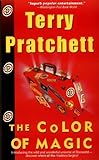
Editors Reads Verdict
The Colour of Magic is Terry Pratchett firing the opening shot of one of literature's great satirical projects. It is rougher and more overtly parodic than the Discworld novels that follow, but it introduces a world and a sensibility that grew into something genuinely profound.
What We Loved
- Pratchett's comic voice is fully formed from page one — the jokes land consistently
- The flat-world-on-a-turtle conceit is a perfect vehicle for genre parody
- Twoflower's cheerful obliviousness makes him one of fantasy's most original protagonists
- Short, propulsive chapters make this an ideal entry point for reluctant fantasy readers
Minor Drawbacks
- The plot is more a series of connected episodes than a unified narrative
- Character depth is secondary to the satirical machinery in this early instalment
- Readers who prefer later, more emotionally resonant Discworld books sometimes find this one thin
Key Takeaways
- → Genre conventions are most effectively skewered by someone who understands them with complete seriousness
- → Comedy and philosophical substance are not opposites — the best satire uses jokes to smuggle in real ideas
- → A world built on absurd premises can still generate genuine emotional stakes
- → The most useful quality in a tourist is an inability to recognise danger
| Author | Terry Pratchett |
|---|---|
| Publisher | HarperCollins |
| Pages | 224 |
| Published | November 24, 1983 |
| Language | English |
| Genre | Fantasy, Humor, Satire, Fiction |
| Difficulty | Beginner |
| Best For | Fantasy readers looking for an irreverent, funny take on the genre's conventions; anyone who loved The Hitchhiker's Guide and wants the same energy applied to Tolkien-style epic fantasy. |
How The Colour of Magic Compares
The Colour of Magic at a glance against 3 similar books readers weigh alongside it.
| Book | Author | Rating | Best for |
|---|---|---|---|
| The Colour of Magic (this book) | Terry Pratchett | ★ 4.1 | Fantasy readers looking for an irreverent, funny take on the genre's conventions |
| American Gods | Neil Gaiman | ★ 4.5 | Fantasy readers with an interest in mythology, American culture, and literary |
| Good Omens | Terry Pratchett & Neil Gaiman | ★ 4.6 | Fans of Pratchett, Gaiman, or British comedy who want a genuinely funny fantasy |
| The Hitchhiker's Guide to the Galaxy | Douglas Adams | ★ 4.7 | Anyone who needs to laugh |
Where the Disc Began
Terry Pratchett launched the Discworld series in 1983 with a novel that is, at heart, an extended act of genre vandalism. The Colour of Magic takes the full apparatus of epic fantasy — the barbarian heroes, the ancient cities of dark magic, the tentacled gods playing games with human lives — and subjects it to a relentless comic pressure that never once suggests Pratchett doesn’t love the material he is skewering.
The world itself is the joke made physical: the Disc is a flat planet, carried through space on the backs of four great elephants, themselves standing on the shell of Great A’Tuin, a star turtle of immense and impassive patience. It is an image simultaneously ridiculous and strangely beautiful, and Pratchett’s genius is to take it absolutely seriously. The Disc is not a parody setting — it is a real place, with its own geography, history, and metaphysics, some of which are deeply strange and all of which are played for maximum satirical effect.
Rincewind and Twoflower: Comedy in Contrast
The novel’s engine is the collision between Rincewind — a wizard who has managed to get through his entire career at Unseen University without learning a single working spell — and Twoflower, the Disc’s first tourist, arriving from the Counterweight Continent with an unlimited letter of credit and a magical self-propelled Luggage. Rincewind is the quintessential Pratchett everyman: not brave, not particularly good, but possessed of a survival instinct that borders on supernatural. Twoflower is his perfect foil: cheerful, curious, completely unable to perceive danger even when it is attempting to eat him.
Their picaresque journey through Ankh-Morpork, the city of a thousand smells, and beyond into stranger territories — the forest of the trolls, the Wyrmberg of dragons, the edge of the Disc itself — is structured as a series of genre parodies stitched together by Pratchett’s witty narrative commentary. The jokes arrive at high velocity, and they hold up.
More Than Parody
What distinguishes The Colour of Magic from mere parody is the genuine warmth running through it. Pratchett clearly loves his characters, even as he refuses to let them be heroic in conventional ways. And underneath the comedy there are real ideas — about the nature of belief, the absurdity of heroism as a social institution, the way mythology shapes reality — that would become the central concerns of the more ambitious Discworld novels to follow.
This is not Pratchett at his deepest or most emotionally complex. Guards! Guards!, Small Gods, and Night Watch take the Discworld further and hit harder. But as an introduction to a unique fictional universe and one of the English language’s great comic voices, The Colour of Magic remains irresistible.
Where to Start on Discworld
A word of guidance for new readers: while The Colour of Magic is book one, many devoted Pratchett fans recommend starting with Guards! Guards! or Small Gods for readers who want the full emotional range immediately. Come back to book one after you are already in love with the world — you will find it even funnier for knowing what it became.
Our rating: 4.1/5 — A gleefully subversive comic fantasy that launches one of literature’s most sustained satirical achievements; lighter than Pratchett’s best, but a joyful introduction to a world like no other.
Reading Guides
- Books Like The Lord of the Rings: 12 Epic Fantasy Novels for Tolkien Fans
- Discworld Books in Order: How to Read Terry Pratchett
The Discworld Series in Context
The Colour of Magic launched a project that would span forty-one novels, published over thirty-two years from 1983 to 2015. The final novel, The Shepherd’s Crown, appeared after Pratchett’s death in March 2015 from Alzheimer’s disease — a condition he was diagnosed with in 2007 and wrote about publicly, becoming one of the most prominent advocates for research into the disease and for the right to die with dignity. He received a knighthood in 2009, and, characteristically, had a sword forged from iron meteorites to go with the honour.
Over those three decades, the Discworld evolved far beyond the genre parody of its first instalment. The City Watch sub-series, beginning with Guards! Guards! in 1989, examined institutional justice and individual courage. The Witches novels, starting with Wyrd Sisters in 1988, explored female power, community, and the nature of narrative itself. The standalone novels — Small Gods, Monstrous Regiment, Going Postal — used the Discworld’s comic machinery to engage directly with organised religion, gender, and corporate capitalism. The Death sub-series, beginning with Mort in 1987, produced some of the most emotionally moving comic fiction in English.
The Colour of Magic is the origin of all of it: the Disc, the turtle, the elephants, the city of Ankh-Morpork with its thousand smells, the sensibility that takes the ridiculous absolutely seriously. Pratchett also co-wrote Good Omens with Neil Gaiman in 1990, a collaboration that became an Amazon Prime television series in 2019 starring David Tennant and Michael Sheen, and which introduced a new generation to Pratchett’s voice.
Reading this first novel after discovering Discworld through a later, deeper entry point is a particular pleasure: you see exactly where the world came from, and you understand how far it travelled. The forty-one novels are among the most sustained achievements in comic literature, and it all began with a flat world on a turtle and a hapless wizard who could not stop running away.
Frequently Asked Questions
What is "The Colour of Magic" about?
The first Discworld novel follows the hapless failed wizard Rincewind and the naive tourist Twoflower across a flat world balanced on the backs of four elephants standing on a giant star turtle — a comic masterpiece that parodies epic fantasy.
Who should read "The Colour of Magic"?
Fantasy readers looking for an irreverent, funny take on the genre's conventions; anyone who loved The Hitchhiker's Guide and wants the same energy applied to Tolkien-style epic fantasy.
What are the key takeaways from "The Colour of Magic"?
Genre conventions are most effectively skewered by someone who understands them with complete seriousness Comedy and philosophical substance are not opposites — the best satire uses jokes to smuggle in real ideas A world built on absurd premises can still generate genuine emotional stakes The most useful quality in a tourist is an inability to recognise danger
Is "The Colour of Magic" worth reading?
The Colour of Magic is Terry Pratchett firing the opening shot of one of literature's great satirical projects. It is rougher and more overtly parodic than the Discworld novels that follow, but it introduces a world and a sensibility that grew into something genuinely profound.
Ready to Read The Colour of Magic?
Check the current price on Amazon.
Check Price on Amazon (paid link)Prices and availability are subject to change. See Amazon for current price.
Review last updated: