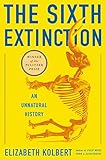
Editors Reads Verdict
Kolbert's Pulitzer Prize-winning investigation of the ongoing biodiversity crisis is alarming, carefully reported, and scientifically rigorous. One of the most important environmental books of the century.
What We Loved
- Pulitzer Prize-winning journalism combining fieldwork with scientific depth
- The historical context of previous mass extinctions gives the current crisis perspective
- Kolbert's fieldwork takes readers to places where extinction is happening in real time
- Scientific accuracy without sacrificing narrative engagement
Minor Drawbacks
- The cumulative weight of evidence can feel overwhelming without adequate prescriptions
- Some chapters are more engaging than others
- The solutions section is brief compared to the problem documentation
Key Takeaways
- → Earth is currently experiencing its sixth mass extinction — the first caused by a single species
- → The current extinction rate is 100 to 1,000 times the background rate
- → Ocean acidification from CO2 absorption threatens entire marine ecosystems
- → Habitat fragmentation isolates populations and accelerates local extinction
- → The end-Cretaceous extinction that killed the dinosaurs helps calibrate the scale of what we face
| Author | Elizabeth Kolbert |
|---|---|
| Publisher | Henry Holt |
| Pages | 336 |
| Published | February 11, 2014 |
| Language | English |
| Genre | Science, Environment, Journalism |
| Difficulty | Intermediate |
| Best For | Anyone who wants to understand the biodiversity crisis with scientific depth rather than media slogans — and the historical context of mass extinctions. |
How The Sixth Extinction Compares
The Sixth Extinction at a glance against 3 similar books readers weigh alongside it.
| Book | Author | Rating | Best for |
|---|---|---|---|
| The Sixth Extinction (this book) | Elizabeth Kolbert | ★ 4.5 | Anyone who wants to understand the biodiversity crisis with scientific depth |
| A Short History of Nearly Everything | Bill Bryson | ★ 4.6 | Anyone who has ever felt they missed out on science in school and wants to |
| Enlightenment Now | Steven Pinker | ★ 4.4 | Anyone who wants a data-based counterweight to civilisational pessimism and a |
| The Selfish Gene | Richard Dawkins | ★ 4.5 | Anyone with intellectual curiosity about evolution, genetics, and the nature of |
The Extinction Happening Around Us
Elizabeth Kolbert is a staff writer at The New Yorker who has spent two decades reporting on environmental science. The Sixth Extinction won the 2015 Pulitzer Prize for General Nonfiction. It is the most rigorous and accessible account available of the biodiversity crisis that is currently underway.
The title refers to the five mass extinctions in Earth’s history — the most recent 66 million years ago, when an asteroid impact wiped out the non-avian dinosaurs — and the ongoing sixth extinction, which is different from all previous ones in a crucial respect: it is being caused by a single species, humans, within a geological eyeblink.
Thirteen Species, Thirteen Stories
Kolbert structures the book around thirteen species at various stages of extinction — some already gone, some clinging to survival in captivity, some declining rapidly in the wild. The American mastodon, the great auk, the golden poison frog, the Panamanian golden frog, the little brown bat, the Sumatran rhino. Each chapter combines field reporting — Kolbert visits the places where each story is unfolding — with the science needed to understand it.
The effect is cumulative. By the time you’ve followed a dozen extinction stories, the abstract concept of a mass extinction becomes visceral and specific.
Ocean Acidification
Among the book’s most alarming chapters concerns ocean acidification — the process by which CO2 absorbed by seawater forms carbonic acid, reducing the ocean’s pH. For organisms that build shells from calcium carbonate (corals, molluscs, many plankton species), acidification represents an existential threat. The chemistry is simple and the implications for marine food webs are severe.
Kolbert visits research stations in the waters of Scotland and off the coast of Papua New Guinea, where the direct effects of acidification are already visible in coral communities.
The Geological Record
The book’s scientific depth comes partly from Kolbert’s serious engagement with paleontology. Understanding previous mass extinctions — their speed, their causes, their aftermath — provides crucial context for interpreting the current crisis. The end-Permian extinction 252 million years ago, which killed 96% of marine species, is the closest analogue to what unconstrained acidification might produce.
A Catastrophe Caused by One Species
The book’s central and most sobering argument is what distinguishes the current extinction from the five that preceded it in Earth’s history: this one is being driven not by an asteroid, a volcanic cataclysm, or a shift in atmospheric chemistry over millennia, but by a single species acting within a geological instant. Kolbert traces the many fronts on which humans are reshaping the biosphere — habitat destruction, the transport of species across oceans that erases the isolation evolution depends on, the warming and acidification of the atmosphere and seas, the simple efficiency of human predation — and shows how these forces combine into a pressure on global biodiversity unlike anything since the great die-offs of deep time. Crucially, she frames this not as a future threat but as a process already well underway, visible in the field stations and dwindling populations she visits. The conceptual leap the book asks the reader to make is to see our own era from the vantage of geological time, to recognize that humanity has become a planetary force on the scale of the asteroid that killed the dinosaurs, and that the consequences will be legible in the fossil record for tens of millions of years.
Reporting From the Front Lines
Kolbert’s method is what makes the abstraction of mass extinction viscerally real: rather than marshaling statistics from a desk, she travels to the specific places where the crisis is unfolding and reports what she sees. She descends into a Panamanian rainforest to witness the amphibian collapse driven by a spreading fungus, dives among bleaching corals on the Great Barrier Reef, visits research stations measuring ocean acidification off Italy and Papua New Guinea, and tramps through the Andes with scientists tracking species fleeing upward as temperatures rise. This on-the-ground reportage, combined with lucid explanations of the underlying science and history, gives the book its cumulative power: by the time the reader has followed a dozen individual extinction stories, each grounded in a particular place and a particular creature, the statistical abstraction has become a series of concrete, irreversible losses. Kolbert’s gift is to make the vast and the slow feel immediate and specific, translating planetary-scale change into scenes the reader can see, and her restraint — she reports rather than sermonizes — only sharpens the impact.
The Long View of Deep Time
A significant part of the book’s intellectual weight comes from Kolbert’s serious engagement with the history of the science of extinction itself, and with the geological record of past catastrophes. She tells the story of how the very concept of extinction was established — how naturalists came to accept that species could vanish entirely, a radical idea in its time — and she anatomizes the five previous mass extinctions, particularly the end-Permian event of 252 million years ago, which destroyed roughly ninety percent of marine species and offers the closest analogue to what unchecked ocean acidification might produce. This deep-time framing is essential to the book’s argument: by situating the present moment within the four-billion-year history of life on Earth, Kolbert allows the reader to grasp both the magnitude and the rarity of what is happening. Mass extinctions are not common events; they are the rare hinges on which the history of life has turned, and the recognition that we are living through one, and causing it, is the book’s central and unforgettable provocation.
Final Verdict
The Sixth Extinction is essential reading for anyone who wants to understand the biodiversity crisis with genuine scientific depth. It is sobering rather than sensationalist — and the sobriety is appropriate.
Our rating: 4.5/5 — One of the most important environmental books of the twenty-first century. Rigorously reported and genuinely alarming.
Reading Guides
Frequently Asked Questions
What is "The Sixth Extinction" about?
Elizabeth Kolbert reports from the front lines of the ongoing mass extinction event — the sixth in Earth's history, and the first caused by a single species.
Who should read "The Sixth Extinction"?
Anyone who wants to understand the biodiversity crisis with scientific depth rather than media slogans — and the historical context of mass extinctions.
What are the key takeaways from "The Sixth Extinction"?
Earth is currently experiencing its sixth mass extinction — the first caused by a single species The current extinction rate is 100 to 1,000 times the background rate Ocean acidification from CO2 absorption threatens entire marine ecosystems Habitat fragmentation isolates populations and accelerates local extinction The end-Cretaceous extinction that killed the dinosaurs helps calibrate the scale of what we face
Is "The Sixth Extinction" worth reading?
Kolbert's Pulitzer Prize-winning investigation of the ongoing biodiversity crisis is alarming, carefully reported, and scientifically rigorous. One of the most important environmental books of the century.
Ready to Read The Sixth Extinction?
Check the current price on Amazon.
Check Price on Amazon (paid link)Prices and availability are subject to change. See Amazon for current price.
Review last updated: